

![MultipartFile resource [file_data]](/assets/img/articles/заглавна-краставици-2025.jpg)
Summary
A review has been made of the main diseases and pests that cause damage during cucumber cultivation. The main rules are indicated, the observance of which will lead to the protection of crops, reduction of plant protection product (PPP) treatments, protection of the health of producers and consumers and, last but not least, protection of the environment from pesticide contamination.
Cucumbers grown in greenhouses and in the open field are attacked by many diseases and pests. Most of them are of major economic importance for the cultivated plants and for the yield obtained from them. Viral, fungal and bacterial diseases can be observed. They attack the roots, stems, leaves and sometimes the fruits. Among the pests are greenhouse whitefly, aphids, thrips and mites. Frequent use of pesticides for pest control provokes adaptation and development of resistance to them, leads to contamination of the environment and produce with residues above the permissible sanitary and hygienic norms, as well as to unhealthy working conditions.
Success in controlling diseases and pests on cucumbers is achieved when the individual plant protection measures are combined into a system that includes:
- Strict prophylaxis;
- Organisational and agrotechnical measures;
- Cultivation of resistant varieties;
- Application of systemic pesticides in the seedling stage;
- Introduction of bioagents;
- Use of biotechnical means;
- Application of highly effective plant protection products (PPP) against harmful organisms that are selective for beneficial species.
DISEASES
Diseases caused by soil-borne pathogens.
Root rot
This is the most widespread and economically most significant disease caused by soil-borne pathogens on cucumbers. It is caused by fungi of the genus Fusarium and Rhizoctonia, which develop at higher temperatures. Under temperature depression fungi of the genus Pythium become active. They are more widespread and are responsible for the strong reduction of yields in affected crops. It attacks cucumbers, watermelons and melons. The critical periods for it are two: the seedling stage and the 7–8 true leaf stage. Depending on the causal agent, the roots turn brown and the absorbing rootlets are absent. At the base of the stem, soft rot may appear, which later affects the entire stem. Initially, the plant wilts at midday, and during the night it restores its turgor. Later, wilting becomes permanent and the plant dies. Such plants should be pulled out, collected in polyethylene bags and destroyed outside the plantation.
The degree of development of the pathogens is influenced by environmental factors – temperature, humidity, amount of infection, presence of mechanical damage to plants caused by pests and agrotechnical practices, deficiency or excess of nutrients. Plants that are stunted in growth and development are more susceptible to these pathogens.
Environmental factors and the complex of root rot causal agents are in constant dynamic equilibrium. The influence of the former is twofold. On the one hand, they stimulate the development and multiplication of pathogens – on the other, they act unfavourably on the host plants. They retard their development, lead to weakening and predisposition to disease. In some cases they can also cause plant death.
Control
- Disinfection of the soil and the manure-soil mixture;
- Disinfection of cultivation facilities and equipment;
- Seed disinfection;
- Removal of the first diseased plants;
- Irrigation of the foci of infection with a 2% solution of CuSO4 or ammonium nitrate (3 l/m2);
- Treatment of neighbouring healthy plants or the entire crop with Trianum G 1 – 10 kg/1000 plants (at soil temperature >8°C, number of applications – 1); Beltanol 400 ml/ha (1–2 treatments); Propamocarb (Proplant) 722 SL 300 ml/ha (3 treatments at 7–10 day intervals, the first at the 2nd true leaf stage); Proradix 3 x 12.5 g/ha (1st – 2nd true leaf stage, the remaining at 15–30 day intervals).
Diseases of the above-ground parts of plants
Viral diseases
Cucumber mosaic

Cucumber mosaic is caused by Cucumber mosaic virus. The vectors of infection are 82 aphid species, which transmit the virus from diseased to healthy plants. Among them, the peach aphid is of the greatest importance.
Cucumber mosaic virus infects over 1200 plant species from about 100 families and causes systemic infection in hosts. Symptoms depend to a large extent on environmental conditions and on the age of the plants at the moment of infection. The apical leaves of affected plants are mosaic mottled and curled. As they grow, the symptoms disappear. Plants remain small due to shortened internodes, the leaves become smaller and the whole plants acquire a chlorotic appearance. The fruits are also small and mosaic mottled. There is another manifestation of cucumber mosaic. If abrupt changes in weather conditions occur when plants are in the incubation period, they lose turgor, begin to wilt and finally dry up. The roots of such plants are necrotic.
Cucumber mosaic is caused by Cucumber mosaic virus. It is not transmitted by seed and sap from diseased plants. It is not transmitted by contact and through the soil and is not preserved in plant residues. The vectors of infection are 82 aphid species, which transmit the virus from diseased to healthy plants. Among them, the peach aphid is of the greatest importance.
Control
- Installation of insect-proof nets on vents;
- Transplanting at optimal dates to protect against infection from
- Mass aphid populations;
- Treatment of seedlings with mineral oils – the last treatment before transplanting;
- Spraying with mineral oils after planting at two-week intervals until the aphid population is reduced;
- Systematic control of vectors – aphids. Registered PPP – see under aphids.
Green English mosaic
In Bulgaria, the virus was identified in 1971. After its massive spread in greenhouse complexes in the country, the disease subsided and its economic significance decreased.
The first symptoms appear on the apical leaves of plants. They are strongly mosaic mottled by alternating dark green and light green (sometimes even yellow-green) areas. In the light areas, leaf growth stops, while in the green areas it continues. As a result, the leaf surface becomes wrinkled, rough and mottled. Sometimes only the veins remain green. The fruits are also mottled and their surface becomes rough due to the unevenly growing areas. Diseased plants lag behind in growth. Flower abortion is observed. The virus is inactivated when the leaves age. Yield is reduced by 25%, and sometimes more.
Green English mosaic is caused by Cucumber mottle mosaic virus. It is transmitted by seed at a rate of up to 8–10%, which is sufficient for initial infection; by sap from diseased plants; under hydroponic cultivation, the degree of infection can reach up to 80%, as the roots of the plants come into contact. Transmission by aphids and other sucking insects has not been established.
Control
- Removal of the first diseased plants;
- Quarantine of plots with diseased plants;
- Prophylaxis;
- Disinfection of working tools with formalin 1:4;
- Disinfection of workers’ hands during tying with 5% solution of trisodium phosphate.
Infectious yellows
The virus of infectious yellows of cucumbers is distributed worldwide and has a wide range of hosts – cultivated plants, weeds and ornamentals. In Bulgaria it was first identified in 1983.
The first symptoms begin on the older leaves. The tissue between the veins becomes lighter and turns yellow. Only the veins remain green. Initially it starts in separate areas, which have a V-shape, and later covers the entire leaf. Such leaves turn yellow, curl downwards and become brittle. Gradually the disease progresses upwards. In young leaves the symptoms are less pronounced, and in the apical ones they are absent. The fruits remain green, but part of the set aborts. The disease can reduce yield by 40–50%.
It is caused by Beet pseudo-yellows virus, which is transmitted by the greenhouse whitefly (Trialeurodes vaporariorum Westw). It belongs to the group Closterovirus.
Control
- Prophylaxis;
- Systematic control of the greenhouse whitefly. Registered PPP – see under greenhouse whitefly.
Bacterial diseases
Angular leaf spot (bacterial blight)
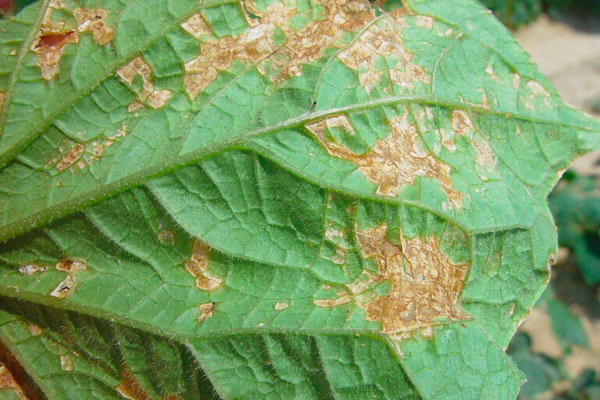
The causal agent of angular leaf spot is the pathogenic bacterium Pseudomonas syringae pv. lachrymans
It massively attacks cucumbers grown in polyethylene greenhouses and in the open field. It is relatively rare on crops grown in glasshouse structures, usually when they are not heated.
The first symptoms appear as small, water-soaked, yellowish spots of irregular shape, limited by the veins. In wet weather, small, cloudy droplets of bacterial exudate appear on their lower surface. Later it dries as a white film on the spots. After the spots enlarge, the centre burns out and falls off. Angular, perforated spots remain on the leaves.
The disease also attacks the fruits. Small, water-soaked spots of irregular shape form on them, covered with cloudy bacterial exudate. When the fruits ripen, the damage penetrates deep into the tissues and reaches the seeds, infecting them. The entire fruits rot due to soft rot. On the cotyledons of plants emerging from such seeds, greasy spots appear. The young plant soon dies.
The causal agent is the pathogenic bacterium Pseudomonas syringae pv. lachrymans. Optimum temperature for development in pure culture – 250C, and lethal – 500C.
Control
- Sowing disinfected seed;
- Removal of weeds and plant residues;
- In the presence of favourable conditions and at first appearance, treatment with: Bordeaux mix 20 WP 375–500 g/ha; Kocide 2000 WG 100–155 g/ha.
Fungal diseases
Downy mildew (cucurbit downy mildew)
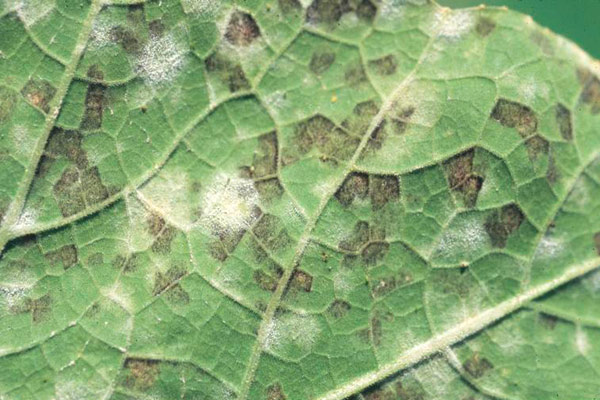
Cucurbit downy mildew is widespread in Bulgaria and is caused by the pathogenic fungus Pseudoperonospora cubensis
The disease is caused by the pathogenic fungus Pseudoperonospora cubensis. It is widespread. In Bulgaria it was recorded in 1966. In addition to cucumbers, it attacks melons, watermelons and other cucurbits. This is the disease of greatest economic importance in cucumber cultivation.
On the upper side of the leaves, yellowish spots of irregular shape are formed, limited by the veins. In the field they are smaller, and in greenhouses larger. In wet weather they appear water-soaked, and their lower surface is covered with a loose greyish-violet coating of the fungus sporulation. Later the spots enlarge, merge and the entire leaf burns. The first spots usually appear on the lowest leaves, but in a short time a significant part of them can be affected. It is of greater importance for cucumbers grown in polyethylene-covered greenhouses, where humidity is higher.
The mycelium develops in the intercellular spaces. The sporangiophores are dichotomously branched and emerge in groups through the stomata. The conidia are ellipsoid with an apical cap at one end. Under favourable conditions they can germinate directly, but they can also form zoospores with two flagella. They germinate in the temperature range 8–300C, with optimum 15–220C.
Control
- Cultivation of resistant varieties;
- Treatment with PPP under favourable conditions and after the appearance of the disease. Registered PPP: Aliette flash 0.3%; Bordeaux mix 20 WP 500–600 g/ha; Galben M (Golbeks WG) 250 g/ha; Golbeks WP 250 g/ha; Enervin SC 120 g/ha; Airone SC 250 g/ha; Zoxis 250 SC 80–100 ml/ha; Infinito SC 120–160 ml/ha; Keefol WG 250 g/ha; Keefol WP 250 g/ha; Kylate WG 250 g/ha; Kylate WP 250 g/ha; Kopranol Duo 250 g/ha; Kocide 2000 WG 100–155 g/ha; Quantum Rock 300 g/ha; Presidium Uno 83–100 ml/ha; Propamocarb (Proplant) 722 SL 300 ml/ha; Taegro 18.5–37.0 g/ha; Champion WP 0.15%.
Powdery mildew
A widespread disease, both in protected structures and in the open field. With the development of resistant varieties, its economic importance has greatly decreased. At present, the predominant varieties for greenhouse and open-field production are resistant or tolerant to the causal agents of powdery mildew. It attacks leaves, petioles and, less often, the stems of plants.
The first symptoms appear on the leaves in the form of small spots of irregular shape, covered with a white powdery coating of the fungus sporulation. Later the spots merge. The leaves burn. Spots can be observed on both the upper and lower leaf surfaces and on the petioles. Sometimes spots are also found on the stem, but they do not cause serious damage. In case of severe infection, plants defoliate, fruits remain small and deformed. Yields are severely reduced.
Two fungi cause powdery mildew on cucumbers – Podosphaera xanthii and Erysiphe cichoracearum. The pathogens form elongated oval or ellipsoid conidia. They also form cleistothecia, but under our climatic conditions they rarely mature and have no importance for the spread and overwintering of the pathogen.
Control
- Cultivation of resistant varieties;
- At first appearance of the disease, treatment with PPP. Registered PPP: Vivando 20 ml/ha; Dagonis 60 ml/ha; Diagonal 80 ml/ha; Domark 10 EC 50 ml/ha; Eminent 125 ME/Rivior 40 ml/ha; Zoxis 250 SC 80–100 ml/ha; Carbicure 300 g/ha; Kocide DF (Kozavet DF) 500 g/ha; Collis SC 40–50 ml/ha; Kumulus 750 g/ha; Custodia 50–100 ml/ha; Legado 80 ml/ha; Limocide 800 ml/ha; Norios 250 SC 70–80 ml/ha; Ortiva Top SC 100 ml/ha; Posis/Flosul 750 ml/ha; Prev-Gold/Sinala 160–600 ml/ha; Sivanto (Sivar) 80 ml/ha; Score 250 EC 0.05%; Sonata SC 500–1000 ml/ha; Sulgran 500 g/ha; Sulphur WG 300 g/ha; Taegro 18.5–37.0 g/ha; Thiovit Jet 80 WG 300 g/ha; Topaz 100 EC 35–50 ml/ha; Trezin/Trunfo 80 ml/ha; Phytosev 200 ml/ha; Flint Max 75 WG 20 g/ha; Fontelis SC 240 ml/ha; Fungisei 300 ml/ha; Heliosoufre C 150–600 ml/ha; Cidely Top 100 ml/ha.
Sclerotinia rot
The disease is almost ubiquitous. The pathogen has more than 400 cultivated and weed host species. All vegetables grown in protected structures are attacked by this disease.
In young plants at the seedling stage, symptoms resemble damping-off. Water-soaked spots appear at the base of the stem or slightly below it. The tissue in them softens and the plant dies. In adult plants, the disease affects all above-ground parts – stems, leaves, fruits, leaf and fruit stalks. The first symptoms are the appearance of water-soaked spots, which soon become covered with abundant white cottony mycelium. Later the mycelium penetrates inside the stem and disrupts sap flow. Affected plants lose turgor and turn yellow. Large sclerotia form in the mycelium, which initially are a dense, cream-coloured mass that gradually darkens until it becomes black. As they grow, the sclerotia cause tearing of diseased tissues and fall onto the soil surface. Others remain in plant residues and with them also enter the soil.
Sclerotinia rot is caused by the fungus Sclerotinia sclerotiorum. The pathogen damages mainly vegetables, tobacco and ornamental crops. It is widespread in cool and humid regions.
Control
Treatment by incorporation of Coniothyrium-based product (Contans WG) 200–600 g/ha.
PESTS
Greenhouse whitefly (Trialeurodes vaporariorum Westw.)
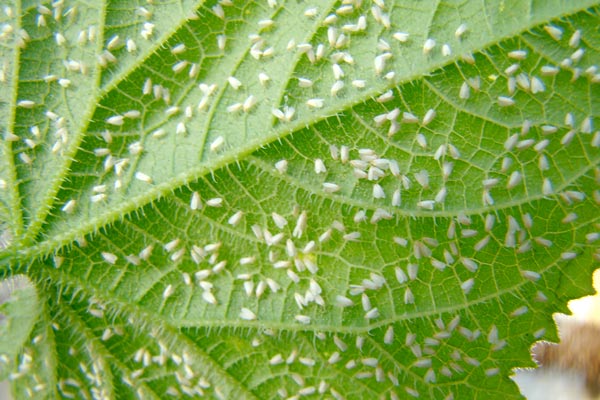
The greenhouse whitefly (Trialeurodes vaporariorum Westw.) not only causes direct damage, but also causes indirect damage as a vector of the infectious yellows virus
It causes severe damage to cucumbers grown in protected structures. In autumn, winter and spring it reproduces in greenhouses, and in June, July and August it attacks plants grown in the open field. Both larvae and adults cause damage. Direct damage is expressed in sap sucking, which leads to plant exhaustion. Indirect damage is manifested in the formation of so-called “honeydew” during feeding, on which sooty saprophytic fungi develop, forming a dense mycelium. The normal course of physiological processes is disrupted, which affects yield. Product quality deteriorates. The whitefly also causes indirect damage by transmitting the infectious yellows virus.
Control
In greenhouse production, the parasitoid Encarsia formosa Gah. can be used to control the pest. Chemical control is aimed at all developmental stages of the pest. Treatment with registered PPP: Benevia 75–112.5 ml/ha; Verimark 200 SC 37.5–50 ml/ha; Clavitus 13 SL 750–1900 ml/ha; Lamdex Extra 28–60 g/ha; Meteor 0.08–0.09%; Mospilan 20 SG 35–40 g/ha; Requiem Prime 500–1000 ml/ha; Sivanto Prime 45 ml/ha.
Cotton aphid (Aphis gossypii Glov.)
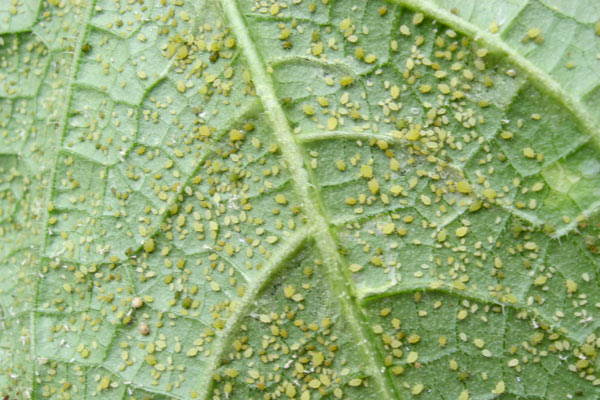
The cotton aphid (Aphis gossypii Glov.) is a vector (carrier) of viral diseases
It attacks all cucurbit crops – watermelons, melons, cucumbers, zucchini and pumpkins. Adults and larvae cause damage by sucking sap from the underside of leaves, the growing point and stems of plants. In case of mass infestation, they form dense colonies, the apical leaves of cucumbers curl and deform. Plants lag behind in development. In case of mass infestation during flowering or fruit set, flowers drop and fruits remain underdeveloped. On the “honeydew” secreted by aphids, saprophytic sooty fungi develop, contaminating the produce. The cotton aphid is a vector (carrier) of viral diseases.
Control
Destruction of weed vegetation. Use of healthy and clean seedlings. Monitoring through the use of yellow sticky traps for aphids in greenhouse conditions. In greenhouses, the bioagents Aphidoletes aphidimyza Rond. and Aphidius colemani D. can be used. Treatment with registered PPP: Azatin EC 100–150 ml/ha; Afinto 10 g/ha; Verimark 200 SC 37.5–50 ml/ha; Griyal 50 ml/ha; Deka EC/Desha EC/Dena EC/Poleci/Decis/Detlin 50 ml/ha; Delmur 50 ml/ha; Decis 100 EC 7.5–17.5 ml/ha; Infis 50 ml/ha; Closer 120 SC 20 ml/ha; Lamdex Extra 28–60 g/ha; Meteor 0.08–0.09%; Mospilan 20 SP 12.5 g/ha; Mospilan 20 SG 25 g/ha; Nimic Ten 390 ml/ha; Oikos 100–150 ml/ha; Oasis 5 EC/Sumi Alpha 5 EC/Sumicidin 5 EC 0.02%; Sivanto Prime 45 ml/ha; Teppeki 10 g/ha; Flipper 1–2 l/ha; Shirudo 15 g/ha; Hinode 10 g/ha.
Thrips
On species of the family Cucurbitaceae, the tobacco thrips (Thrips tabaci Lind.) and the western flower thrips (California thrips) (Frankliniella occidentalis Perg.) occur. Adults and larvae cause damage by sucking sap from leaves, the growing point of plants, from the fruit set and fruits. On attacked organs, small whitish/silvery spots with black dots are formed, which represent the pest’s excrements. At higher population density, the spots merge and leaves dry out. Fruits “bronze” and deform. Attacked plants at the seedling stage may dry up and die.
Control
For biological control of these pests in greenhouses, the predatory mites Amblyseius cucumeris Oud. and Amblyseius swirskii Athias-Henriot, as well as predatory bugs Orius spp., can be used. Treatment with registered PPP: Azatin EC 100–150 ml/ha; Benevia 75–112.5 ml/ha; Deka EC/Desha EC/Dena EC/Poleci/Decis/Detlin 30 ml/ha; Exalt 200–240 ml/ha; Lamdex Extra 42–80 g/ha; Meteor 0.06–0.07%; Naturalis 100–150 ml/ha; Oikos 100–150 ml/ha; Requiem Prime 500–1000 ml/ha; Sineis 480 SC 10–25 ml/ha; Flipper 1–2 l/ha.
Leaf miners
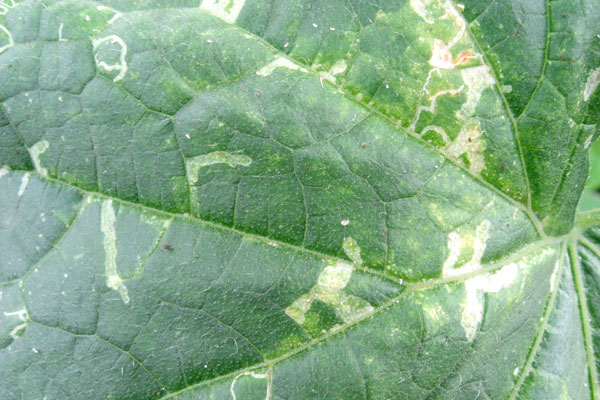
Leaf miners develop year-round in greenhouses, feed on the parenchyma and form mines on the leaves, thus destroying chlorophyll in the leaves
On cucumbers, the tomato leaf miner fly (Liriomyza bryoniae Kalt.) and the South American leaf miner fly (Liriomyza huidobrensis Blanch.) occur. In greenhouse conditions these pests develop year-round. The females use their ovipositor to puncture the upper epidermis of the leaves and lay eggs. Punctures made by females are pinpoint, white-coloured, which later turn brown. The main damage is caused by larvae. They feed on the parenchyma and form mines on the leaves. They destroy chlorophyll, thereby reducing the photosynthetic capacity of leaves. In case of severe infestation, mines can cover the entire leaf blade.
Control
For control of these pests in greenhouses, the bioagents Dacnusa sibirica T. and Diglyphus isaea W. can be used. Treatment with registered PPP: Benevia 40–60 ml/ha; Verimark 200 SC 37.5–50 ml/ha.
Cutworms
Above-ground cutworms
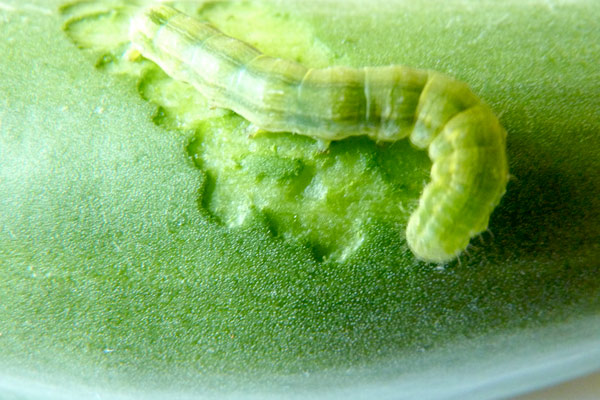
Among the above-ground cutworms, the cotton bollworm and the silver Y moth are of economic importance
The larvae of the cotton bollworm (Helicoverpa armigera Hubn.) skeletonise and partially consume leaves, damage flowers, buds and fruits. The larvae of the second generation are the most harmful.
The larvae of the silver Y moth (Chrysodeixis chalcites Esper) initially skeletonise leaves. As a result of the damage, irregularly shaped holes are observed. Later the larvae completely consume the leaves, leaving only part of the veins. On cucumber fruits, larvae cause superficial gnawing. Damaged fruits have no commercial value.
Soil cutworms (Grey worms)
They include the winter (Agrotis segetum Schiff.), spring (Euxoa temera Hb.) and ipsilon cutworms (Agrotis ypsilon Rott). Young larvae feed by gnawing the leaves from below without affecting the upper epidermis. Older larvae hide during the day below the soil surface, under clods of earth, and at night feed on leaves, gnawing holes and later the entire leaf, leaving only the thicker veins. Adult larvae almost do not come out of the soil, gnaw stems below the surface. The larvae are earth-grey to black, smooth, shiny, with a greasy lustre, and can often be found near plants, curled up in a “ring”.
Control
Regular field inspections. Destruction of weed vegetation. Treatment with registered PPP: Azatin EC 100–150 ml/ha; Beltirul 50–100 g/ha; Verimark 200 SC 37.5–50 ml/ha; Deka EC/Desha EC/Dena EC/Poleci/Decis/Detlin 50 ml/ha; Exalt 200–240 ml/ha; Benevia 60–112.5 ml/ha; Nimic Ten 260–390 ml/ha; Oikos 100–150 ml/ha; Trika Expert 1000–1500 g/ha.
Two-spotted spider mite (Tetranychus urticae Koch).
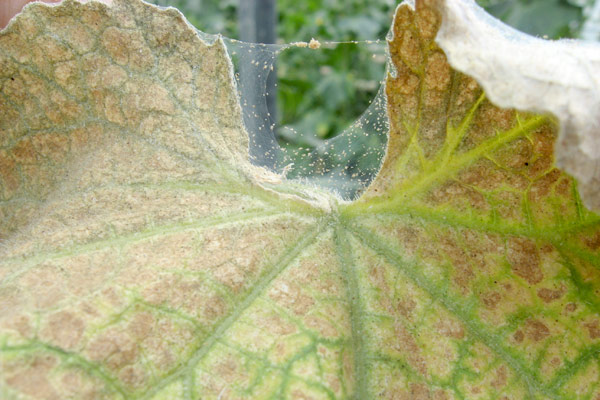
The two-spotted spider mite (Tetranychus urticae Koch) lives and feeds on the underside of the leaf. It prefers older leaves with reduced water content and aged, drought-stressed plants
Cucumbers are one of the preferred vegetable crops of this pest. The spider mite lives and feeds on the underside of leaves. It spins webbing, which in case of heavy infestation can completely cover the leaves and encompass flowers, fruits and shoots of affected plants. It causes damage by piercing the epidermis of leaves and tender stems and sucking part of the cell sap with chloroplasts. At the puncture sites, small light pinpoint spots appear, which gradually increase in number and leaves acquire a marbled appearance. Later the spots turn brown, merge and cover the entire leaf. The spider mite prefers older leaves with reduced water content and aged, drought-stressed plants. In case of severe infestation, plants dry up.
Control
Maintaining an optimal water regime. Drought favours pest development. In greenhouses, the predatory mite Phytoseiulus persimilis Ath.-Henr. can be used for control of spider mites. Treatment with registered PPP: Bermectin 15–100 ml/ha; Valmec 15–100 ml/ha; Danitron 5 SC 100–200 ml/ha; Laota 15–100 ml/ha; Naturalis 100–200 ml/ha; Neem Azal T/S 0.3%; Nissorun 10 WP 50–75 g/ha; Requiem Prime 500–1000 ml/ha; Shirudo 15 g/ha.
Root-knot nematodes (Meloidogyne spp.).
Cucumbers are a crop that is often attacked by root-knot nematodes, especially under greenhouse conditions. These pests cause complex changes in the tissues of the root system of plants, resulting in gall formation. Larvae penetrate most often immediately next to the root tip, move towards the conductive vessels and begin to feed. Changes occur in the host cells – hypertrophy, disappearance of cell membranes, formation of giant cells and galls. The galls are irregular in shape and of different sizes. Initially they are white, but later darken and become loose. The damaged root system does not function normally, plants suffer from water deficiency, wilt and die. Attacked young plants lag behind in growth. In cucumbers the leaves become slightly curled and their surface becomes uneven. Root-knot nematodes spread with infected seedlings, vehicles, tillage tools, soil particles, etc.
Control
The system of control measures includes good prophylaxis, agrotechnical measures and chemical means. Great attention should be paid to the production of healthy seedlings. Equipment should be disinfected with formalin at a ratio of 1:50. At the end of the growing season, crops are inspected for nematode infestation, based on which the duration of crop rotation is determined. Treatment with PPP: Velum Prime 62.5 ml/ha; Nemguard Granules 2–2.5 kg/ha. Grafting onto tolerant rootstocks is an effective method for controlling root-knot nematodes.
Control of diseases and pests in cucumber cultivation includes:
I. Plant protection measures to eliminate infection from the previous crop (applied in greenhouse production);
II. Preparation for the new production season;
III. Control of diseases and pests after transplanting.
Plant protection measures to eliminate infection from the previous crop are carried out at the end of the growing season, when the greenhouse is inspected to determine the degree of infestation and the type of diseases and pests on the roots and above-ground plant mass. For this purpose, in one greenhouse block (15 ha), 10 plants are examined at 10–15 representative plots arranged in a checkerboard pattern. Their roots are removed with a straight shovel and examined for the presence of root-knot nematodes or pathogens.
I. Plant protection measures to eliminate infection from the previous crop (applied in greenhouse production)
Based on the established phytosanitary status, the means and methods for eliminating infection and limiting the sources of disease and pest infestation in the next growing season are selected. This is done in several ways:
1. Spraying plants and structures at the end of the growing season with a 4% solution of technical formalin (dilution 1:10);
2. Evaporation of formalin by adding potassium permanganate. For 1 ha, 60 l of formalin + 6 kg of potassium permanganate are required, distributed in 30 metal cans, which are placed in a checkerboard pattern.
3. Sulphur sublimation.
4. If it is not possible to carry out the above treatments, desiccation of plants with a total herbicide is carried out.
Regardless of the method and means, the dried vegetative mass is removed and burned or buried.
II. Preparation for the new production season.
1. During the non-vegetation period, facilities are kept free from weeds and volunteers.
2. Around the greenhouse, a 5–6 m strip of bare fallow is maintained by mechanical cultivation or by total herbicides.
3. In the greenhouse area and adjacent to it, crops with common pests and diseases should not be grown.
4. When introducing bioagents, the requirements for their protection from pesticides (green and yellow list) must be observed; insecticides that are safe for beneficial species are applied.
5. For crops grown in the open field, well-ventilated, drained and well-levelled areas with spatial isolation from other crops of the family Cucurbitaceae are selected. Where possible, areas are inspected for the presence of pathogens and pests so that the necessary measures can be taken.
III. Control of diseases and pests after transplanting.
During the growing season, a complex of plant protection measures must be applied to protect the crop:
Maintaining phytosanitary standards at a very high level; good management of agrocenoses, because the occurrence of pests can be strongly influenced by general agrotechnical conditions; transplanting of healthy seedlings.
In greenhouses, an optimal air temperature regime and nutrient solution temperature, optimal air humidity are maintained; optimal agrotechnics including optimal composition of the nutrient solution, irrigation, pruning, removal of old leaves, etc.; installation of protective nets on vents and doors; placement of yellow and blue sticky traps near the tops of plants for monitoring and reducing initial pest density; collection and removal of plant waste from the greenhouse and its destruction outside; placing plants at optimal spacing to ensure a favourable air, light, water and nutrient regime; avoiding mechanical damage to plants.
When applying plant protection products (PPP) by spraying, low-volume sprayers should be used, as they are automatically adjusted, which reduces personnel exposure to risk; rotational treatments with pesticides with different modes of action are carried out to avoid resistance development in pest populations; localised treatments; use of broader-spectrum products to reduce the number of sprays; introduction and protection of bioagents; application of plant protection products via drip irrigation systems, thereby avoiding direct contact with the product and protecting some beneficial species; observing intervals for re-treatment, pre-harvest intervals and re-entry intervals specified on the label.
Biological control is an important element of the cultivation technology. If bioagents are used and it is necessary to apply plant protection products simultaneously, when choosing the time of their application, the side effects on beneficial species and the requirements for their protection must be taken into account.
Effective plant protection measures require:
- Regular inspection of crops and timely detection of pests;
- Accurate determination of the species composition of both pests and beneficial species in agrocenoses;
- Determination of the pest:bioagent ratio;
- Carrying out treatments in accordance with economic injury levels.
- Placement of a disinfection solution at the doors.
References
- Atanasov N., M. Vitanov, E. Loginova, E. Ilieva, 2005. Integrated protection of greenhouse crops from diseases and pests. Sofia, Videnov&Sin and PantaNeo Publishing, 159.
- Baharieva, D., B. Velev, S. Stefanov, E. Loginova, 1992. Diseases, weeds and pests of vegetable crops, Zemizdat, 338.
- Arogundade O., T. Ajose, J. Matthew, I. Osijo, 2021. Current and Emerging Pests and Diseases of Cucumber (Cucumis sativus L.) in Africa, In book: Cucumber Economic Values and Its Cultivation and Breeding.
- Klein M., 2024. Cucumber Diseases, Tips Bulletin.