

![MultipartFile resource [file_data]](/assets/img/articles/заглавна-бактериози-домати.jpg)
Summary
Tomato cultivation in Bulgaria is widespread, both in home gardens and in intensive production. The crop is susceptible to various diseases, which requires precise plant protection. Phytopathogenic bacteria are widely distributed in nature, especially in areas with warm and humid climates. On tomatoes in our country in recent years, the population of P. syringae pv. tomato, X. vesicatoria and X. euvesicatoria has predominated. They are the main causal agents of bacterial spots and specks on tomatoes and pepper. These pathogens can develop both symptomatically and asymptomatically. Bacterial spots caused by X. vesicatoria and X. euvesicatoria appear as watery, brown lesions on all above-ground parts of the plant, whereas bacterial speck caused by P. syringae pv. tomato leads to small, dark spots with a chlorotic halo. These pathogens can overwinter on plant residues or be spread through seeds, with infected plants remaining a primary source of inoculum during the growing season. Bacterial diseases of tomato are a serious problem, but there are effective ways of management and prevention, requiring a combination of integrated strategies to minimize their impact on the plants.
Tomato cultivation in Bulgaria has been facing challenges in recent years. Historically, the country was a major exporter of tomatoes, especially during the 1960s and 1970s, but production has subsequently declined significantly. Today, Bulgarian farmers grow about 120,000–150,000 tons of tomatoes annually, which is insufficient to meet domestic demand, leading to imports of 80,000–90,000 tons per year. Several factors contribute to this decline:
• Labour shortages and depopulation of rural areas hinder agricultural production.
• High production costs and irrigation problems have affected yields.
• Climate change, including high summer temperatures and droughts, has impacted open-field tomato production.
• Massive development of bacterial diseases and seed infection.
Tomatoes can be affected by several bacterial diseases:
• Bacterial spot – Xanthomonas vesicatoria, Xanthomonas euvesicatoria, which lead to lesions on leaves, stems, flowers and fruits.
• Bacterial speck, caused by Pseudomonas syringae pv. tomato, which develops at lower temperatures.
• Bacterial canker – Clavibacter michiganensis subsp. michiganensis, which can lead to severe defoliation and fruit damage.
• Bacterial wilt, caused by Ralstonia solanacearum, which leads to rapid wilting and death of the plants.
Bacteria are most commonly spread through infected seeds, plant material and moisture on plants. They can significantly reduce tomato yields by causing defoliation, fruit spotting and plant wilting. In recent years, bacterial diseases of tomato caused by Xanthomonas vesicatoria, Xanthomonas euvesicatoria and Pseudomonas syringae pv. tomato have predominated. Bacterial diseases caused by Clavibacter michiganensis subsp. michiganensis and Ralstonia solanacearum occur to a significantly lesser extent.

Bacterial speck caused by Pseudomonas syringae pv. tomato
Bacterial speck leads to leaf loss, reduced photosynthesis and overall plant vigour. Bacterial canker can cause lesions on fruits and plant wilting, making tomatoes unfit for sale. Bacterial wilt leads to sudden wilting of plants, preventing fruit development. Studies show that improved cultivation techniques, such as organic treatments and resistant cultivars, can help mitigate these losses and improve yields. In addition, biocontrol agents from the genus Bacillus are being investigated as environmentally friendly alternatives for managing bacterial diseases.
As a result of climate change in recent years, a predominance of the asymptomatic population of X. vesicatoria and X. euvesicatoria has been established. During the mass flowering stage, watery, ellipsoidal, grey-brown spots with a lighter centre and dark margin are observed on pedicels and sepals. The symptomatic manifestation of the disease affects some plant organs, while the asymptomatic one affects others.
Individual green and ripening fruits are healthy or covered with black pinpoint specks, either solitary or merged into specked zones; the fruit skin does not crack, is surrounded by a lighter watery band, does not peel and is sunken - mixed infection (Xanthomonas vesicatoria, Xanthomonas euvesicatoria and Pseudomonas syringae pv. tomato).
Seeds are mottled with individual brown spots of irregular shape and size.
Management of Pseudomonas syringae pv. tomato includes practices such as removal of infected plant parts, disinfection of working tools and avoiding excessive fertilization, which stimulates bacterial growth. Chemical treatments, such as copper-based applications, can help limit them (Xin et al., 2018).
Several approaches are applied to control the causal agent of bacterial speck (Pseudomonas syringae pv. tomato) in tomatoes:
- Copper-based bactericides: They remain a common choice, although resistance has been observed in some strains (García-Latorre et al., 2024).
- Biological agents: Research indicates that filtrates and extracts from Alternaria leptinellae can significantly reduce disease severity (García-Latorre et al., 2024).
- Use of resistant cultivars (Ganeva & Bogatzevska, 2019).
- Disinfection treatments for seeds: Thermal treatment combined with bactericides is an effective preventive measure (Orsi et al., 2012).
- Antagonistic microorganisms: Beneficial bacteria and fungi can suppress the pathogen through competition and production of antimicrobial compounds.
- Essential oils and biopesticides: Nano- and microtechnologies are being investigated to enhance the efficacy of essential oils against bacterial pathogens (Preston, 2004).
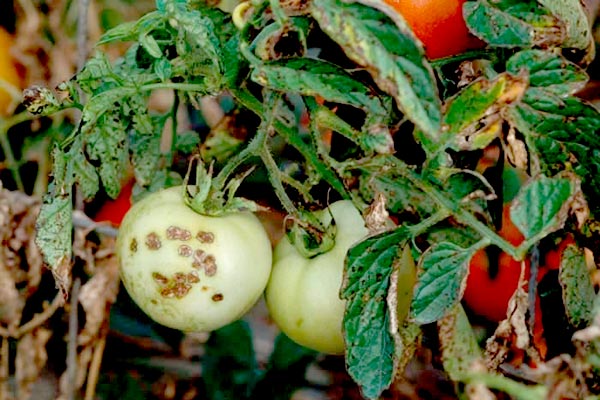
Bacterial spot – Xanthomonas vesicatoria on fruits and leaves
Control of Xanthomonas vesicatoria and Xanthomonas euvesicatoria requires a combination of integrated strategies to minimize their impact on tomato plants. Both species can survive in plant residues and soil for prolonged periods, making crop rotation and disinfection crucial for their management (Nakayinga et al., 2021; Timilsina et al., 2025).
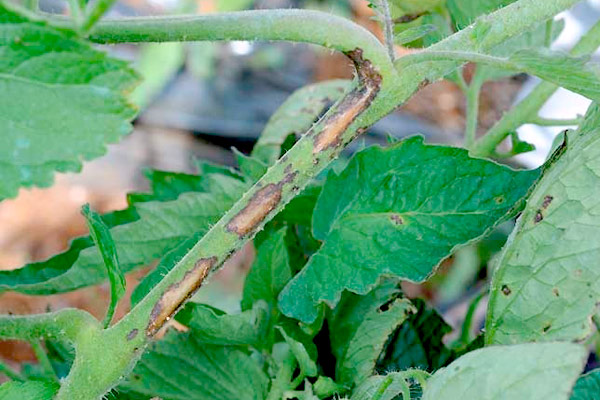
Bacterial spot – Xanthomonas vesicatoria, leading to lesions on stems
Both Xanthomonas vesicatoria and Xanthomonas euvesicatoria can infect tomato seeds and flowers, contributing to disease spread. The bacteria can be transmitted through seeds and can persist inside the stigma, leading to indirect seed infection. Infected seeds may not show symptoms but can carry the bacteria, making seed sanitation and treatment crucial for disease prevention (Timilsina et al., 2025).
Effective control of both pathogens includes the following practices:
- Avoid planting tomato or pepper consecutively in the same area to reduce bacterial survival in the soil.
- Disinfect tools, remove infected plant residues and avoid working with plants when they are wet.
- Some tomato cultivars have partial resistance to bacterial spot, although their effectiveness varies.
- Proper irrigation: The use of drip irrigation instead of overhead irrigation is recommended to reduce the spread of bacteria through water splashes (Osdaghi et al., 2021).
- Copper-based bactericides: Widely used in practice, although sometimes with limited efficacy (Monteiro et al., 2022).
- Bacteriophages: Some studies show that bacteriophage treatments can reduce bacterial populations (Sadunishvili et al., 2015).
- Soaking seeds in hot water (50–55°C) for 20–30 minutes can kill bacteria without damaging seed viability. This method is effective but requires precise temperature control to prevent seed injury (Osdaghi et al., 2021).
- Sometimes treatment with 1% sodium hypochlorite for 1–2 minutes is applied for seed disinfection (Monteiro et al., 2022).
- Beneficial bacteria such as Bacillus spp. and Pseudomonas fluorescens have shown potential to suppress infections caused by Xanthomonas. Application of microbial biocontrol agents during seed germination can help prevent bacterial development. Some strains of Bacillus subtilis and Trichoderma spp. can enhance plant defence responses against bacterial infections. Plant growth-promoting rhizobacteria help support plant immune responses and suppress bacterial growth in the soil (da Silva et al., 2021).
- Some plant-based extracts (e.g. thyme oil, garlic extract) have antimicrobial properties against Xanthomonas. They can be used in organic farming as an alternative to chemical treatments (GaÅ et al., 2018).
The most effective protection of tomato plants against bacterial diseases is the application of combinations of good plant protection practices.
References
- da Silva, A. P. S., Olivares, F. L., Sudré, C. P., Peres, L. E. P., Canellas, N. A., da Silva, R. M., & Canellas, L. P. (2021). Attenuations of bacterial spot disease Xanthomonas euvesicatoria on tomato plants treated with biostimulants. Chemical and Biological Technologies in Agriculture, 8, 1-9.
- GaÅ, K., Kuzmanovic, N., ProkiÄ, A., IvanoviÄ, M., ZlatkoviÄ, N., & Obradovic, A. (2018). Biocontrol potential of bacteriophage KΦ1 in control of pepper bacterial spot. In International Congress of Plant Pathology (ICPP) 2018: Plant Health in A Global Economy. APSNET.
- Ganeva, D., & Bogatzevska, N. (2019). Tomato lines from interspecific hybridization-donors of resistance to leaf bacterial infections. Bulgarian Journal of Agricultural Science, 25(4).
- García-Latorre, C., Rodrigo, S., & Santamaria, O. (2024). Biological Control of Pseudomonas syringae in Tomato Using Filtrates and Extracts Produced by Alternaria leptinellae. Horticulturae, 10(4), 334.
- Monteiro, F. P., Ogoshi, C., & Mallmann, G. (2022). Chemical control of bacteria Xanthomonas hortorum pv. gardneri and Xanthomonas euvesicatoria pv. perforans in vitro. Plant Pathology & Quarantine, 12, 133-146.
- Nakayinga, R., Makumi, A., Tumuhaise, V., & Tinzaara, W. (2021). Xanthomonas bacteriophages: a review of their biology and biocontrol applications in agriculture. BMC microbiology, 21, 1-20.
- Orsi, I., Malatrasi, M., Belfanti, E., Gullì, M., & Marmiroli, N. (2012). Determining resistance to Pseudomonas syringae in tomato, a comparison of different molecular markers. Molecular Breeding, 30, 967-974.
- Osdaghi, E., Jones, J. B., Sharma, A., Goss, E. M., Abrahamian, P., Newberry, E. A., ... & Vallad, G. E. (2021). A centenary for bacterial spot of tomato and pepper. Molecular Plant Pathology, 22(12), 1500.
- Preston, G. M. (2004). Plant perceptions of plant growth-promoting Pseudomonas. Philosophical Transactions of the Royal Society of London. Series B: Biological Sciences, 359(1446), 907-918.
- Sadunishvili, T., Kvesitadze, E., & Kvesitadze, G. (2015). Xanthomonas vesicatoria specific virus and its potential to prevent tomato bacterial spot disease. In Nanotechnology to Aid Chemical and Biological Defense (pp. 35-47). Springer Netherlands.
- Timilsina, S., Iruegas-Bocardo, F., Jibrin, M. O., Sharma, A., Subedi, A., Kaur, A., ... & Goss, E. M. (2025). Diversification of an emerging bacterial plant pathogen; insights into the global spread of Xanthomonas euvesicatoria pv. perforans. PLoS pathogens, 21(4), e1013036.
- Xin, X. F., Kvitko, B., & He, S. Y. (2018). Pseudomonas syringae: what it takes to be a pathogen. Nature Reviews Microbiology, 16(5), 316-328.