

![MultipartFile resource [file_data]](/assets/img/articles/заглавна-овощна-юни-2025.jpg)
The meteorological conditions in June will be conducive to an increased infectious background of fungal pathogens – late brown rot in fruit trees, apple and pear scab, if these diseases have not been controlled earlier. During the month, treatments in orchards against codling moths, leaf-mining moths and aphids must be continued. More suitable conditions for conducting plant protection sprays will be created during the first half of the first and on most days of the second ten-day period.
In fruit tree nurseries
Control of diseases and pests continues in nurseries, seedbeds and mother plantations with clonal and quince rootstocks.
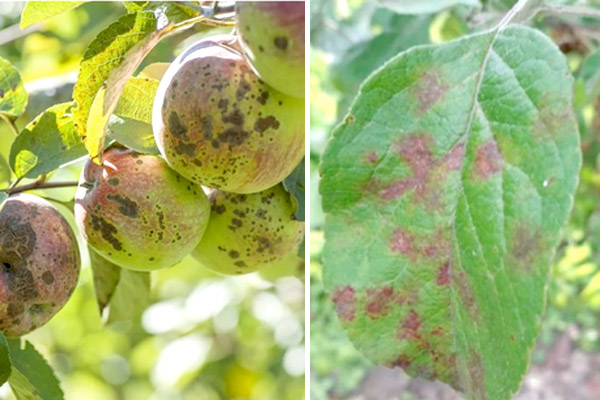
Scab (Venturia inaequalis) on apple
Apple and pear nurseries and mother plantations are sprayed with a copper product –1% Bordeaux mixture, Funguran OH 50 WP – 150-250 g/da, Champion WP – 0.3%, Capper Key – 180-300 g/da against scab and with a pyrethroid insecticide – Decis 100 EC – 7.5-12.5 ml/da, Sumicidin 5 EC (0.02%), Aficar 100 EC (15 ml/da), Efcymentrin 10 EC (15 ml/da) or Dipel 2X (0.1%) against leaf-chewing insects and with one of the products – Afinto (14 g/da), Mospilan (25 g/da), Teppeki (14 g/da), Closer 120 EC (20 ml/da, and in case of heavy infestation 40 ml/da) against aphids. Spraying is continued until the end of growth.
Apple and peach cultivars susceptible to powdery mildew, as well as clonal apple rootstocks, are sprayed every 8-10 days with a sulphur-based product – Sulphur WG 600 g/da, Solfo 80 WG – 750 g/da.
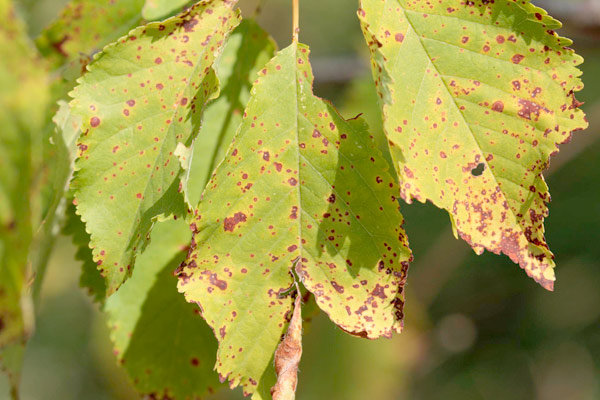
Sour cherry and sweet cherry cultivars, as well as mahaleb rootstocks, are sprayed every 8-10 days with Syllit 544 SC – 125 ml/da against shot-hole disease (cylindrosporiosis).
Clonal quince rootstocks and pear seedlings in seedbeds are sprayed with a copper product – 1% Bordeaux mixture, Funguran OH 50 WP – 150-250 g/da, Champion WP – 0.3%, Capper Key – 180-300 g/da against brown leaf spots at 10-day intervals until the end of growth.
In the presence of San José scale and fall webworm, spraying is carried out respectively with a pyrethroid insecticide – Decis 100 EC – 7.5-12.5 ml/da, Sumicidin 5 EC (0.02%), Aficar 100 EC (15 ml/da), Efcymentrin 10 EC (15 ml/da) or Dipel 2X (0.1%) against fall webworm. Caterpillar nests of the fall webworm are cut out and burned.
In orchards

In June, moths of the first generation of plum fruit moth fly. Females lay their eggs on the young fruits. The caterpillars hatch one week after oviposition, bore into and feed on the fleshy part of the fruit, making tunnels directed towards the stalk.
Poisoned band traps are placed for the destruction of caterpillars of the second generation of plum fruit moth. Fallen wormy fruits – apples, pears, plums, walnuts – are collected to reduce the population density of the second generation of codling moths. Pheromone traps are placed to capture codling moth adults, in order to determine the timing of spraying against their second generation. Non-poisoned band traps are inspected to determine the beginning of the flight of moths of the second generation of codling moths.
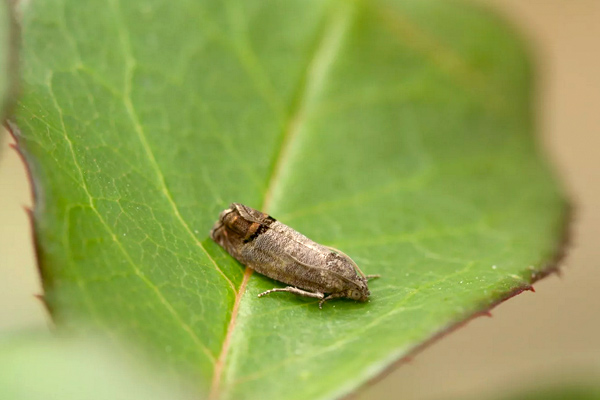
Adult of apple codling moth
In June, caterpillars of the first generation of the apple codling moth cause damage. They bore into the fruits and feed on the seeds in the seed chamber. As a result of the damage, fruits drop prematurely.
A total of 2500-3000 apple fruits of various cultivars, collected from several trees scattered throughout the orchard, are examined to determine the level of infestation and the need for spraying against the second generation of the apple codling moth. If infestation is below 2%, spraying is not carried out.
Fallen wormy fruits are collected and destroyed in order to reduce the population density of second-generation codling moths.
Wormy hazelnut fruits are collected and destroyed to reduce the population density of the hazelnut weevil.
Monitoring is carried out to detect the first rust spots on plum leaves and to follow the development of leaf-mining moths and mites.
Surveying of orchards continues to detect trees infected with viral diseases and to mark them.
Poisoned baits (potatoes, carrots or other vegetables soaked with Actellic 50 EC, Biona Sincar – 4 l per 1 kg) are placed, or Mesurol Schneckenkorn (250 g/da) is buried against the mole rat. Using a small shovel or tongs, the bait is placed in the mole rat galleries.
Against San José scale, treatment is carried out with a pyrethroid insecticide – Decis 100 EC – 7.5-12.5 ml/da, Sumicidin 5 EC (0.02%), Aficar 100 EC (15 ml/da), Efcymentrin 10 EC (15 ml/da).
Caterpillar nests of the fall webworm that are found are cut out and burned, and infested orchards are treated with Dipel 2X (0.1%).
During the month, apple trees are sprayed twice with a sulphur-based product – Sulphur WG 600 g/da, Solfo 80 WG – 750 g/da or with one of the products – Systhane 20 EW – 0.03%, Luna Experience – 50-75 ml/da, Flint Max 75 WG – 0.02% against powdery mildew.
Peach orchards are sprayed with a sulphur-based product – Sulphur WG 600 g/da, Solfo 80 WG – 750 g/da or with one of the products – Systhane 20 EW – 0.03%, Luna Experience – 50-75 ml/da, Flint Max 75 WG – 0.02% against powdery mildew, and with a pyrethroid insecticide – Decis 100 EC – 7.5-12.5 ml/da, Sumicidin 5 EC (0.02%), Aficar 100 EC (15 ml/da), Efcymentrin 10 EC (15 ml/da) against oriental fruit moth, Anarsia, green beetle, aphids and scale insects, leaf-chewing caterpillars, and with one of the products – Valmec (60-96 ml/da), Apollo 50 SC (40 ml/da), Nissorun 5 EC (0.05%), Naturalis (100-150 ml/da) against mites.
A second spraying of peach orchards is carried out after 10-12 days with a pyrethroid insecticide – Decis 100 EC – 7.5-12.5 ml/da, Sumicidin 5 EC (0.02%), Aficar 100 EC (15 ml/da), Efcymentrin 10 EC (15 ml/da) against Anarsia and with a sulphur-based product – Sulphur WG 600 g/da, Solfo 80 WG – 750 g/da or one of the products – Systhane 20 EW – 0.03%, Luna Experience – 50-75 ml/da, Flint Max 75 WG – 0.02% against powdery mildew.
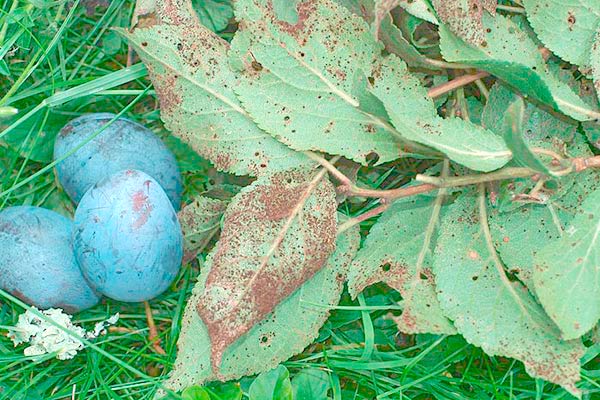
Rust on plum
Plum orchards are sprayed with Signum (45 g/da) against rust and Chorus 50 WG (45 g/da) against brown rot, and with one of the products – Carpovirusine (100 ml/da), Madex Top (10 ml/da), Dipel DF (50-150 g/da), Sineis 480 SC (20-37.5 ml/da), Delegate 250 WG (30 g/da), Avant 150 EC (33.3 ml/da), Deka EC (30 ml/da), Decline 2.5 EC (30 ml/da), Lamdex Extra (60-100 g/da) against plum fruit moth. In case of high population density of mites and aphids, treatment is carried out with one of the products – Valmec (60-96 ml/da), Apollo 50 SC (40 ml/da), Nissorun 5 EC (0.05%), Naturalis (100-150 ml/da) and with Teppeki (14 g/da), Mospilan (25 g/da), Closer 120 EC (20 ml/da, and in case of heavy infestation 40 ml/da), respectively.
Pear orchards infested with pear psylla and stink bugs are treated with a pyrethroid insecticide – Decis 100 EC – 7.5-12.5 ml/da, Sumicidin 5 EC (0.02%), Aficar 100 EC (15 ml/da), Efcymentrin 10 EC (15 ml/da).
Quince orchards are sprayed with Chorus 50 WG (45 g/da) against brown rot and brown leaf spots, and with one of the products – Carpovirusine (100 ml/da), Madex Top (10 ml/da), Dipel DF (50-150 g/da), Sineis 480 SC (20-37.5 ml/da), Delegate 250 WG (30 g/da), Avant 150 EC (33.3 ml/da), Deka EC (30 ml/da), Decline 2.5 EC (30 ml/da), Lamdex Extra (60-100 g/da) against codling moth.
Apricot orchards are sprayed with a pyrethroid insecticide – Decis 100 EC – 7.5-12.5 ml/da, Sumicidin 5 EC (0.02%), Aficar 100 EC (15 ml/da), Efcymentrin 10 EC (15 ml/da) against oriental fruit moth, Anarsia, San José scale, leafrollers, and with one of the products – Valmec (60-96 ml/da), Apollo 50 SC (40 ml/da), Nissorun 5 EC (0.05%), Naturalis (100-150 ml/da) against mites.
Sweet and sour cherry orchards are treated with Syllit 544 SC – 125 ml/da against shot-hole disease (cylindrosporiosis).
In strawberry plantations
Strawberry plantations infested by root weevils are sprayed with one of the insecticides – Decis 100 EC (17.5 ml/da) or another deltamethrin-based product, Mospilan 20 SP (30 g/da), Naturalis (100 ml/da) – applied by irrigation beforehand.
After harvesting the fruits, strawberry plantations are sprayed with a copper product – 1% Bordeaux mixture, Funguran OH 50 WP – 150-250 g/da, Champion WP – 0.3%, Capper Key – 180-300 g/da against white and red leaf spots.
In raspberry plantations
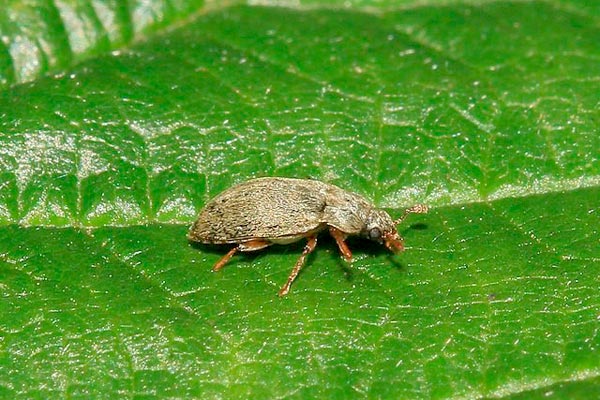
Raspberry beetle
After harvesting the fruits, plantations are sprayed with a pyrethroid insecticide – Decis 100 EC – 7.5-12.5 ml/da, Sumicidin 5 EC (0.02%), Aficar 100 EC (15 ml/da), Efcymentrin 10 EC (15 ml/da) against raspberry beetle, raspberry gall midge and raspberry agrilus. In case of mite infestation, one of the products – Valmec (60-96 ml/da), Apollo 50 SC (40 ml/da), Nissorun 5 EC (0.05%), Naturalis (100-150 ml/da) is added.
Raspberry plantations are sprayed with a copper product – 1% Bordeaux mixture, Funguran OH 50 WP – 150-250 g/da, Champion WP – 0.3%, Capper Key – 180-300 g/da against leaf spots.
In blackcurrant plantations
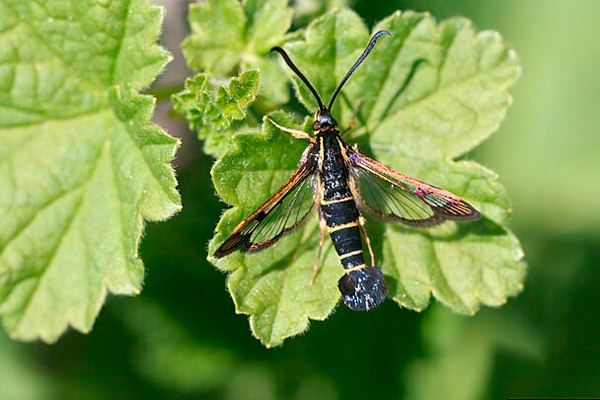
Blackcurrant clearwing moth
Blackcurrant plantations are sprayed 10-12 days after the last treatment with a pyrethroid insecticide – Decis 100 EC – 7.5-12.5 ml/da, Sumicidin 5 EC (0.02%), Aficar 100 EC (15 ml/da), Efcymentrin 10 EC (15 ml/da) against clearwing moth.
After harvesting the fruits, plantations are sprayed with one of the products – Valmec (60-96 ml/da), Apollo 50 SC (40 ml/da), Nissorun 5 EC (0.05%), Naturalis (100-150 ml/da) against mite species.
The interrows in blackcurrant plantations are sprayed with Agroxone 500 SL (120 ml/da) and Fusilade Max 125 EC (100-300 ml/da). Weeds are mapped for a second time.