

![MultipartFile resource [file_data]](/assets/img/articles/заглавна-дървеници.jpg)
Abstract
Plant bugs are widespread in Bulgaria and in certain years become pests of major economic importance to cultivated plants. Their harmful activity is manifested in several aspects: direct damage from sap sucking, leading to a reduction in the quantity and quality of production; indirect damage through creating conditions for infection with phytopathogens; as allergens for humans, causing discomfort in households where they overwinter, etc. The selection and application of appropriate agrotechnical and plant protection measures can lead to a reduction in the distribution and harmful activity of these pests.
Southern green stink bug (Nezara viridula L.)
The southern green stink bug is a polyphagous species that attacks more than 120 plant species belonging to 32 families (Kiritani et al., 1965). Although the species is highly polyphagous, a preference has been observed for species from the family Fabaceae. It has been established that host plants significantly influence the development of nymphs and adults. When feeding on leguminous crops, nymphs develop more rapidly, whereas feeding on wild cruciferous plants slows down the development of the individual stages (Velasco and Walter, 1992; Knight and Gurr, 2007). In Bulgaria the species reproduces massively on vegetable and other crops (Harizanov and Harizanova, 2018).
In Bulgaria the southern green stink bug develops two generations per year and overwinters as an adult insect under plant residues, under cracked tree bark, in abandoned buildings and in other sheltered places. With rising temperatures in spring, the bugs leave their overwintering sites and begin to feed. Copulation takes place mainly in the evening or during the day in shaded places. The eggs are laid in clusters on the underside of the leaves (Fig. 1). After hatching, first-instar nymphs gather on the empty egg chorions (Fig. 2). A characteristic feature is that first-instar nymphs do not feed. After they reach the second nymphal instar, they begin to suck sap and cause damage to the various host plants.

Fig. 1 and 2. Eggs and first-instar nymphs of N. viridula
Damage is caused by adults and nymphs, which suck sap from leaves, buds and fruits (Fig. 3). While feeding, the bugs inject enzymes into plant tissues and suck up the liquefied food. Attacked buds exhibit delayed growth and, under heavy infestation, turn yellow and dry up. On fruits, small, light spots form at the feeding sites, and the tissue beneath the skin is corky. Damaged fruits have reduced organoleptic qualities and an impaired commercial appearance.
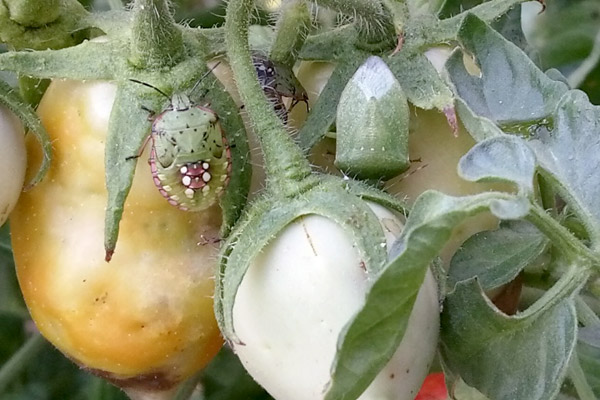
Fig. 3 Fifth-instar nymph and adult of Nezara viridula on tomato fruits
Brown marmorated stink bug (Halyomorpha halys Stål)
This species is polyphagous and attacks more than 120 plant species (Haye et al., 2015; Bergmann et al., 2016). Among fruit crops, the bug is most commonly found on apple (Malus domestica), peach (Prunus persica), sweet cherry (Prunus avium) and European plum (Prunus subg. Prunus) (Funayama, 2007). Among vegetable crops it mainly attacks common bean (Phaseolus vulgaris), pepper (Capsicum annuum), tomato (Solanum lycopersicum), eggplant (Solanum melongena) and okra (Abelmoschus esculentus) (Kuhar et al., 2012).
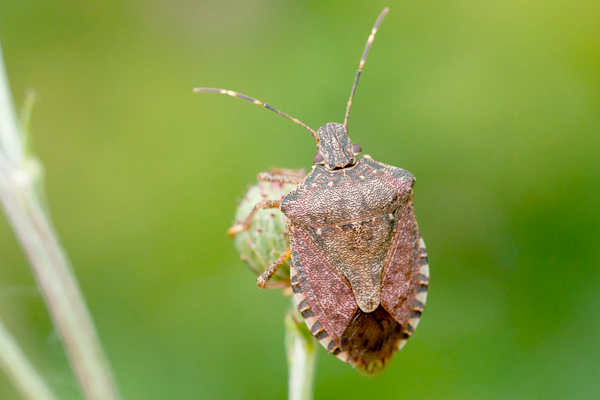
Fig. 4 Halyomorpha halys adult
Under the climatic conditions of Southern Bulgaria, the species develops one generation per year. It overwinters as an adult insect under plant residues, in abandoned agricultural or residential buildings as well as in other sheltered places (Fig. 4). In spring the overwintered adults leave their overwintering sites, and this period may last from the end of March to the beginning of June. Female individuals are sexually immature and require two to three weeks to reach sexual maturity, after which they begin to copulate (Sargent et al., 2011). They lay their eggs in clusters, attaching them to the underside of leaves and less frequently to stems and fruits. After hatching, first-instar nymphs remain on or around the egg mass. Once they reach the second instar, the nymphs disperse and begin to feed. Damage is caused by nymphs and adults, which suck sap from fruits, pods, buds and stems of host plants. On apples, damage manifests as the formation of brown corky tissue beneath the fruit skin. On fruits of green apple cultivars, dark green spots appear, while on red-fruited cultivars dark red spots are formed. On tomatoes and peppers, damage manifests as white to pale-yellow, soft areas on the fruit surface (Fig. 5). In crops such as hazelnut, the bugs can cause damage throughout the entire vegetation period. Feeding on unformed kernels interrupts kernel development, leaving the shells empty. Feeding on developing kernels may lead to the formation of deformities. Damage to fully developed kernels manifests as corky and necrotic spots (Fig. 6).
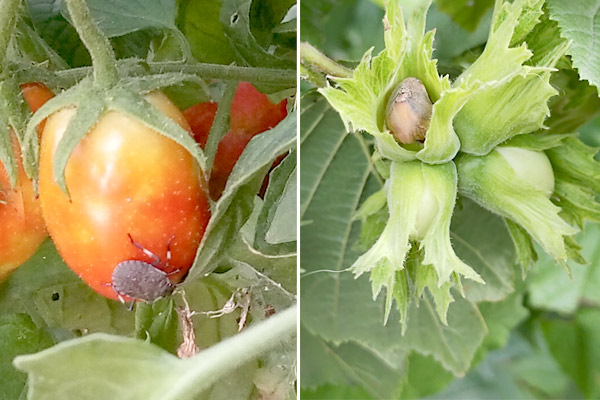
Fig. 5 and 6. Damage to tomato (left) and damage to hazelnut (right)
Hairy shieldbug (Dolycoris baccarum L.)
This species is polyphagous and is widely distributed throughout the country. In urban environments it is found mainly in parks and gardens on shrubby and woody ornamental species. Under field conditions it attacks cereal, leguminous, vegetable and industrial crops. A preference is observed for species from the families Rosaceae and Asteraceae.
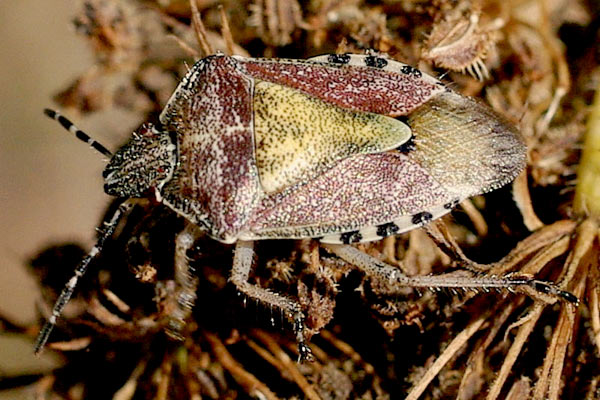
Hairy shieldbug (Dolycoris baccarum L.)
The bug develops two generations per year and overwinters as an adult under plant residues and in other sheltered places. Early in spring the overwintered adults become active and begin to feed in order to reach sexual maturity. Females lay their eggs in groups on various parts of the host plants – on leaves, stems, petioles and fruits.
Damage is caused by nymphs and adults, which suck sap from leaves, stems, buds and fruits. On raspberry, the bugs suck sap from leaves and fruits. Attacked fruits are soft, have reduced organoleptic qualities and no market value. On tomato, the bugs also damage the fruits, and at the feeding sites light spots appear, with corky tissue underneath. This species is often found together with the southern green stink bug and the brown marmorated stink bug.
Ornate cabbage bug (Eurydema ornata L.)
The species is widespread throughout the country and feeds on cultivated and wild plant species from the family Brassicaceae. In Bulgaria the bug occurs at high population densities in regions producing oilseed rape (Brassica napus) and cabbage (Brassica oleracea var. capitata).
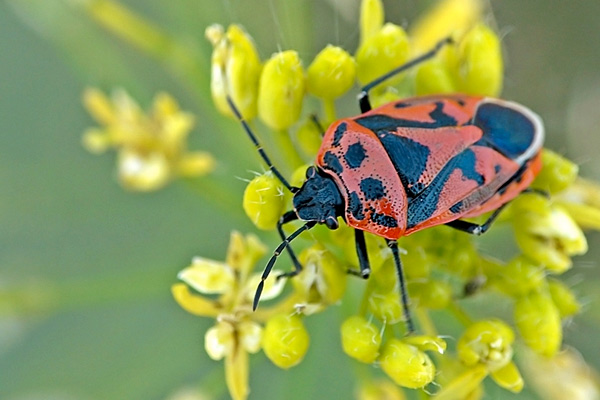
Ornate cabbage bug (Eurydema ornata L.)
The species develops two generations per year and overwinters as an adult insect under plant residues, soil clods, fallen leaves of weeds and trees, and in other places.
The overwintered adults become active at the end of March and the beginning of April. Initially, they attack cruciferous weeds and later move onto cultivated plants. Oviposition begins at the end of April, with eggs laid on the underside of leaves, on petioles, stems and pods of wild and cultivated cruciferous plants. Eggs are laid mainly in two rows, most often 12 in number.
Damage to plants is caused by nymphs and adults, which suck sap from young leaves, petioles, flower stalks and pods. Pale yellow spots appear on the leaves, which gradually spread over the entire leaf and cause it to dry out. On plants left for seed, adults and nymphs attack the flower stalks and later move onto the pods. Attacked pods dry up and drop off, and the resulting seeds have reduced germination capacity.
Common cabbage bug (Eurydema oleracea L.)
The species is distributed throughout the country and is often found together with the ornate cabbage bug. It attacks all representatives of the family Brassicaceae.
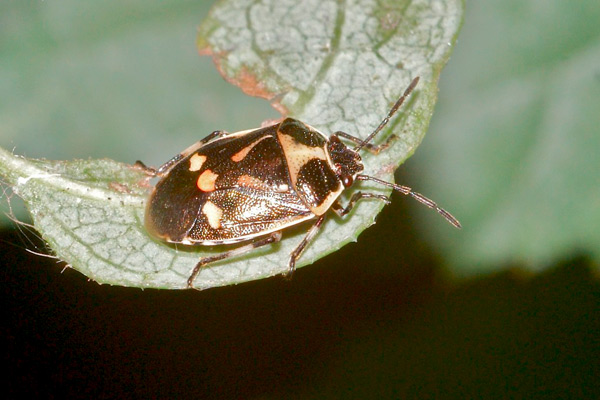
Common cabbage bug (Eurydema oleracea L.)
The bug develops two generations per year and overwinters as an adult insect. At the end of March it leaves the overwintering sites and moves onto cruciferous weeds. Oviposition begins in May, with eggs also laid in two rows on the underside of leaves or on stems. After hatching, first-instar nymphs gather on the empty egg chorions until they reach the second instar. Initially they feed in groups, and after reaching the fourth nymphal instar they are found individually. Damage is caused by nymphs and adults, which suck sap from leaves; under heavy infestation the plants may die. More severe damage is observed on seedlings and young plants.
Palomena prasina
This species occurs throughout the country and is often confused with the southern green stink bug. Both species are polyphagous and are found together on cultivated and wild plant species. In Europe, the pest attacks apple (Malus domestica), pear (Pyrus communis) and hazelnut (Corylus avellana).
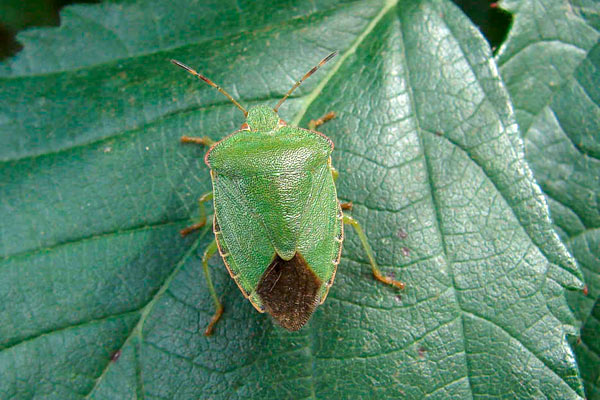
As with other species from this family, it overwinters as an adult insect under plant residues, in agricultural and residential buildings and other sheltered places. With rising temperatures in spring, adults leave their overwintering sites and begin to feed. Damage is caused by nymphs and adults, which suck sap from leaves, buds and fruits.
Control:
Agrotechnical method
Maintaining fields free from weed vegetation and destroying plant residues in autumn help to reduce bug population density.
In some countries, newer agrotechnical practices are also applied, such as the use of trap crops. The use of early and late soybean cultivars can serve as trap crops for bugs, since most of them show a preference for leguminous crops (Bundy and McPherson, 2000). Different trap crops may be used for different crops: for cotton, sorghum (Sorghum bicolor) is suitable (Tillman, 2006); for maize (Zea mays), white mustard (Sinapis alba), pea (Pisum sativum) and black mustard (Brassica nigra) are recommended (Rea et al., 2002); for early spring crops, triticale sown in October or November, or sunflower and buckwheat can be used (Mizell III et al., 2008); for tomato, sorghum is the most suitable (Gordon et al., 2017).
Biological control
In recent years, there has been increased interest in the possibilities for biological control of this group of pests. The literature describes a large number of parasitoids and predatory insect species that successfully suppress bug populations. Egg parasitoids are more numerous than those attacking adults. Among egg parasitoids, species from the families Scelionidae, Eupelmidae and Encyrtidae are of greatest importance (Abram et al., 2017). One of the most widespread and most effective egg parasitoids is Trissolcus basalis. This species parasitizes species from the family Pentatomidae (Waterhouse, 1998; Loch and Walter, 1999), but shows a preference for N. viridula, which is its main host. Among adult parasitoids, species from the family Tachinidae are of greatest importance (Jones, 1988). Numerous predatory insect species from the orders Orthoptera, Hemiptera, Hymenoptera, Coleoptera and Neuroptera that attack bugs have also been described. Some predators attack only eggs, others only nymphs, and others both eggs and nymphs.
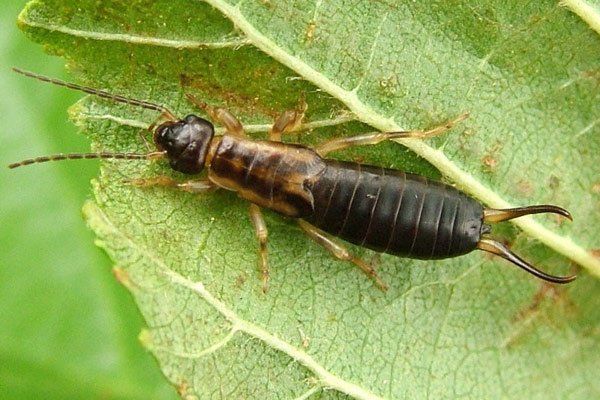
Earwig (Forficula auricularia)
In Bulgaria, the common earwig (Forficula auricularia) has been observed feeding on eggs and nymphs of the southern green stink bug and the brown marmorated stink bug.
Chemical method
Chemical control is the most commonly used means for managing plant bugs. Synthetic insecticides are used to reduce pest populations before they cause serious economic losses. Since the number of registered plant protection products for controlling phytophagous bugs is limited, growers often use broad-spectrum insecticides such as organophosphates, pyrethroids and neonicotinoids. The application of pyrethroid insecticides alone provides 50 to 100% control of bugs, whereas combining pyrethroids with organophosphate or carbamate insecticides achieves 67–80% control of bugs (Greene and Capps, 2002).
REFERENCES
- Kuhar, T. P., Kamminga, K. L., Whalen, J., Dively, G. P., Brust, G., Hooks, C. R., ... & Herbert, D. A. (2012). The pest potential of brown marmorated stink bug on vegetable crops. Plant Health Progress, 13(1), 41.
- Haye, T., Gariepy, T., Hoelmer, K., Rossi, J. P., Streito, J. C., Tassus, X., & Desneux, N. (2015). Range expansion of the invasive brown marmorated stinkbug, Halyomorpha halys: an increasing threat to field, fruit and vegetable crops worldwide. Journal of Pest Science, 88(4), 665-673.
- Bergmann, E. J., Venugopal, P. D., Martinson, H. M., Raupp, M. J., & Shrewsbury, P. M. (2016). Host plant use by the invasive Halyomorpha halys (Stål) on woody ornamental trees and shrubs. PloS one, 11(2), e0149975.
- Kiritani, K., Hokyo, N., Kimura, K., & Nakasuji, F. (1965). Imaginal dispersal of the southern green stink bug, Nezara viridula L., in relation to feeding and oviposition. Japanese Journal of Applied Entomology and Zoology, 9(4).
- Knight, K. M., & Gurr, G. M. (2007). Review of Nezara viridula (L.) management strategies and potential for IPM in field crops with emphasis on Australia. Crop Protection, 26(1), 1-10.
- Velasco, L. R. I., & Walter, G. H. (1992). Availability of different host plant species and changing abundance of the polyphagous bug Nezara viridula (Hemiptera: Pentatomidae). Environmental Entomology, 21(4), 751-759.
- Sargent, C., Martinson, H. M., & Raupp, M. J. (2011). The orient express in Maryland: the brown marmorated stink bug, Halyomorpha halys (Stål)(Hemiptera: Pentatomidae). MD Entomol, 5(3), 2-21.
- Waterhouse, D. F. (1998). Biological control of insect pests: Southeast Asian prospects (No. 435-2016-33746).
- Loch, A. D., & Walter, G. H. (1999). Multiple host use by the egg parasitoid Trissolcus basalis (Wollaston) in a soybean agricultural system: biological control and environmental implications. Agricultural and Forest Entomology, 1(4), 271-280.
- JONES, W. A. (1988). Stink Bug, Nezara viridula (L.)(Heteroptera: Pentatomidae). Ann. Entçrnal. Soc. Am, 81(2), 252-273.
- Bundy, C. S., & McPherson, R. M. (2000). Dynamics and seasonal abundance of stink bugs (Heteroptera: Pentatomidae) in a cotton–soybean ecosystem. Journal of Economic Entomology, 93(3), 697-706.
- Abram, P. K., Hoelmer, K. A., Acebes-Doria, A., Andrews, H., Beers, E. H., Bergh, J. C., & Wiman, N. G. (2017). Indigenous arthropod natural enemies of the invasive brown marmorated stink bug in North America and Europe. Journal of Pest Science, 90(4), 1009-1020.
- Gordon, T. L., Haseeb, M., Kanga, L. H. B., & Legaspi, J. C. (2017). Potential of three trap crops in managing Nezara viridula (Hemiptera: Pentatomidae) on tomatoes in Florida. Journal of Economic Entomology, 110(6), 2478-2482.
- Greene, J. K., & Capps, C. D. (2002). Insecticide efficacy on stink bugs-2002. Summaries of Arkansas Cotton Research, 264-269.
- Mizell III, R. F., Riddle, T. C., & Blount, A. S. (2008, December). Trap cropping system to suppress stink bugs in the southern coastal plain. In Proceedings of the Florida State Horticultural Society (Vol. 121, pp. 377-382).
- Rea, J. H., Wratten, S. D., Sedcole, R., Cameron, P. J., Davis, S. I., & Chapman, R. B. (2002). Trap cropping to manage green vegetable bug Nezara viridula (L.)(Heteroptera: Pentatomidae) in sweet corn in New Zealand. Agricultural and Forest Entomology, 4(2), 101-107.
- Tillman, P. G. (2006). Sorghum as a trap crop for Nezara viridula L.(Heteroptera: Pentatomidae) in cotton in the southern United States. Environmental Entomology, 35(3), 771-783.