

![MultipartFile resource [file_data]](/assets/img/articles/заглавна-фитосанитарни.jpg)
Abstract
Stone fruit species have early phenology and high sensitivity to temperature amplitudes and are particularly susceptible to adverse winter conditions. Frost damage in orchards does not only lead to a reduction in yield for the specific year. It represents a complex physiological and structural stress that weakens plant immunity, alters the phytosanitary status of the plantation and triggers invasion by secondary infections and pest attacks. The effects of extreme temperatures manifest differently in young and in bearing orchards, which necessitates a differentiated approach in the assessment and subsequent recovery measures.
Young orchards are extremely susceptible to low temperatures; their tissues are poorly lignified and have not completed the process of hardening of the wood before the onset of winter dormancy. The underdeveloped root system hinders the uptake of reserve substances, which further impairs resistance to extreme conditions. Damage from low temperatures in young orchards often includes necrosis of the cambium, injuries in the graft union area and partial or complete desiccation of one-year-old shoots. As a result of this damage, growth retardation, crown deformation and delayed entry into bearing are observed, and in more severe cases – the need to replant individual trees.
In bearing trees, prolonged exposure to extreme low temperatures leads to significantly more complex and often underestimated consequences. In addition to the obvious damage and death of flower buds, low temperatures can cause internal ruptures in the conductive tissues, disrupting the normal physiological flow between the root system and the canopy. A common phenomenon is damage to the fruit set, expressed in poor development or premature shedding of flowers or young fruits. The initiation of generative buds for the following year may also be impaired, which compromises yields in the longer term.
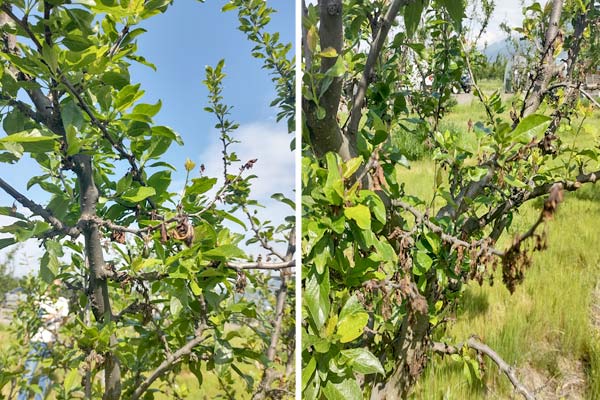
Frost damage on plums in the town of Karlovo. The frost damage is combined with brown rot. Photos © Chief Assist. Prof. Dr. Diyana Aleksandrova, Chief Assist. Prof. Dr. Maria Hristozova
An extremely important consequence of winter frost damage is the overall reduction in the immunity of the tree. Damaged tissues release fewer phytoncides and secondary metabolites, which creates a prerequisite for the penetration of numerous phytopathogens. The most common infections in such cases are diseases that develop on the foliage and include bacterial damage caused by Pseudomonas syringae, Xanthomonas arboricola pv. pruni. The fungal diseases Cytospora spp. and Botryosphaeria dothidea, Blumeriella jaapii, Cladosporium carpophilum, Monilinia spp. also find favourable conditions for development in the damaged tissues. The beginning of vegetation, under weakened phytosanitary control, may be accompanied by twig dieback, necrosis and expanding cankers, which necessitates timely diagnosis and pruning of infected parts.
No less serious is the impact of low temperatures on the entomofauna in orchards. Damaged trees release increased amounts of volatile compounds that act as attractants for numerous pests. Bark beetles of the genus Scolytus and the genus Xyleborus concentrate mainly on weak and stunted trees, as they are most suitable for feeding the adults and larvae. Most often, trees with frost damage or with a weak root system are subject to attack. Adults of the Mediterranean flat-headed root-borer (Capnodis tenebrionis L.) and the flatheaded borer (Perotis lugubris F.) often initially colonize frost-damaged areas and subsequently spread into adjacent healthy tissues.
Despite the inevitability of some winter damage, a number of well-planned agrotechnical, phytopathological and entomological measures can reduce losses and support recovery. Among the most important preventive approaches is balanced fertilization, with particular attention to avoiding late nitrogen applications in autumn. Formative pruning should focus on the removal of frost-damaged and necrotic parts, thereby stimulating the development of new healthy tissue.
Phytopathological control includes preventive spraying with copper-based products. During the spring growth period, the use of systemic or penetrant fungicides is recommended. Monitoring at the beginning of vegetation and timely diagnosis of primary symptoms are of paramount importance.
Pest monitoring begins as early as the early vegetation period, applying specific techniques and methods to detect the presence of harmful insect species. It is recommended to carry out regular surveys of orchards, as well as to use pheromone and coloured sticky traps. Depending on the pest species and the economic injury level, spring insecticide treatments may be applied. Against fruit sawflies, insecticide treatments are targeted at the adults, before and during oviposition, and at the larvae, during hatching and penetration into the young fruit. This treatment also affects defoliating caterpillars, weevils and tortricid moths. After flowering, the first colonies of aphids are observed forming on the shoot tips. With increasing population density, growth retardation and deformation of young shoots are observed. At the appearance of the first colonies, treatment with systemic, penetrant and translaminar insecticides is recommended. To prevent the development of resistance to the plant protection products used, it is necessary to alternate them and to use products from different groups.
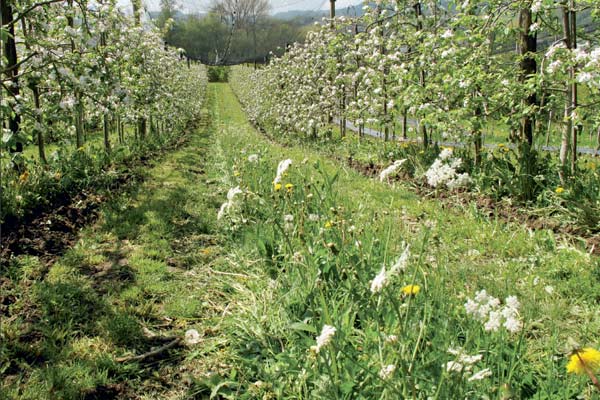
To preserve biological balance, it is recommended to plant flower strips of various nectar- and pollen-producing species in the alleys or in close proximity to the orchards. In this way, the development and conservation of beneficial insect species – bees, predators and parasitoids – are promoted.
In the absence of fruits during the vegetation period, a “reduced tree maintenance scheme” can be applied, but the measures must not be omitted. Plant protection is aimed at strengthening the attacked wood; maintaining a healthy leaf area and preventing mass pest infestation.
In conclusion, frost damage in stone fruit species requires a multi-faceted approach that combines knowledge from breeding, physiology, phytopathology and entomology. Only integrated strategies, based on flexible approaches, can ensure the resilience of orchards and long-term productivity under conditions of increasingly frequent climatic anomalies.
References
- Hanson, E., & Sundin, G. (2020). How to minimize costs in frost-damaged cherry orchards. Michigan State University Extension. Retrieved May 5, 2025, from https://www.canr.msu.edu/news/how_to_minimize_costs_in_frost_damaged_cherry_orchards
- Kocurek, P., Gołąb, G., Kalandyk, A., & Pawłowski, M. (2023). Increasing risk of spring frost occurrence during the cherry tree flowering in times of climate change. Water, 15(3), 497. https://doi.org/10.3390/w15030497
- Orchard People. (n.d.). How to protect fruit trees from frost with water. Retrieved May 5, 2025, from https://orchardpeople.com/how-to-protect-fruit-trees-from-frost-with-water/
- Pacific Northwest Extension. (n.d.). Cherry (Prunus spp.) - Brown Rot Blossom Blight and Fruit Rot. Pacific Northwest Plant Disease Management Handbook. Retrieved May 5, 2025, from https://pnwhandbooks.org/plantdisease/host-disease/cherry-prunus-spp-brown-rot-blossom-blight-fruit-rot
- Stark Bro’s Nurseries & Orchards Co. (n.d.). Pest & disease control for cherry trees. Retrieved May 5, 2025, from https://www.starkbros.com/growing-guide/how-to-grow/fruit-trees/cherry-trees/pest-and-disease-control
- University of Minnesota Extension. (n.d.). Cherry Leaf Spot. Retrieved May 5, 2025, from https://extension.umn.edu/plant-diseases/cherry-leaf-spot
- University of Missouri Extension. (2021). Care of fruit trees after spring frost. Integrated Pest Management Program. Retrieved May 5, 2025, from https://ipm.missouri.edu/meg/index.cfm?ID=613
- Ystaas, J., Heide, O. M., & Sønsteby, A. (2006). A method for assessing frost damage risk in sweet cherry orchards. Scientia Horticulturae, 109(3), 234–241. https://doi.org/10.1016/j.scienta.2006.04.026