

For pears, spraying against scab should continue. Only two fungicides are approved for combating this disease - Dithane M-45 – 0.3% and Luna Experience – 20-75 ml/deka, but all fungicides listed for combating apple scab can be used. Treatment is also carried out against fruit worms and against pear psyllids, specifically against the common pear psyllid and the pear sucker. For simultaneous control of these pests, one of the following insecticides is used: Decis 2.5 EC – 0.03%, Decis 100EC – 12.5 ml/deka, Deca EC – 30-50 ml/deka, Karate Express WG – 60-80 g/deka, Vaztak New 10 EC – 0.02%, Sineis 480SC – 37.5 ml/deka, Sumi Alpha 5EC – 0.03%.
Fungicide spraying for quinces is against brown rot and brown leaf spots, for which Horus 50WP – 0.03% or Luna Experience – 20-75 ml/deka is used. To combat fruit worms, one of the insecticides listed against the codling moth is added to the fungicide solution.
In July, the harvest of sweet and sour cherries continues, and no spraying is carried out for these two crops. During harvesting, all fruits should be picked to minimize the overwintering infection from the cherry fruit fly. Furthermore, all fruits infected with brown rot should be removed and taken out of the orchard.
Usually in July, in young non-fruiting sweet and sour cherry orchards, where the problem with the black cherry aphid was not resolved in June and the density of the cherry leaf wasp is high, it is necessary to spray with one of the insecticides: Mospilan 20SG – 25g/deka, Karate Express WG – 40-60g/deka, Calypso 480SC – 0.02%.
For plums in July, fungicide spraying is directed against rust and brown rot. Horus 50WG – 0.045% is used. During this period, treatments against the plum fruit moth and the common plum scale continue. Against the plum fruit moth, one of the following insecticides is used: Vaztak New 100EC – 0.0125%, Decis 2.5EC – 0.05%, Dursban 4E – 0.15%, Coragen 20SC – 16-30 ml/deka, Sumi Alpha 5EC – 0.02%, Pirinex 48EC – 0.15%, Runner 240SC – 0.03%. Among the listed insecticides, Vaztak New 100EC – 0.02%, Dursban 4E – 0.1%, and Pirinex 48EC – 0.15% are also effective against the common plum scale, which allows their use for simultaneous control of the pests.
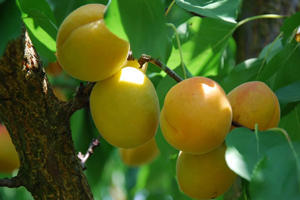
At the beginning of July, fruit ripening begins for early peach varieties, and during this period, no spraying is carried out for them. For late varieties, spraying against brown rot, the oriental fruit moth, and the peach twig borer is necessary. Against brown rot, among the three approved fungicides Delan 700 WDG – 0.05%, Horus 50WG – 0.045%, and Luna Experience – 63-75 ml/deka, Luna Experience is the most suitable as it has the shortest pre-harvest interval. Against the oriental fruit moth, one of the following insecticides is used: Avant 150EC – 33.3 ml/deka, Karate Express WG – 100-120 g/deka, Eforia 045 – 150 ml/deka, Nexide 015SC – 0.03%, Decis 2.5EC – 0.04%, Sumi Alpha 5EC – 0.02%, and against the peach twig borer, one of the insecticides: Karate Express WG – 100-120 g/deka, Sumi Alpha 5EC – 0.02%, Dursban 4E – 0.15%, Vaztak New 100EC – 0.015%.
After harvest, the leaves of strawberry plantations are mowed, removed from the plantation, and destroyed by burning or buried to rot. If the strawberry mite density is high, spraying is done to prevent damage to the young leaves. There is no acaricide for controlling the strawberry mite that is included in the list of approved plant protection products. According to Assoc. Prof. Elena Tsolova, very good results are obtained from Bi-58 – 0.1% - 0.15% or Nimazal TS at a concentration of 0.3-0.5%.
Temperatures in July are high, which necessitates spraying early in the morning or in the evening when temperatures are below 25°C. Furthermore, it is very important to use products with a short pre-harvest interval, considering that during this period in some areas, the harvest of late-ripening sweet and sour cherries continues, and for apples, plums, and peaches, the harvest of early varieties begins.