

![MultipartFile resource [file_data]](/assets/img/articles/заглавна-био-домати.jpg)
Summary
The cultivation of vegetable crops under regenerative agriculture conditions is a challenge for the “Vegetable Production” sector, especially in terms of growing plants in accordance with the principles of organic farming. The cultivation of tomatoes on a raised bed without tillage has a beneficial effect on the crop, but in order to obtain higher yields it is necessary to optimize the sowing date of the seeds, to determine the type and density of the weed vegetation, to accurately refine the fertilization rate and to optimize the plant protection of the crop. The growing interest in the production of no-till vegetables, both by direct seeding and from seedlings, necessitates a change in cultivation technologies through the management of mulching using various cover crops, some of which are characterized by a high content of organic matter, and through the improvement and application of integrated weed management techniques.
Methodology of the experiment
The study was conducted in the first year after the cessation of soil tillage. Deep ploughing was carried out in winter and several disc harrow operations in spring. The soil surface was shaped into a high flat bed, after which all soil tillage was discontinued. As a result, favourable conditions were created for the emergence of weed vegetation, which served as a living mulch during the vegetation period of the main crop.

In the variety "Prometey" the plants are determinate (short-stemmed), compact, well-foliated. The fruits are intensely red, oval, with an average weight of 60-65 g, 2-3 locular, firm, crack-resistant, with a small and shallow stem scar. The dry matter content is 4.8%. The variety is high-yielding. Average yield is 4-5 t/da. The fruits are suitable for processing into whole peeled and unpeeled tomatoes, tomato juice, concentrates and drying. The variety was bred at the Maritsa Vegetable Crops Research Institute.
For the purposes of the experiment, the tomato variety Prometey was used, grown by direct sowing of seeds, carried out on 28 May, at a spacing of 60+20+20/30 cm. The vegetation period lasted 146 days and ended on 21 October with the first autumn frosts.
Fertilization of the plants was carried out with an aqueous extract of Lumbrical (1 L organic fertilizer soaked in 10 L of water for 24 hours, applied to the soil without dilution), according to the following schedule: first fertilization – 200 ml/plant; second fertilization – 250 ml/plant; third fertilization – 100 ml/plant; fourth fertilization – 100 ml/plant.
The regenerative cultivation of tomatoes was compared with traditional cultivation involving several mechanized and manual hoeings during the vegetation period, under organic field conditions.
An analysis was carried out to determine soil moisture in the no-till treatment and in the treatment with tillage during the vegetation period. Sampling was carried out in the period May-October (during the vegetation period), three times a month at 10-day intervals, and in the months of November and December – once a month. Samples were taken at three points at two depths: 0-10 cm and 10-20 cm.
Plant productivity and yield
Under regenerative agriculture without soil tillage and using weed vegetation as a living mulch, significant differences in plant productivity were established compared to the treatment with soil tillage. A considerably higher quantity of green fruits was found, which is a critical factor in late open-field production in cases of early onset of autumn frosts, when the crop cannot reach commercial maturity. This does not allow the full potential of the plants to be realized. From the observations made and the recording of the phenophases of plant development, it was established that under conditions without soil tillage and with mulch from weed vegetation, tomatoes exhibit delayed growth and form fruits later, which has a negative effect on their productivity.

In late open-field tomato production, the yield of red fruits for fresh consumption and processing, which can be offered directly on the market, is of greatest importance. Pink and breaker fruits harvested immediately before the early autumn frosts are ready for consumption later, after ripening in storage facilities or under shelters, and provide additional income. Green fruits are suitable for pickling.
Tomatoes grown without soil tillage are characterized by a low yield of red fruits – 344 kg/da, pink – 194 kg/da, breaker – 1005 kg/da and green – 961 kg/da. By comparison, tomato cultivation with tillage during the vegetation period is characterized by a significantly higher yield of red fruits – 2879 kg/da, pink – 339 kg/da, breaker – 780 kg/da and green – 238 kg/da. The total yield of red, pink, breaker and green fruits recorded in the first year of the experiment after the cessation of soil tillage and the maintenance of weed vegetation as a living mulch during the vegetation period was 2505 kg/da, while in the control treatment with tillage during the vegetation period it was 4236 kg/da. These differences are due, on the one hand, to the delay in plant growth and development and, on the other hand, to the early onset of autumn frosts.
In conclusion, it can be noted that the cultivation of tomatoes on a raised bed without soil tillage is favourable for the crop, but in order to obtain better results it is necessary to carry out earlier sowing of the seeds, at the end of April - beginning of May, when conditions are favourable for plant emergence, and not to delay the sowing time until the end of May.
Soil moisture
The moisture content of the alluvial-meadow soil in the 0-10 cm layer varies from 17.5% to 24.7% (gravimetric percentage), which is about 80-90% of the field capacity (FC), estimated on the basis of the mechanical composition and organic carbon content. In the lower layer (10-20 cm) the moisture content varies from 17.3% to 23.2%, which is approximately the same as in the upper layer. A slight tendency towards better moisture supply is observed in the no-till treatment, corresponding to lower bulk density and higher total porosity (Fig. 1).
Bulk density in the surface 0-10 cm layer varies from 1.00 to 1.11 g.cm-3, which is typical for layers with a high humus content and for surface cultivated layers. This corresponds to a total porosity between 57 and 60% vol. (at a particle density of 2.63 g.cm-3). With depth, compaction is observed, and the bulk density reaches 1.41 and 1.31 g.cm-3, respectively.
During sampling, it is noticeable that the soil structure in the no-till bed is more compact and dense, while in the treatment with soil tillage it is looser. It has been established that soil texture and structure have a major influence on infiltration, permeability and water-holding capacity. The soil water available for plant growth constitutes approximately 0.01 percent of the world’s water reserves. Regenerated soils absorb and retain more water in the soil profile, which allows crops to develop productively for a longer period without rainfall or irrigation. Water supports regenerative processes aimed at improving the physical fertility of the soil by stimulating biomass accumulation through greater plant and root growth, by maintaining soil biological activity, and by operating within desirable ranges of drying and wetting of soils to support nutrient release and soil structure formation.
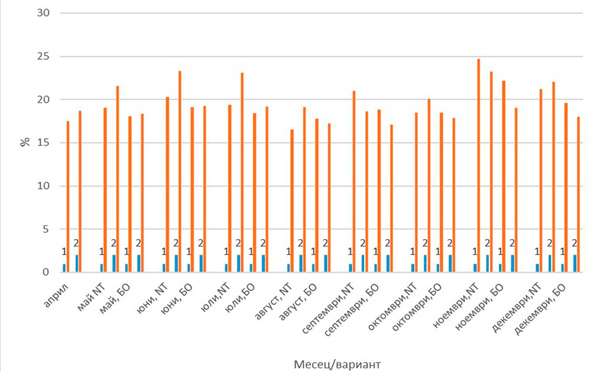
Fig. 1. Moisture of the alluvial-meadow soil (1 – depth 0-10 cm; 2 – depth 10-20 cm; NO – no till; BO – with tillage
References
- Booker B., 2009. No-Till Tomato Production. PhD Thesis
- Botelho R., Branco R., Bolonhezi D., Salles F., Balieiro Neto G., Suguino E. Minami W., Nahas E., 2013. Soil properties and tomato agronomic attributes in no-tillage in rotation with cover crops. African Journal of Agricultural Research. 8. 184-190. 10.5897/AJAR12.1256.
- Bullock, P., Newman, A. C. D., and Thomasson, A. J.,1985. Porosity aspects of the regeneration of soil structure after compaction. Soil Tillage Res. 5, 325–341. doi: 10.1016/S0167-1987(85)80001-5
- Herrero, E, J Mitchell, W Lanini, S Temple, E Miyao, R Morse, and E Campiglia., 2001. Soil Properties Change in No-till Tomato Production. California Agriculture 55 (1): 30–34. https:/doi.org/10.3733/ca.v 55, N1, p.30.
- Ronald D. M., 1999. No-till Vegetable Production—Its Time is Now. Horttechnology, 9(3), 373 – 379