

![MultipartFile resource [file_data]](/assets/img/articles/заглавна-облепиха-1.jpg)
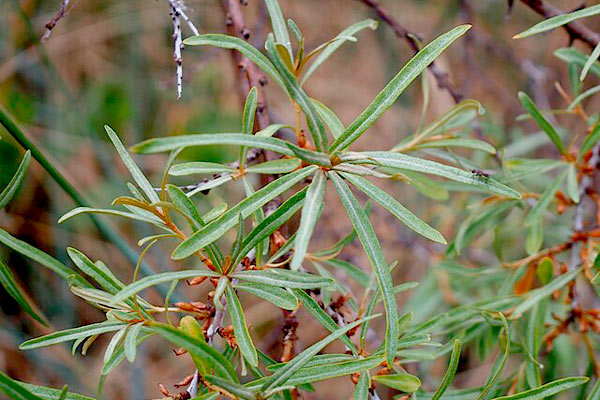
Sea buckthorn, also known as sea buckthorn berry, sallow thorn or Siberian pineapple, is a perennial shrub 1–3 m high or a tree up to 3–6 m, with a rounded, compact, spreading or pyramidal crown depending on the cultivar. The ancient Greeks called sea buckthorn Hippophae – “shining horse”, and its leaves were part of the diet of racing and war horses.
This fruit crop belongs to the family Elaegnaceae Sindl, genus Hippophae L. A characteristic feature is the formation of nodules on the roots and branches of different order, thanks to which, in symbiosis with soil bacteria, it fixes atmospheric nitrogen, similarly to leguminous crops. Of all three species – H. thibetana Schlecht, H. salicifolia D. Don and H. rhamnoides L., only H. rhamnoides L. has economic importance and valuable properties for human health, the cosmetics industry, pharmacy and medicine, due to more than 190 active ingredients. It can also be used in landscaping of parks and gardens, as it has high ornamental value – because of its attractive leaves and long fruiting twigs laden with berries.
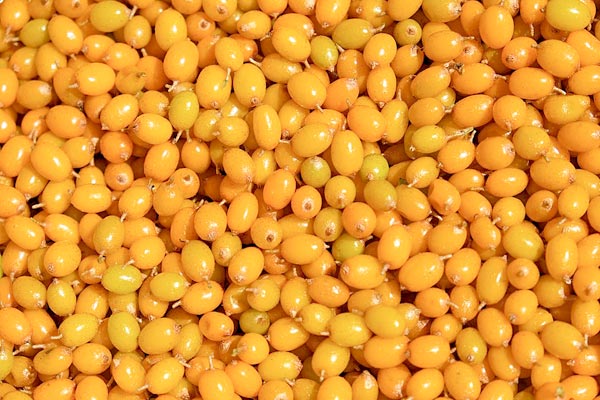
It starts bearing fruit after the third year. The most valuable quality of sea buckthorn fruits is the sea buckthorn oil contained in the pulp and seeds – up to 6–7% in fresh fruits, reaching 10% in some cultivars. The oil has a complex composition: 40–50 mg/% carotenoids, 100–160 mg/% vitamin E, 2.70–5.60 mg/% vitamin K1, 240–280 mg/% sterols and a large amount of saturated and unsaturated fatty acids.
The fruits of this berry crop have an exceptionally rich and diverse chemical composition: carbohydrates – 4.56–16.86%, with a predominant content of monosaccharides; organic acids – 1.53–3.35%; pectin – 0.31–0.34%; tannins and aromatic substances 0.14–0.29%.
The content of vitamin E is high – 8–16 mg/% as well as that of vitamin C, which can reach 300–500 mg/%. The fruit pulp also contains the following vitamins: A (1.99–18.50 mg/%), B1 (up to 0.035 mg/%), B2 (up to 0.06 mg/%), folic acid (up to 0.08 mg/%), K (2.7–5.6 mg/%), P (250–700 mg/%), as well as other biologically active compounds (in mg/%): triterpenic acids (20–110), serotonin (up to 2.5), betaine (90–360), coumarins (1–2.4) and oxycoumarins (75–90).
Sea buckthorn oil has bactericidal, wound-healing and analgesic effects, which is why it is used in the treatment of peptic ulcer disease of the stomach and duodenum, certain gynaecological diseases, hard-to-heal wounds and as a general tonic.
In ancient Mongolian, ancient Greek, Chinese and Tibetan medicine, sea buckthorn fruits were used in the treatment of biliary diseases, skin diseases, rheumatism and gout. Juice from the fruits and decoctions of fruits and twigs are used against hair loss.
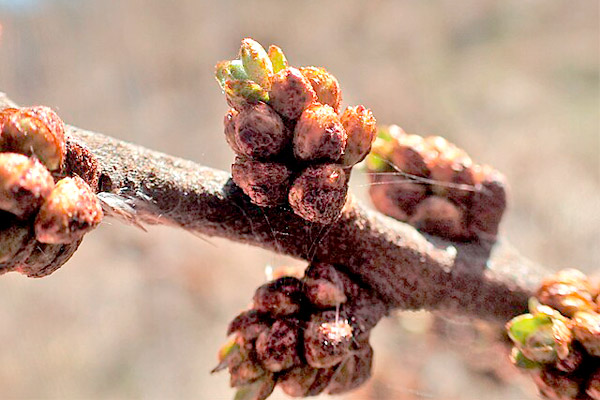
Sea buckthorn has specific requirements for site conditions.
It is a cold-hardy plant – during deep dormancy it withstands down to -45 to -50 oC (Siberian and Mongolian forms), but under our conditions – winters characterised by temperature fluctuations and temporary warming – its winter hardiness decreases sharply.
Sea buckthorn is also very demanding with respect to soil and air moisture and does not tolerate either high air temperatures or drought. This is due to its shallow root system.
Therefore, for successful cultivation of the crop, cooler regions are needed, with relatively small temperature fluctuations and higher precipitation.
Sea buckthorn is demanding with regard to soil conditions; it grows and bears well on soils with light mechanical composition, well drained, with slightly acidic to neutral reaction – pH 6.5–7, rich in phosphates combined with high humus content and organic residues. It does not tolerate heavy and waterlogged soils.
This berry crop is a light-loving plant. Under strong shading it grows tall, branches weakly and enters fruiting late.
Therefore, the sites designated for planting sea buckthorn must correspond as closely as possible to its requirements.
The most suitable soils for it are light – alluvial, cinnamon forest, carbonate, grey-brown forest and dark-grey soils.
Primary soil tillage is carried out at a depth of 40–50 cm. Pre-plant fertilisation with 4–5 t/da of organic fertilisers is done before that or during the previous year. An additional 80–100 kg/da superphosphate and 20–30 kg/da potassium sulphate are applied. If it is not possible to fertilise the entire area, 5–6 kg of farmyard manure, 80–100 g superphosphate and 25–30 g potassium sulphate, thoroughly mixed with soil, are placed in each planting pit.
The most suitable time for planting is autumn, but spring planting is also possible, no later than the end of April. The preferred planting material is two- and three-year-old rooted plants. Planting is carried out in trenches 50 cm deep or in planting pits – 40 x 50 cm and 35–40 cm deep. On heavier soils drainage is needed, and the filling is done with a mixture of soil, sand and peat in equal proportions. Planting distances are 3.5–4 m between rows and 2–2.5 m within the row. The root collar must be 5–10 cm above the soil surface. After planting, the plants are not pruned back. Each plant is watered with 10–15 l of water.
Sea buckthorn is a dioecious plant, therefore the correct arrangement of male pollinator plants is a very important condition. Reliable pollination of female plants is achieved by alternating every two rows of female plants with one mixed row – for every 5 female plants one male plant is planted.
The most effective way to grow sea buckthorn is with grassed inter-rows and systematic mulching within the row with mown grass. Depending on soil fertility, the plants are annually top-dressed with 20–25 kg/da ammonium nitrate or another nitrogen fertiliser at the same rate.
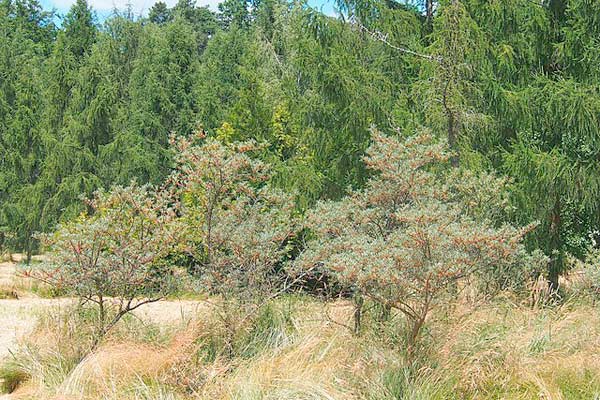
Plants are trained as multi-stem bushes – with several shoots – or as single-stem trees. In order for the tree to have a compact, low crown, during the first 4–5 years only the surplus, improperly placed and crown-thickening branches are removed. Newly emerged root suckers are removed by cutting them at the base. Some branches may be shortened by 10–20 cm to stimulate branching. Once a year, a sanitary pruning is carried out to remove dry, damaged and broken branches. After the eighth year, rejuvenation pruning is carried out – on three-year-old wood.
If there is no wind during flowering, additional pollination of the female flowers is necessary – flowering twigs from male plants are cut and attached in the crowns of the female plants or shaken over them.
Fruit development lasts about 100 days, and ripening occurs at the end of July – August.
For mechanised harvesting, vibration machines are used which shake the branches. Manual harvesting of the fruits is difficult due to the presence of spines on the branches, the short fruit stalks and the fruits tightly attached to the branches. Therefore, it is advisable to grow cultivars with few or no spines and with longer fruit stalks.
Some of the most widespread cultivars are of Russian origin. Here are several newer Russian cultivars:
Pantelevskaya
The plant is of medium vigour, with a branched and rounded crown, with branches emerging at an angle of 45 o.
The fruits are large, with an average weight of 0.8–1 g, elongated-oval, orange-red, with a fruit stalk 3–4 mm long.
Chemical composition of the fruits: sugars – 5.8%, acids – 1.9%, vit. C – 87.5 mg/%, sea buckthorn oil – 5.7%.
The cultivar has a mid to late ripening period. Productivity is high.
Chuyskaya
The plant is of medium vigour, the crown is branched and compact, with branches emerging at an angle of 60–80 o.
The fruits are large – 0.9 g, oval-cylindrical, pale orange, with a sweet-sour taste.
Chemical composition of the fruits: sugars – 8%, acids – 1.7%, vit. C – 85 mg/%, carotene – 4 mg/%, sea buckthorn oil – 5.5%.
The cultivar has an early ripening period. Productivity is high. A disadvantage is that dieback of bushes is observed.
Prevoskhodnaya
The plant is of medium vigour, the crown is loose and branched, and the branches emerge at an angle of 45–60 o and are almost without spines.
The fruits have an average weight of 0.6 g, cylindrical in shape, yellow-orange, with a sweet-sour taste.
Chemical composition of the fruits: sugars – 8.5%, acids – 1.9%, vit. C – 80 mg/%, carotene – 3.7 mg/%, sea buckthorn oil – 5%.
Cultivars of German origin are also grown – Askola, Dorana, Frugana, Habego, Hergo, Leikora, Sirola, pollinator cultivars (Pollmix-4, Klon 1-4).
Modern sea buckthorn cultivars
Avgustina
The plant is of medium vigour, the crown is branched and compact.
The fruits are large – 1–1.1 g, with an oval-ovoid shape, yellow-orange, with a delicate skin, sparsely arranged on the branches. The fruit stalk is 5–6 mm long.
Chemical composition of the fruits: sugars – 9.6%, acids – 1.5%, vit. C – 111.6 mg/%, carotenes – 2 mg/%, sea buckthorn oil – 6.7%.
The cultivar has an early ripening period and high winter hardiness. Productivity is very good.
Elizaveta
The plant is of medium vigour, with a compact, oval crown and few spines on the branches.
The fruits are large – 0.8–1 g, oval-cylindrical, orange, with a pineapple flavour, sparsely arranged on the branches. The fruit stalk is 5–6 mm long.
Chemical composition of the fruits: sugars – 5.9–8.9%, acids – 1.1–1.6%, vit. C – 71.3–100 mg/%, sea buckthorn oil – 4.4–5.1%.
The cultivar has a late ripening period. Productivity is very good. It has very good resistance to cold, diseases and pests.
Velikan
The plant is of medium vigour, the crown is oval and moderately dense.
The fruits are large – 0.7–1.2 g, orange and cylindrical in shape. The fruit stalk is 4–5 mm long.
Chemical composition of the fruits: dry matter – 16.1%, sugars – 6.6%, acids – 1.5%, vit. C – 157 mg/%, carotenes – 3.1 mg/%, vit. E – 12.2 mg/%, sea buckthorn oil – 2.7%.
The cultivar has a late ripening period and no spines on the branches.
Dzhemovaya
The plant is of weak vigour, with a rounded and moderately dense crown.
The fruits are medium in weight – 0.6–0.73 g, oval in shape, orange with a reddish tinge towards the calyx.
Chemical composition of the fruits: sugars – 5.8%, acids – 1.3%, vit. C – 154 mg/%, sea buckthorn oil – 8–10%.
The cultivar has a late ripening period, with very good productivity and winter hardiness. Processed fruits are of high quality.
Nivelena
The plant is of medium vigour, the crown is weakly branched, with few spines on the branches.
The fruits are medium – 0.5–0.6 g, with a rounded-elongated shape, orange-red, with a firm skin.
Chemical composition of the fruits: dry matter – 13.5%, sugars – 2.2%, acids – 2.6%, vit. C – 77 mg/%.
The cultivar has a medium ripening period. Productivity is high. It is resistant to cold and diseases. Suitable for processing.
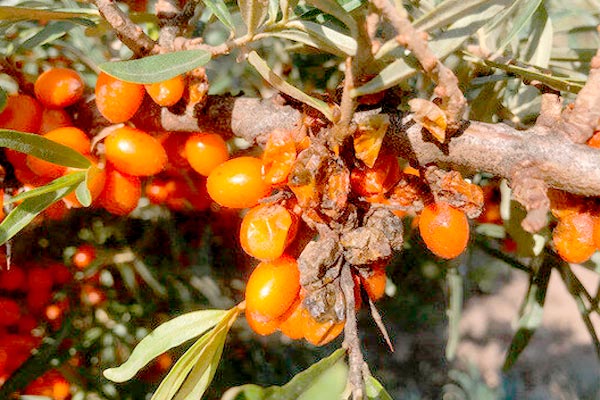
Damage caused by sea buckthorn fly (Rhagoletis batava)
Sea buckthorn is attacked by a number of diseases – powdery mildew, verticillium and fusarium wilt, moniliosis and others, and pests – green and black sea buckthorn aphid, sea buckthorn flea beetle, sea buckthorn fly, sea buckthorn moth, sea buckthorn mite. Many of these diseases and pests are not widespread in our country, but are widespread in countries close to us – Russia, Poland, Belarus, Germany, Latvia, Ukraine, therefore we will describe only those that occur in our country.
Verticillium and fusarium wilt (Verticillium spp., Fusarium spp.)
Complete dieback of individual shoots is observed, which develops within a short time. Initially, the leaves lose their bright colour and turgor. Then rapid yellowing and leaf fall occur. Within a few days the plant may lose its leaves, except for a tuft of young leaves at the shoot tips; fruits may colour prematurely and remain shrivelled on the twigs. On the bark, orange or pink-red swellings appear with cracks emerging from them.
The causal agent infects plants through wounds on the roots, stems and twigs. When damage to the roots is detected, the affected plants must be uprooted immediately. In other cases, the affected parts are cut out and removed in good time.
The pathogen develops more often where vegetables – tomatoes, potatoes, peppers and strawberries – are grown together with sea buckthorn.
References:
1. Mondeshka, P., 2005. Medicinal fruit plants. Zemizdat.
2. Stoyanova, N., V. Antonova, D. Serbezova, 2018. Sea buckthorn. Agricultural Academy – Sofia, Institute of Agriculture – Kyustendil.
3. Drevinska, K., I. Moročko-Bičevska, 2022. Sea buckthorn diseases caused by pathogenic fungi. In Proceedings of the Latvian Academy of Sciences, 76(4): 393-401.
4. Kummer, V., D. Hanelt, P. Hanelt, H. Jage, H. John, H. Richter, U. Richter, B. Schultz. Phyllactinia hippophaës (Erysiphales) rediscovered in Germany. Polish Botanical Journal, 55(2): 409-416.
5. Moskalets, V., T. Moskalets, M. Kliuchevych, N. Pelekhata, M. Svitelskyi, 2022. Sea buckthorn gall mite (Aceria hippophaena Nal.) in the orchards of sea buckthorn (Hippophae rhamnoides L.) and elements of its control agrotechnology. Scientific Horizons, 25(12): 51-59.
6. Shalkevich, M. S., N. Y. Koltun, R. I. Pleskatsevich, 2015. Sea buckthorn pests and diseases in Belarus. Natural resources and bioeconomy studies, 31: 83-86.
7. Zalewska, E. D., G. Zawislak, E. D. Król, 2023. Fungi inhabiting aboveground organs of sea buckthorn (Hippophae rhamnoides L.) in organic farming. Acta Agrobotanica, 76: 168497.