

![MultipartFile resource [file_data]](/assets/img/articles/заглавна-no-till-технология.jpg)
Summary
Organic vegetable production is based on the main requirements for organic production and is aligned with the characteristics and specific requirements of vegetable crops. Some of the key elements for successful production on the farm are: soil health, the use of cover crops and weed control. The application of no-till technology in crop cultivation without soil tillage, through direct sowing/planting, provides favourable benefits for the soil (reduces compaction, erosion, preserves moisture) and improves the productivity of agricultural land. The correct choice of crops according to their vegetation period allows for intensive use of the area through growing two, three, sometimes even four crops in one vegetation period.
No-till technology is one of the practices related to conservation tillage, the aim of which is to reduce soil erosion while keeping the soil surface covered with crop residues. Other practices that achieve a similar effect are strip-till, ridge-till and mulching, each characterized by a specific method of application, particularities, advantages and disadvantages.
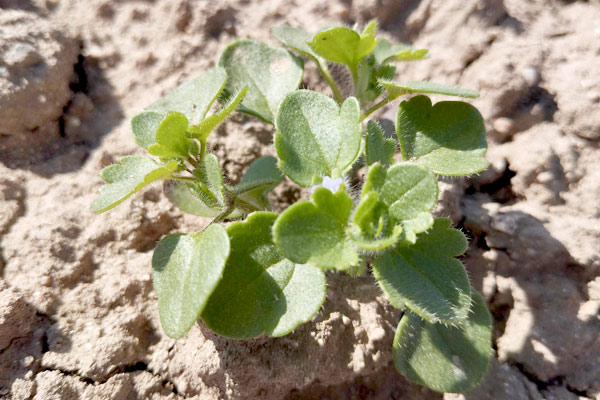
Ivy-leaved speedwell (Veronica hederifolia). An early spring weed, recorded on the no-till bed at the beginning of April 2024, after tillage operations were stopped.
To improve soil quality in organic vegetable production, conservation tillage is recommended, but its application may be hindered by difficulties in weed control and soil compaction. In some studies, the results have shown that the effect of this type of farming is closely related to soil and climatic conditions, field management practices, level and type of weeds, preceding crop, soil structure, etc. For a comprehensive assessment of the effect of no-till technology, observations cannot be limited to a few years and a significantly longer period of time is required.
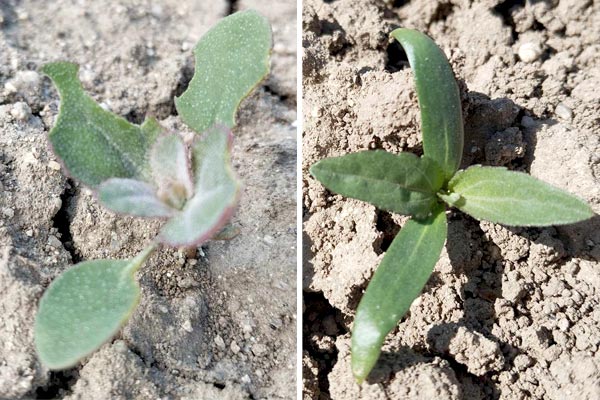
Garden orache (Atriplex hortensis) and Common cocklebur, Rough cocklebur (Xanthium strumarium L.). Early spring weeds, recorded on the no-till bed at the beginning of April 2024, after tillage operations were stopped.
In organic farming, a large number of soil tillage operations are applied, mainly for weed control, but they also include soil preparation before sowing/planting, incorporation of catch crops, application of organic fertilizers, and maintenance of a friable soil structure. Nevertheless, farmers show increasing interest in no-till technology in order to reduce the following problems: soil compaction due to repeated mechanized tillage; formation of a soil crust that can prevent proper seed wetting, increasing irrigation losses by up to 35%; negative impact on soil biological organisms. According to FAO, conservation agriculture relies on three main principles: minimal soil disturbance, permanent soil cover and diversified crop rotation.
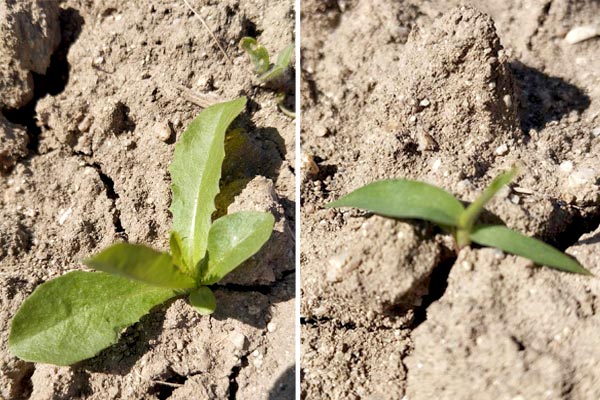
Prickly lettuce (Lactuca serriola) and Large crabgrass (Digitaria sanguinalis). Early spring weeds, recorded on the no-till bed at the beginning of April 2024, after tillage operations were stopped.
Conservation tillage is characterized by several major issues. For greater clarity, a comparison is made with conventional tillage, where the working parts of agricultural machinery reach a depth of about 20 cm. The differences in tilled depth and degree of soil fragmentation, due to the different tools, have different effects on soil structure. This has a positive effect on the homogeneous redistribution of organic matter in the cultivated soil layer and on weed control through deeper incorporation of weed seeds, depending on the agricultural machinery used. Stopping soil tillage prevents the formation of a soil crust and protects against erosion by leaving crop residues (organic matter) on the surface. More stable aggregates have been measured in the upper soil layer under conservation tillage compared to ploughing. In addition, several studies have shown that the absence of tillage increases soil organic carbon, as well as the abundance, species diversity and activity of microorganisms in this soil layer. The lack of tillage also leads to an increase in the biomass and diversity of earthworms, preserving their habitat and promoting water infiltration and root system development. The increase in earthworm abundance enhances biologically formed macroporosity in the deeper soil layers.
Questions arise regarding the impact of no-till technology on soil fertility and crop productivity. There is a tendency for an increase in organic matter in the first 10 cm of soil due to the accumulation and decomposition of crop residues on the surface, but it decreases sharply in the lower soil layers. A decrease in total porosity is observed in the soil layers that are not mechanically fragmented, especially in soils with low shrink-swell activity (sandy soils). Conversely, in poorly drained clay soils, conservation tillage tends to exacerbate problems. A solution may be found by replacing “mechanical” porosity with “biological” porosity resulting from the burrowing activity of earthworms. On the other hand, soil compaction and reduced organic matter in the deeper soil layers can limit the activity of soil microorganisms. In this respect, two issues arise for which long-term solutions must be sought. The first concerns the abundance of earthworms, the effectiveness of their activity in maintaining and improving macroporosity in the soil under no-till technology, and whether this activity is sufficient for the optimal functioning of the soil-plant system. The second issue relates to the reduced microbial activity in the deeper soil layers and what the consequences will be for the sustainable management of nutrients.
In organic farming, the adaptive and productive qualities of cultivated crops depend on soil biological processes for nutrient uptake. Soil fertility in organic farming tends to be higher than in conventional farming, due to higher organic matter content, richer soil micro- and macrofauna, and the activity and diversity of earthworms. Thus, conservation tillage techniques that alter soil fertility could strongly affect nutrient content, water properties, weed abundance and the entire crop production system – yield quantity and stability, weed species and abundance. Weed infestation is a significant problem in vegetable production. The ban on herbicide use and the cessation of in-season tillage allow weeds to reach critical levels, become strong competitors to cultivated plants and compromise the crop. On the other hand, they reach full development, produce seeds and multiply to a great extent, which will severely hinder the vegetation of vegetable crops in the following year. Therefore, weed control is a major problem for organic vegetable cultivation and must be well adapted under no-till technology in this type of farming, especially considering that crop residues left on the soil surface limit the practice of mechanical weeding. The main challenges for adopting no-till technology are to preserve soil fertility and to implement effective weed control.
Organic cultivation of crops in combination with no-till technology is characterized by greater microbial biomass and better mineralization of total C and N in the upper soil layer (about 15 cm). These findings emphasize that the increased microbial biomass and their activities in this soil layer compensate for their reduction in the deeper layers due to the lack of fresh organic matter and greater compaction of soil particles. The soil microclimate at the surface (temperature and moisture) plays a crucial role in the mineralization of nitrogen and carbon, and under conservation tillage these soil conditions may slow down the process.
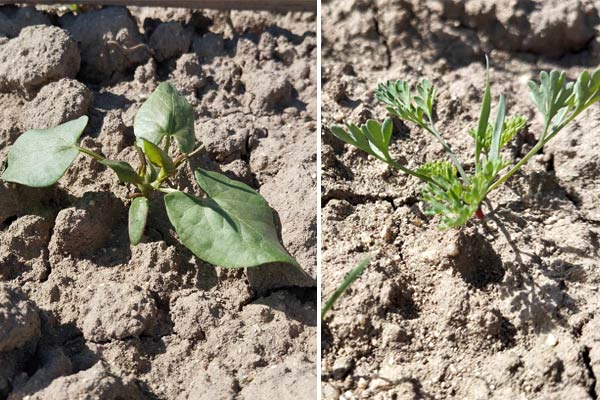
Black bindweed (Polygonum convolvulus L.) and Common fumitory (Fumaria officinalis). Early spring weeds, recorded on the no-till bed at the beginning of April 2024, after tillage operations were stopped.
Weed control can be achieved by designing an appropriate crop rotation, alternating sowing seasons, using biennial crops, and exploiting the competitiveness of varieties, in combination with conservation tillage practices in organic vegetable production. The cultivation of legumes – garden pea and common bean – is suitably combined with late crops, which at the same time suppress the development of early and late spring weeds, reduce their density, and when individual stronger weed plants appear, mechanical cleaning of the stand is carried out. After harvesting at commercial maturity, the leafy-stem mass can be cut and left on the soil surface as a living mulch.
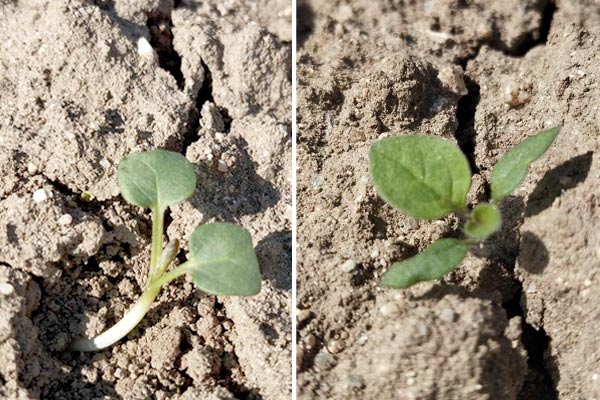
Field bindweed (Convolvulus arvensis) and Black nightshade (Solanum nigrum). Early spring weeds, recorded on the no-till bed at the beginning of April 2024, after tillage operations were stopped.
Weed control can be carried out by mowing the weeds at a height of 1–2 cm above the soil surface after the emergence of vegetable plants in direct sowing, or before transplanting. This activity limits their growth and they do not compete with the cultivated plants for light. Left on the soil surface, the mown weed vegetation dries out and serves as mulch that retains soil moisture. Limiting weed growth and development by mowing does not allow them to reach flowering and seed formation stages and thus restricts their spread in the following year. Control of annual weeds is easily achieved by mowing at a certain interval of time, but combating perennial grasses is much more difficult, the most dangerous of which is Johnsongrass. Limiting the spread of this weed species can only be achieved by mechanical removal at an early stage of its development.
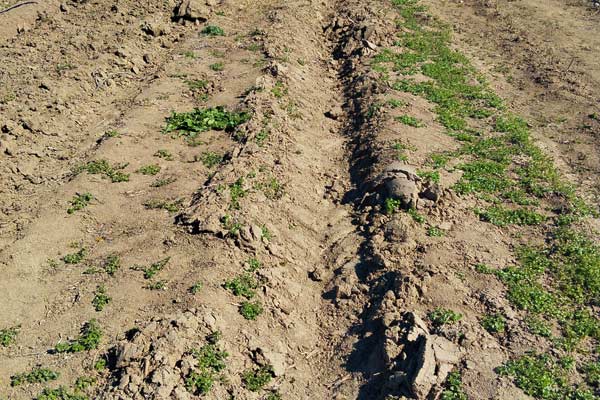
The two beds – no-till (on the left) and with tillage (on the right) – one year later, at the end of March 2025, where the reduced weed density on the bed without tillage can be seen.
Under conservation tillage, soil compaction and increased stability of soil aggregates are observed. During the first 2 years of transition from ploughing to reduced or very reduced tillage, an increase in compacted zones in the soil profile has been observed; however, after 5–6 years, earthworm activity and soil cracking have helped roots pass through these compact zones. Therefore, more long-term research is needed in order to draw conclusions about soil compaction under conservation tillage and the effect on the soil-plant system.
Another significant problem in organic vegetable production is the profiling of the soil surface, which is carried out according to the biological characteristics of the cultivated crops and hinders the application of no-till technology for some vegetable species. This concerns those that require the formation of high beds: garlic, onion, tomato, pepper, carrot, lettuce, head cabbage. For other crops, ridges are formed (potatoes), which also complicates their cultivation. No-till is applicable when they are grown on a flat surface, but this will affect their productivity. No-till technology is most easily implemented for crops with trailing stems from the Cucurbitaceae family and grown on a flat surface: watermelons, melons and pumpkins.
The following general conclusions can be drawn regarding the advantages and disadvantages of no-till technology in organic vegetable cultivation:
- By maintaining soil cover, no-till systems mitigate erosion; soil compaction caused by machinery tillage is reduced; they have a positive effect on moisture retention and improve soil structure, which leads to better aggregate stability and biological activity.
- Organic matter increases in the soil layer to a depth of about 15 cm.
- The activity of earthworms and soil microorganisms is preserved to a depth of up to 15 cm.
- In the deeper soil layers, the soil becomes compacted and poorer in organic matter.
- Weed control is difficult to carry out.
- It is difficult to apply to certain types of vegetable crops depending on their cultivation technology, which necessitates the development of new planting schemes.
- The cessation of soil tillage has a positive economic effect by reducing machine working time, energy consumption, machinery costs and depreciation.
Photos © Assoc. Prof. Dr. Tsvetanka Dincheva, Maritsa Vegetable Crops Research Institute, Plovdiv; Assoc. Prof. Dr. Emil Dimitrov, Nikola Poushkarov Institute of Soil Science, Agrotechnologies and Plant Protection, Sofia
References
1. Birkhofer K, Bezemer TM, Bloem J, Bonkowski M, Christensen S, Dubois D et al (2008) Long- term organic farming fosters below and aboveground biota: implications for soil quality, bio- logical control and productivity. Soil Biol Biochem 40(9):22–37
2. Blanco-Canqui H, Lal R (2007) Soil structure and organic carbon relationships following 10 years of wheat straw management in no-till. Soil Tillage Res 95(1–2):240–254
3. Bohlen PJ, Edwards WM, Edwards CA (1995) Earthworm community structure and diversity in experimental agricultural watersheds in Northeastern Ohio. The significance and regulation of soil biodiversity. Plant and soil 170:233–239
4. Fließbach A, Mäder P (2000) Microbial biomass and size-density fractions differ between soils of organic and conventional agricultural systems. Soil Biol Biochem 32(6):757–768
5. Gerhardt RA (1997) A comparative analysis of the effects of organic and conventional farming systems on soil structure. Biol Agric Hortic 14(2):139–157
6. Hole DG, Perkins AJ, Wilson JD, Alexander IH, Grice F, Evans AD (2005) Does organic farming benefit biodiversity? Biol Conserv 122(1):113–130
7. Holland JM (2004) The environmental consequences of adopting conservation tillage in Europe: reviewing the evidence. Agric Ecosyst Environ 103(1):1–25
9. Kay BD, VandenBygaart AJ (2002) Conservation tillage and depth stratification of porosity and soil organic matter. Soil Tillage Res 66(2):107–118
10. Kladivko EJ (2001) Tillage systems and soil ecology. Soil Tillage Res 61(1–2):61–76
11. Peigné J, Ball B, Roger-Estrade J, David C (2007) Is conservation tillage suitable for organic farm- ing? A review. Soil Use Manag 23(2):129–144
12. Peigné J, Vian JF, Cannavacciuolo M, Lefevre V, Gautronneau Y, Boizard H (2013) Assessment of soil structure in the transition layer between topsoil and subsoil using the profil cultural method. Soil Tillage Res 127:13–25
13. Peigné, J., Lefevre, V., Vian, J., Fleury, P. (2015). Conservation Agriculture in Organic Farming: Experiences, Challenges and Opportunities in Europe. In: Farooq, M., Siddique, K. (eds) Conservation Agriculture. Springer, Cham. https://doi.org/10.1007/978-3-319-11620-4_21
14. Pelosi C, Capowiez Y, Caro G, Guernion M, Hedde M, Peigné J et al (2013) Reducing tillage in cultivated fields: a way to improve soil functional diversity. Appl Soil Ecol (Forthcoming), DOI: 10.1016/j.apsoil.2013.10.005
15. Rasmussen KJ (1999) Impact of ploughless soil tillage on yield and soil quality: a Scandinavian review. Soil Tillage Res 53(1):3–14