

![MultipartFile resource [file_data]](/assets/img/articles/заглавна-сяра-пшеница.jpg)
Summary
With the growing need for sustainable agricultural practices, nano-fertilizers have emerged as an innovative alternative to conventional fertilizers. These advanced fertilizers improve nutrient use efficiency, promote crop growth and minimize environmental damage by enabling precise nutrient delivery. This review evaluates various techniques for applying nano-fertilizers and their impact on plant growth, yield and quality. Furthermore, it examines their interactions with soil composition and microbial communities, highlighting their role in enzyme activity and nutrient cycling. Although nano-fertilizers offer significant advantages, challenges such as proper dosage regulation, potential toxicity and long-term environmental effects require further research. This brief paper also presents the latest advances in nano-fertilizer technology and emphasizes the importance of an integrated approach to optimizing agricultural productivity while preserving soil health and environmental sustainability.

Bulgaria has unique natural conditions for cereal production, first and foremost the unrivalled baking quality of common winter wheat varieties. However, these opportunities are not fully realized. One of the main and necessary conditions for obtaining high wheat yields is the use of high-quality seed material with effective compounds on which seed germination depends (Erdem et al., 2016). The intensification of production includes the use of various fertilizers to optimize plant nutrition and pesticides to control pests, diseases and weeds in modern agriculture. The improvement of existing forms of the agricultural system is based on the wide application of plant protection products and agents and the reproduction of soil fertility, as well as the introduction of differentiated soil tillage systems, taking into account the biological requiremen ts of the crop.
Most chemicals used in modern agricultural production are synthetic and are not destroyed either by plant enzyme systems or by physical or chemical approaches. This leads to accumulation in the harvested produce, and consequently in the bodies of humans and animals.
The effectiveness of sulfur preparations and their combinations in wheat cultivation has been confirmed by information from the literature, and therefore they are recommended for use in agriculture.
Fungal pathogens causing brown rust in wheat can result in yield losses of up to 50–60%. One of the most effective methods of preventing these losses is the development of resistant varieties with high yield potential. Therefore, the main control strategy – genetic resistance – is used to control rust diseases in wheat, especially leaf rust. To date, host genetic resistance remains the most effective (El-Orabey et al., 2019).
It is known that sulfur helps to slow down oxidative processes in plants while increasing reduction processes, whereas cereals increase their viability and improve grain quality.
There is less research on the effect of sulfur on phosphorus and potassium uptake by plants than on nitrogen, and the findings are often contradictory (Shekel, 1979, Tisdale, 1974). A positive effect of sulfur on the uptake of phosphorus and potassium by plants together with nitrogen has been observed in calcareous sod-podzolic soils (Tserling, 1990, Shevyakova, 1983, Shkel, 1979). Researchers explain the improvement of plant nutrition with phosphorus and potassium under the influence of sulfur nanoparticles in these cases by the increased mobility of soil elements under the action of sulfuric acid (Svetlov et al., 1987, Archer, 1974). Thus, our research shows that the influence of sulfur-containing preparations is relevant and promising, but in practice has been carried out on an insufficient scale.
Studies on the effect of sulfur and calcium reveal the effectiveness of using sulfur to increase productivity (Ivanitsky, Ya.V., 2011, Maslova et al., 2008, Maslova, 2008), since sulfur deficiency in grain significantly affects the yield and quality of wheat grains (Zhao et al., 1999). Nitrogen cannot be used efficiently without sulfur, and protein content cannot reach its full yield potential. Moreover, sulfur is a component of several key compounds in crops, so sulfur deficiency is a limiting factor not only for growth and seed yield, but also for poor product quality (Singh, 2003). Limitation of sulfur availability contributes to the synthesis of low protein content (Flaete et al., 2005), reduces the size and quality of wheat grains due to the cessation of disulfide bond formation, formed by the sulfhydryl groups of cysteine (Gyori, 2005, McGrath, 2003). Wheat grain containing sulfur, measured as sulfur concentration in addition to nitrogen concentration, is the key to seed quality (Karimi and Mohsenzadch, 2015, Geiger, 2009, Whitesides, 2005) and its deficiency leads to a decrease in productivity. The results show similarity between CuO or ZnO in wheat plants with higher root toxicity associated with the smaller size of sulfur nanoparticles (Hasan et al., 2018, Dimkra et al., 2013, Tea et al., 2007).
Nowadays, the most promising area is the use of pre-sowing seed treatment with nanoparticles, as evidenced by the growth in sales volumes. A characteristic feature of the action of the active substances is that they intensify physiological and biochemical processes in plants and at the same time increase yield and stress resistance. Such regulators include natural and synthetic substances which, in small doses, actively influence plant metabolism (Burkitbayev et al., 2021). Intensive crop cultivation technology ensures full realization of the potential of plants to form high yields of good quality. The resistance of the studied varieties is confirmed by data on the ionic balance of Na+, K+ and Ca2+ in the primary roots of wheat (Terletskaya et al., 2019). In global agricultural practice, new high-yielding varieties, scientifically based crop rotations, and the rational use of mineral formulations and plant protection products are recognized as key factors in increasing yields. These techniques require high energy and material inputs and are not always environmentally safe. An acute problem of modern crop production at present is the production of environmentally friendly agricultural products and the reduction of anthropogenic pressure on the biogeocenosis (Monostori et al., 2017).
The indicator of the sulfur status in plants correlates significantly with the bioavailable sulfur in the soil. The indicator of sulfur in the shoot biomass is as follows: it affects sulfur concentration, the mass ratio of nitrogen to sulfur (N / S), the mass ratio of phosphorus to sulfur and the sulfur nutrition index. Bioavailable sulfur in the soil correlates significantly with the nitrogen to sulfur ratio in the shoots of winter wheat and winter oilseed rape.
Crops require nutrients for high yields; however, they can only absorb ionic forms of the elements. At this stage, microorganisms are beneficial because they convert organically bound nitrogen, phosphorus and sulfur into soluble ions such as NH 4 +, NO 3 –, H 2 PO 4 +, HPO 4 – and SO 4 –. Mineralization is the transformation of organic compounds into inorganic compounds, which is a biological process that depends on temperature, precipitation, soil properties, the chemical composition of plant residues, the structure and composition of microbial communities and the C:N ratio in the soil after the application of plant material. Adjusting the values of these factors makes it possible to determine the rate and direction of mineralization of plant residues in the soil.
Recommendations are not well developed for soil testing for sulfur content when growing crops in arid areas. To assess the significance of sulfur and nitrogen content in soil and tissue for predicting sulfur deficiency at sites, morphology is apparently observed, as the two minerals are often associated. Therefore, there is a likelihood of an increased response to sulfur application. It is recommended to maintain the use of the N:S ratio, which may indicate S deficiency for both barley and wheat (Conyers & Holland, 2020).
Sulfur dioxide (SO 2 ) plays a beneficial role in protecting plants from environmental stress. SO 2 increases the drought tolerance of young plants through H2S signalling and provides a new strategy for enhancing plant resistance to drought stress (Li et al., 2021).
The key to ensuring high soil fertility and increasing crop yields is balanced mineral nutrition for all elements, taking into account their content, distribution and transformation in the soil (Kulhanek et al., 2014). Sulfur stands alongside elements such as nitrogen, phosphorus and potassium – the second proteinogenic element after nitrogen. Sulfur deficiency, as well as nitrogen deficiency, reduces protein synthesis, while the external manifestation of sulfur starvation in plants almost coincides with the signs of nitrogen deficiency. Its absolute necessity for the processes of respiration, photosynthesis, nitrogen and carbohydrate metabolism has been established (Järvan, Edesi & Adamson, 2011).
Previously, plant sulfur nutrition was satisfied without additional effort, but now and in the future the resources for its entry into the soil are decreasing and the demand for it in agriculture is increasing due to the higher demand for high-quality agricultural products. The main reasons for the increase in sulfur deficiency are the lower sulfur dioxide content in the atmosphere, the increased use of highly concentrated and ballast-free compounds without sulfur, higher crop yields and increased sulfur removal (Matraszek et al., 2015)
It has been established that the application of nano-sulfur to soils with low sulfur content increases the coefficients of nutrient use from fertilizers, accelerates their translocation from vegetative organs to the grain. The sulfur agrochemical influences nitrogen metabolism in wheat plants, plays an essential role from the earliest stages of development in metabolism in the plant cell, which is closely related to the nitrogen cycle, since both elements are mandatory components of proteins. If there is a deficiency of one of the two elements, protein synthesis slows down and may completely stop in the absence of both (nitrogen and sulfur) available sources for plants (Maslova, 1993).
In a trial conducted in the period 2023/2024 in the organic field of the “IPGR K. Malkov” in the town of Sadovo, four varieties and five advanced lines of winter common wheat bred at the Institute were included: Sadovo 1, Pobeda, Avenue, Magiji, MH 258/3355, RU 251/268, BA 1325, BA 1378 and BA 1390. The effect of the Bulgarian liquid fertilizer Sulfeko on the productivity of the studied accessions was evaluated. The product was applied at different doses and growth stages of the crop.
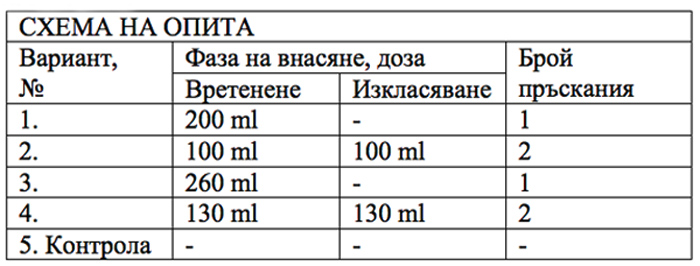
Table 1 Trial layout
The results are published in the report on project ZFTK 37 of the Agricultural Academy. The greatest plant height was recorded in variant No. 3, which included the maximum dose of the product applied once at the stem elongation stage. The highest total tillering was obtained in variant No. 3 and variant No. 5, while the maximum productive tillering was recorded in variant No. 4 and in the control plants. For the traits length of main spike, number of spikelets and number of grains in the main spike, maximum results were achieved with two applications of the product at a dose of 130 ml. The grain mass in the main spike and the grain mass per plant reached their optimum in variants No. 1 and No. 4, while the lowest values of these traits were recorded in the untreated plants (No. 5 control). The influence of the liquid fertilizer Sulfeko on grain yield is also pronounced, as for this indicator the studied genotypes achieved the lowest average yield in variant No. 5 (control, without spraying), and the maximum yield was recorded in variant No. 2, which included two applications of the product at a dose of 100 ml. The increase of the trait between the individual variants compared to the control is in the range from 13.3% (var. No. 1) to 18.4% (var. No. 2).
Scheme of application of the liquid fertilizer Sulfeko
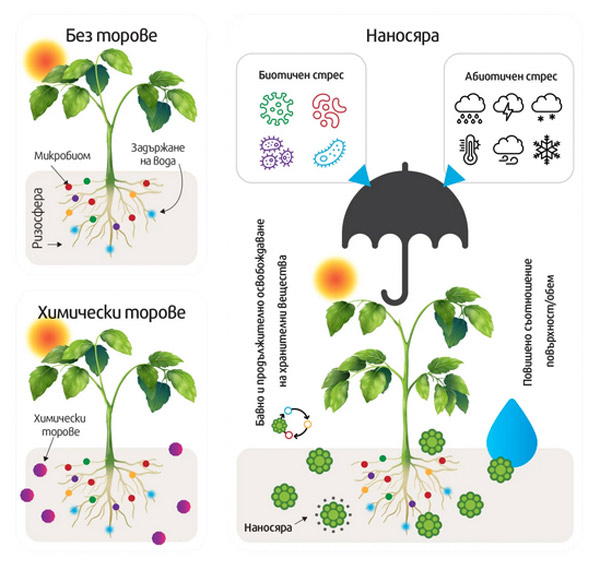
Nanostructured sulfur-containing growth stimulants affect the germination of wheat seeds.
In recent years, the global agricultural sector has been facing increasing challenges in enhancing crop productivity while promoting environmental sustainability. Although conventional fertilizers are effective, they often lead to significant nutrient losses through leaching, volatilization and fixation. These losses reduce nutrient use efficiency and contribute to environmental challenges (Geisseler, Scow, 2014). The introduction of nano-fertilizers in agriculture offers a potential solution to these challenges.
Nano-fertilizers are nutrient formulations encapsulated or coated with nanomaterials, allowing controlled nutrient release and gradual dispersion in the soil (Jithendar et al. 2024). Compared with conventional fertilizer options, nano-fertilizers provide several advantages, including improved nutrient use efficiency, reduced environmental impact, and enhanced agricultural output and product quality (Lazcano et al. 2024). This improvement is largely due to the nanoscale size of these fertilizers, which facilitates better uptake and penetration into plant tissues. In addition, the interaction between nano-fertilizers and soil microorganisms is a critical area of interest, as soil microbes are key organisms for soil nutrient cycling and plant growth (Lazcano et al. 2024). Optimizing application methods and doses of nano-fertilizers remains a key research area. Various techniques, including foliar sprays and root applications, have been investigated with varying degrees of success (Soni et al. 2024). The timing and frequency of application are also crucial factors that significantly affect crop responses and yield (Parameshnaik et al. 2024).
Concerns about the potential phytotoxicity and long-term impacts of nano-fertilizers on the soil ecosystem highlight the need for careful management of application doses (Bhadu et al. 2023). The integration of nano-fertilizers with conventional fertilization practices has shown promising results in various cropping systems. Such combined strategies improve nutrient use efficiency while preserving soil health (Kumar, Dahiya, 2024). This approach allows a reduction in the application rates of conventional fertilizers while maintaining or even improving yield (Vadlamudi 2022).
Conclusions
Nano-fertilizers have emerged as a promising innovation in agriculture, increasing nutrient efficiency, improving yields and reducing the environmental footprint of traditional fertilization methods. This review has examined various application techniques and their interaction with soil properties and microbial communities, highlighting their role in sustainable crop production.
The liquid fertilizer Sulfeko (nano-sulfur) has a positive effect on the productivity of varieties and lines of common winter wheat, enabling the achievement of higher yields under organic farming conditions.
The effect of the fertilizer on plant height, total tillering, productive tillering, length of the main spike and number of spikelets in the main spike is comparatively weaker, with the average values recorded between the different variants being close to those of the control.
Nano-fertilizers contribute significantly to the sustainable development of agriculture while ensuring soil health and environmental safety.
References
- Archer, 1974. A sand culture experiment to compare the effects of sulphur on five wheat cultivars (T. aestivum L.) Aust. J. Agric. Res., 25 (3) (1974), pp. 369-380, 10.1071/ar9740369
- Bhadu, A.; David, A.A.; Thomas, T.; Kumar, A. 2023, Effect of Inorganic Fertilizers, FYM and Nano Urea on Soil Health, Growth and Yield of Cluster Bean (Cyamopsis tetragonoloba L.) cv. HGS 563. Int. J. Plant Soil Sci. 35, 404–410.
- Burkitbayev M. , N. Bachilova, M. Kurmanbayeva, K. Tolenova, N. Yerezhepova, M. Zhumagul, A. Mamurova, B. Turysbek, G. Demeu, 2021. Effect of sulfur-containing agrochemicals on growth, yield, and protein content of soybeans (Glycine max (L.) Merr) Saudi J. Biol. Sci., 28 (1), pp. 891-900, 10.1016/j.sjbs.2020.11.033
- Conyers M.K. , J.E. Holland 2020. Sulfur and nitrogen responses by barley and wheat on a sandy soil in a semi-arid environment Crop & Pasture Sci. V, 71 (10), pp. 894-906, 10.1071/CP20280
- De Ruiter J.M. , R.J. Martin. 2001.Management of nitrogen and sulphur fertiliser for improved bread wheat (Triticum aestivum) quality N. Z. J. Crop Hortic. Sci., 29 (4), pp. 287-299, 10.1080/01140671.2001.9514190
- Dimkpa C.O. , D.E. Latta, J.E. McLean, D.W. Britt, M.I. Boyanov, A.J. Anderson 2013. Fate of CuO and ZnO nano- and microparticles in the plant environment Environ. Sci. Technol., 47 (9), pp. 4734-4742, 10.1021/es304736y
- El-Orabey, W.M., Hamwieh, A., Ahmed, S.M., 2019. Molecular markers and phenotypic characterization of adult plant resistance genes Lr 34, Lr 46, Lr 67 and Lr 68 and their association with partial resistance to leaf rust in wheat. J. Genetics 98. https://doi.org/10.1007/s12041-019-1122-1.
- Erdem H., M.B. Torun, N. Erdem, A. Yazıcı, I. Tolay, E. Gunal, F. Özkutlu.2016. Effects of different forms and doses of sulphur application on wheat J. Food Sci. Technol., 4 (11), pp. 957-961, 10.24925/turjaf.v4i11.957-961.837
- Flæte N.E.S. , K. Hollung, L. Ruud, T. Sogn, E.M. Færgestad, H.J. Skarpeid, E.M. Magnus, A.K. Uhlen. 2005. Combined nitrogen and sulphur fertilisation and its effect on wheat quality and protein composition measured by SE-FPLC and proteomics J. Cereal Sci., 41 (3) , pp. 357-369, 10.1016/j.jcs.2005.01.003
- Geiger Franz M. 2009. Second harmonic generation, sum frequency generation, and χ3: dissecting environmental interfaces with a nonlinear optical swiss army knife Annu. Rev. Phys. Chem., 60 (1), pp. 61-83, 10.1146/annurev.physchem.59.032607.0936
- Geisseler, D.; Scow, K.M. 2014, Long-term effects of mineral fertilizers on soil microorganisms–A review. Soil Biol. Biochem. 75, 54–63.
- Grzyb A, A. Wolna-Maruwka, A. Niewiadomska 2020. Environmental factors affecting the mineralization of crop residues Agronomy, 10 (12) p. 1951, 10.3390/agronomy10121951
- Gyori Z. 2005. Sulphur content of winter wheat grain in long term field experiments Commun. Soil Sci. Plant Anal., 36, pp. 373-382, 10.1081/CCS-200043098
- Hasan M.K. , C.X. Liu, Y.T. Pan, G.J. Ahammed, Z.Y. Qi, J. Zhou 2018. Melatonin alleviates low-sulfur stress by promoting sulfur homeostasis in tomato plants Sci. Rep., 8 (1), p. 10182, 10.1038/s41598-018-28561-0
- Ivanitsky, Ya.V., 2011. Influence of sulfur and calcium on grain productivity and quality of winter wheat grain. Krasnodar, Russia. 40 p. (in Russian).
- Järvan M., L. Edesi, A. Adamson, 2011. Effect of sulphur fertilization on grain yield and yield components of winter wheat, Acta Agriculturae Scandinavica, Section B - Soil Plant Sci. pp. 1-9, 10.1080/09064710.2011.630677
- Jithendar, B.; Kumar, R.; Rana, N. 2024. Revolutionizing Crop Nutrition: Exploring Nano Fertilizers in Agriculture. Int. J. Plant Soil Sci. , 36, 327–339.
- Kumar, K.; Dahiya, S. 2024. The comparative impact of chemical fertilizers, nano-urea and nano-DAP on growth and yield of wheat crop. Int. J. Adv. Biochem. Res. 8, 1133–1139.
- Lazcano, C.; Zhu-Barker, X.; Decock, C. 2021. Effects of organic fertilizers on the soil microorganisms responsible for N2O emissions: A review. Microorganisms , 9, 983.
- Li , H.L. Yi, X.P. Liu, H.X. Qi 2021. Sulfur dioxide enhance drought tolerance of wheat seedlings through H2S signaling Ecotoxicol. Environ. Saf., V:207 (2021), 10.1016/j.ecoenv.2020.111248
- Maslova I.Y.I., 1993. Diagnostics and regulation of nutrition of spring wheat gray. Novosibirsk:
- Maslova I.Ya, T.H. Yakusheva, I.N. Sharkov, 2008. Features of replenishment of the fund of sulfur available to plants in crops with different conservativeness of humus Agrochemistry, No. 3, pp. 5-14 (in Russian)
- Maslova I.Ya. 2008. The effect of aerotechnogenic substances containing sulfur on some agrochemically significant processes and properties of soils Agrochemistry, No. 6 (2008), pp. 80-94
- Matraszek, R., Chwil, S., Hawrylak-Nowak, B., Kozłowska-Strawska, J., 2015. Effect of sulphur and cadmium on macronutrient balance in spring wheat. Proc. Natl. Acad. Sci., India Sect. B: Biol. Sci. 87(3), 927–936. https://doi.org/10.1007/s40011-015-0658-y.
- McGrath, S.P.. 2003. Sulphur: a secondary? Not anymore! New Ag International. March 2003, pp. 70–76.
- Monostori I., F. Szira, A. Tondelli, T. Árendás, K. Gierczik, L. Cattivelli, A. Vágújfalvi 2017. Genome-wide association study and genetic diversity analysis on nitrogen use efficiency in a Central European winter wheat (Triticum aestivum L.) collection PLoS ONE, 12 (12), Article e0189265, 10.1371/journal.pone.0189265
- Parameshnaik, C.; Murthy, K.N.K.; Hanumanthappa, D.C.; Seenappa, C.; Reddy, Y.A.N.; Prakasha, H.C. 2024. Effect of Nitrogen Management through Nano Fertilizers on Growth, Yield Attributes and Yield of Maize (Zea mays L.). Asian J. Soil Sci. Plant Nutr. 10, 250–257.
- Ryant P. , L. Hřivna 2004. The effect of sulphur fertilisation on yield and technological parameters of spring wheat grain Pobrano z Agronomy Sci., 59 (4) (2004), pp. 1669-1678 https://www.czasopisma.up.lublin.pl/index.php/as/article/view/2044
- Sahota, T.S., 2006. Importance of Sulphur in Crop Production. Northwest Link, Published in Ontario Farmer, Dec. 13, 2005, 38 (42), Page B25 and Northwest Link, pp. 10–12.
- Sedlar Ondrej, Jiri Balik, Martin Kulhanek. 2021. Crop sulfur status in relation to soil sulfur determined using anion exchange membranes and Mehlich
Journal of Plant Nutrition Volume 44, 2021 - Issue 11 - Shevyakova N.I. 1983. Metabolism and physiological role of proline in plants under water and salt stress Plant Physiol., 30, pp. 768-782 (in Russian)
- Shkel, M.P., 1979. The use of sulfur-containing fertilizers. - Minsk: Urajay. 63 p. (in Russian).
- Singh, B.R., 2003. Sulfur and Crop Quality — Agronomical Strategies for Crop Improvement. Abstracts of COST Action 829 Meetings, Braunschweig, Germany (May 15-18, 35–36.
- Soni, S.K.; Dogra, S.; Sharma, A.; Thakur, B.; Yadav, J.; Kapil, A.; Soni, R. 2024, Nanotechnology in Agriculture: Enhancing Crop Productivity with Sustainable Nano-Fertilizers and Nano-Biofertilizers. J. Soil Sci. Plant Nutr. 24, 6526–6559.
- Stankowski S., G. Podolska, S. Kaczmarek, A. Jaroszewska, G. Hury, M. Sobolewska 2019. Influence of sulphur fertilization on yielding and chemical composition of grain of spring wheat (Triticum aestivum L.) grown in different habitat conditions J. Elementol., 24, pp. 1007-1023, 10.5601/jelem.2018.23.4.1743
- Svetlov, V.A., Shamsutdinov, I.Sh., Valnikov, I.U., 1987. Efficiency of sulfur-containing fertilizers. Chemistry 9, pp. 38–40 (in Russian).
- Tea I., T. Genter, N. Naulet, M. Lummerzheim, D. Kleiber 2007. Interaction between nitrogen and sulfur by foliar application and its effects on flour bread-making quality. J. Sci. Food Agric., 87 (15), pp. 2853-2859, 10.1002/jsfa.3044
- Terletskaya N. , Ulshan Duisenbayeva, Aiman Rysbekova, Meruert Kurmanbayeva, Irina Blavachinskaya. 2019. Architectural traits in response to salinity of wheat primary roots Acta Physiologiae Plantarum, 41 (9), p. 157, 10.1007/s11738-019-2948-0
- Tisdale S.L. 1974 Secondary nutrients in liquid fertilisers. Sulphur. Part 1 An introduction Fert. Solut., 18 , pp. 8-18
- Tserling, V.V., 1990. Diagnostics of nutrition of agricultural crops. Handbook. M.: Agropromizdat. 235 p. (in Russian).
- Vadlamudi, J.S.; Anitha, S.; Sawargaonkar, G.L.; Prameela, P. 2022, Effect of Combined Application of Non–Nano and Nano Fertilizers on the Growth, Yield and Oil Content of Sunflower under Semi-arid Conditions. Int. J. Plant Soil Sci. 34, 1102–1111.
- Whitesides George M. 2005 Nanosci., Nanotechnol., Chem., 1 (2), pp. 172-179, 10.1002/smll.200400130
- Zhao F.J. , M.J. Hawkesford, S.P. McGrath. 1999. Sulphur assimilation and effects on yield and quality of wheat J. Cereal Sci., 30 (1), pp. 1-17, 10.1006/jcrs.1998.0241