

![MultipartFile resource [file_data]](/assets/img/articles/заглавна-грах-русе.jpg)
Summary
High-quality seed material is of decisive importance for the quantity and quality of the obtained plant production. The mass production of pea seeds is significantly affected by abiotic (meteorological conditions) and biotic (attacks by diseases, pests and weeds) environmental factors, with one of the most dangerous pests being the pea weevil.
During the period 2018-2021 at the Institute of Agriculture and Seed Science “Obraztsov chiflik” – Ruse, the condition of the seeds of spring forage pea cultivar “Ruse 1”, which were used for sowing, was studied in order to determine its economic value and the seeding rate. It was established that as a result of the damage caused by the larvae of the pea weevil, the pea seeds lose part of their mass (up to 12.3%) and germination capacity (up to 64%). The lower germination of the spring forage pea seeds deteriorates the economic (sowing) value of the seeds. The low economic value of the seeds, in combination with the lower thousand seed weight, leads to large differences in the crop seeding rate over the years (from 13.563 to 29.902 kg/da).
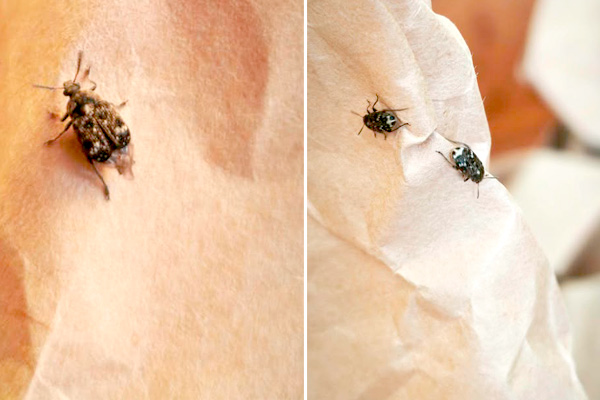
Cleaning, sorting and selection of the seed material are the main activities through which the agrotechnical method for control of harmful insects is implemented (Kharizanov and Kharizanova, 2018). These activities are of particular importance for the control of seed beetles and in particular of the pea weevil (Bruchus pisorum L.) – one of the most dangerous pests of the seeds of field forage pea in the world and in Bulgaria (Ilieva and Dochkova, 2000; Mendesil et al., 2016). Globally, infestation levels of pea seeds vary from 10 to 90%. As a result of their vital activity, seed beetles damage the seeds, which is expressed in weight loss, reduced germination, deterioration of nutritional qualities and economic losses due to the reduced market value of the seeds. Burns and Briggs (2001) report damage to pea seeds ranging from 42 to 82% in the United States, and Baker (1998) – 15-20% in South Australia, with infested seeds losing up to 25% of their weight as a result of larval feeding. In Bulgaria, Ilieva and Dochkova (2000) indicate that the degree of damage caused by pea weevil to seeds of spring forage pea is high and in some cultivars reaches 46.5%. At the same time, damaged seeds lose 21.3-32.4% of their weight and 84-100% of their germination capacity (Dochkova and Naneva, 1995). In addition, damaged seeds are prone to fragmentation during harvesting and germination, the health status of the seedlings is seriously affected, and due to the presence of cantharidin (in the insect body and its excrements) they are dangerous for consumption by humans and animals (Lecheva, 1989).
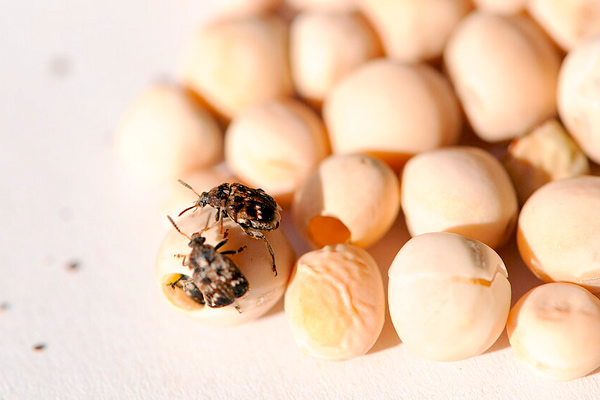
Early-flowering cultivars of winter and spring forage pea are more heavily attacked by pea weevil compared to medium-early and late-flowering cultivars, due to the coincidence of the mass flight of the weevil with the mass flowering of the pea and the formation of the first green pods (Dochkova et al., 1990). Spring forage pea cultivars do not contain condensed tannins in the seed coat, which is a prerequisite for a higher degree of damage to the seeds compared to wintering cultivars (Ilieva and Dochkova, 1999).
According to FAO data, in the period 2018-2021, in Bulgaria the areas under peas have halved, the yield fluctuates with a decreasing trend, as a result of which the total quantity of grain production decreases (Table 1).

The aim of the present study is to determine the condition of the seeds of spring forage pea cultivar “Ruse 1”, which will be used for sowing, with a view to determining their economic value and the seeding rate.
Material and methods
The study was conducted during the period 2018-2021 in the experimental field of the Institute of Agriculture and Seed Science “Obraztsov chiflik” – Ruse. The field forage pea “Ruse 1” was bred at the Institute of Agriculture and Seed Science “Obraztsov chiflik” – Ruse. Its vegetation period is 72-91 days and it belongs to the group of medium-early maturing pea cultivars. The pods are multi-seeded (4-7 seeds) with a smooth surface. The seeds are spherical in shape, the seed coat is yellow. The average number of seeds per plant is 50. Thousand grain weight – 283.9 g. Crude protein content in the grain – 23.15%. The good drought tolerance and high adaptability of the cultivar allow it to be grown in all regions of the country (Patenova et al., 2007).
The pea crops were grown using conventional technology, which includes two insecticide treatments (at the beginning and at the end of flowering) with a product registered for control of pea weevil (Decis 2.5 EC).
During the preparation for sowing, bulk samples (about 500 g) of seeds were taken in three replications and the following indicators were recorded:
- thousand seed weight – by weight, according to the Methodology for sampling and analyses for purity, germination and thousand grain weight, 2009
- damaged seeds – number in a sample of 100 seeds, visual assessment
- weight loss as a result of the vital activity of the pea weevil larva, in percent – according to the formula of Adams and Schulter (1978)
- germination – in percent, according to the Methodology for sampling and analyses for purity, germination and thousand grain weight, 2009
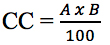
The economic value of the seeds was calculated by the formula:
where
EV – economic (sowing) value
A – seed purity, %
B – seed germination, %
and is used for determining the seeding rate, kg/da
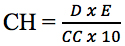
where
SR – seeding rate
D – thousand seed weight, g
E – number of plants per 1 m2
EV – economic value (Trankov et al., 1993)
The differences between the variants were tested using one-way analysis of variance (ANOVA). The statistical evaluation of the data was performed with the Statgraph software (P ≤ 0.05).
Results and discussion
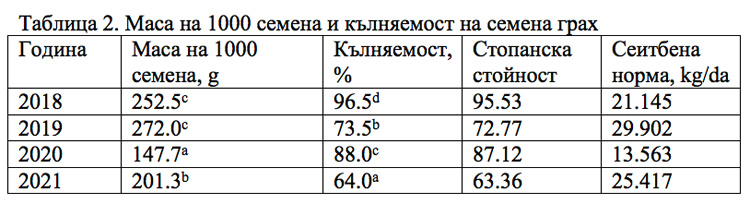
Thousand seed weight is the main component of yield and is used as a measure of seed size, which can vary depending on many factors, including meteorological conditions (AGRI-FACTS, 2018). Over the four years under study, the recorded thousand seed weight varied from 147.7 to 272.0 g and is lower compared to the data presented by the breeders of the cultivar (Table 2). This is explained by the unstable agrometeorological conditions of the region, which have had an adverse effect on the spring forage pea crops in recent years (Gintchev and Zhekova, 2021). Water stress and extreme temperatures are limiting factors. Water deficit also affects the ability to fix atmospheric nitrogen (Benezit et al., 2017).
Legend: Values followed by different letters in each column are significantly different at P ≤ 0.05.
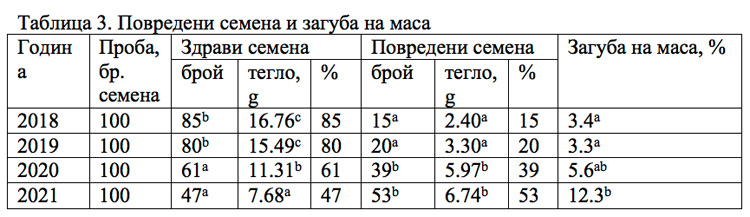
The damaged seeds, as a result of the vital activity of the pea weevil larvae and the emergence of adults of the new generation, are presented in Table 3.
Legend: Values followed by different letters in each column are significantly different at P ≤ 0.05.
The damaged seeds vary from 15 to 53%, with a noticeable increasing trend over the years studied. The two insecticide treatments with Decis 2.5 EC proved to be an ineffective method for controlling pea weevil, probably due to resistance of the species and/or shortcomings in its application. With an increase in the proportion of damaged grains, the healthy ones logically decrease – from 85 to 47%. As a result of the increase in the percentage of damaged seeds, the weight loss in the seed material also increases (Table 3). The calculated weight loss reached its highest level in the last year of the study – 12.3%.
The increase in the percentage of damaged seeds has a direct effect on seed germination, which for the study period decreased from 96.5 to 64% (Table 2). Such a decline in germination, due to the large number of damaged seeds, is consistent with the findings of other researchers and is explained by the fact that during its development in the seed, the pea weevil larva feeds by destroying the embryo and a large part of the endosperm, as a result of which the seeds do not germinate or germination is reduced (Nikolova and Georgieva, 2015; Nikolova, 2022).
Conclusions
As a result of the damage caused by the larvae of the pea weevil, pea seeds lose part of their mass (quantitative damage) and germination capacity (qualitative damage).
As a result of the lower germination of spring forage pea seeds, the economic (sowing) value of the seeds deteriorates (decreases).
The low economic value of the seeds, in combination with the lower thousand seed weight, leads to large differences in the crop seeding rate over the years.
References
1. Gintchev G., E. Zhekova. 2021. Study of the influence of agrometeorological conditions on the productivity of spring forage pea. Journal of Mountain Agriculture on the Balkans, 24 (6), 251-266.
2. Dochkova B., D. Naneva. 1995. Study on the losses caused by Bruchus pisi L. and the role of Sigalphus thoracicus West in their reduction in different cultivars and lines of spring forage pea. Problems of breeding, seed science, seed production and agrotechnics. Ruse, Scientific Works II, 191-195.
3. Dochkova B., D. Naneva, S. Suchanski. 1990. Study on the degree of infestation of winter and spring forage pea cultivars by pea weevil (Bruchus pisorum L.). Breeding, seed production and agrotechnics of field crops. Ruse, Vol. I, 204-210.
4. Lecheva I. 1989. Protection of seed peas from pests. Zemedele, 3, 51-53.
5. Ilieva A., B. Dochkova. 1999. Biochemical evaluation of forage pea cultivars and lines with a view to breeding for resistance to pea weevil Bruchus pisi L. (Coleoptera: Bruchidae). Acta Entomologica Bulgarica, 2,3,4, 37-40.
6. Nikolova I. 2022. Influence of Bruchus pisorum L. (Coleoptera: Chrysomelidae) on seed viability in spring pea genotypes. Journal of Mountain Agriculture on the Balkans, 25 (1), 222-244.
7. Patenova G., L. Nenova, I. Venkova. 2007. Biological and economic characteristics of some forage pea cultivars. In: International Scientific Conference “Plant gene pool – basis of modern agriculture”, Sadovo, I, 247-248.
8. Trankov I., G. Moskov, M. Doikova, G. Pepelyankov, B. Rangelov, D. Bahariev. 1993. Cultivation of agricultural crops. Dionis, Sofia, 82-88.
9. Kharizanov A., V. Kharizanova. 2018. Agricultural Entomology. Academic Publishing House of the Agricultural University, Plovdiv, p. 64.
10. AGRI-FACTS. 2018. Using 1,000 kernel weight for calculating seeding rates and harvest losses (available at www.open.alberta.ca/publications/3989714 )
11. Adams J.M., G.G.M. Schulter. 1978. Losses caused by insects, mites and micro-organisms. In K.L. Harris & C.J. Lindblad eds. Postharvest grain loss assessment methods, pp. 83-95. New York, American Association of Cereal Chemists. 193 pp.
12. Baker G. 1998. Fact sheet: pea weevil agdex: 430/662. Urrbrae: Primary Industries and Resources and South Australian Research and Development Institute.
13. Benezit M., V. Biarnes, M.-H. Jeuffroy. 2017. Impact of Climate and Diseases on Pea Yields: What Perspectives with Climate Change?. Oilseed & Fats Crops and Lipids, 24(1), D103.
14. Burns J.W., D.E. Briggs. 2001. Pea aphid and pea seed weevil control in dried pea. Effects on yield and yield components from insecticide application timings. Wallingford: CABI.
15. Ilieva A., B. Dochkova. 2000. Biochemical evaluation of forage pea genotypes with a view to breeding for resistance to pea weevil Bruchus pisi L. Bulgarian Journal of Agricultural Science, 6, 169-174.
16. Mendesil E., B. Rämert, S. Marttila, Y. Hillbur, P. Anderson. 2016. Oviposition preference of pea weevil, Bruchus pisorum L. among host and non-host plants and its implication for pest management. Frontiers in Plant Science, 6, 1166.
17. Nikolova I., N. Georgieva. 2015. Evaluation of damage caused by Bruchus pisorum L. (Coleoptera: Chrysomelidae) on some parameters related to seed quality of pea forage cultivars (Pisum sativum L.). Journal of Central European Agriculture, 16 (3), 330-343.
18. https://www.fao.org/faostat/en/#data/QCL 26.02.2025