

![MultipartFile resource [file_data]](/assets/img/articles/цветояд-синап.jpg)
Summary
The concept of weed in agriculture refers to any wild or semi-cultivated species that occurs in a crop of cultivated plants against the will of humans. The harmful effect of weeds manifests itself everywhere, annually or throughout the entire growing season, in all crops and plantations. Weeds worsen the conditions for the development of cultivated plants, as they absorb moisture and nutrients from the soil, suppress or shade the cultivated plants, draw nutrients directly from the plants, contribute to the development and spread of diseases and pests of cultivated species (as they are their primary or intermediate hosts), hinder mechanized operations, deteriorate product quality, etc. Their strong adaptability to environmental conditions makes them a serious problem for the normal growth and development of agricultural crops worldwide. This review summarizes data from studies in Bulgaria and abroad on weeds that are hosts of economically important diseases and pests of agricultural crops.
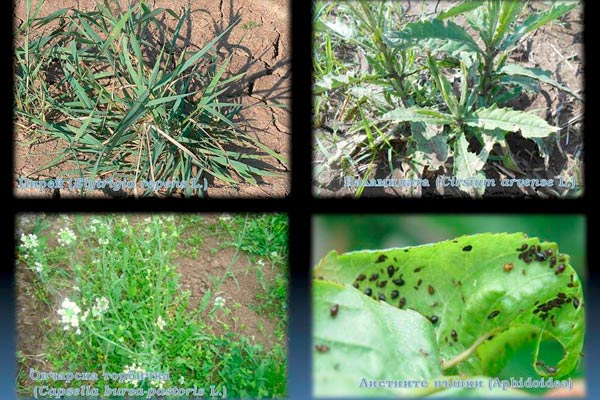
It is known that weeds are among the main harmful factors in agriculture. In arable land, weeds are the main competitors of agricultural crops with respect to water and nutrients, suppress growth, reduce yields and the profitability of production per unit area. Their strong plasticity and competitiveness in relation to environmental conditions makes them a serious problem for the normal growth and development of agricultural crops. However, the harmful impact of weeds is not limited only to their competition for the main vegetation factors; they also promote the spread of most pests and disease agents by creating foci for their multiplication, hinder the mechanized cultivation of crops, increase the cost of soil tillage, harvesting, etc.
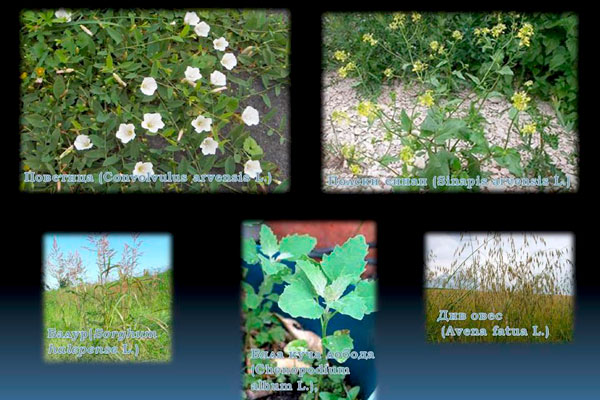
The present review aims to summarize data from studies in Bulgaria and abroad regarding weeds that are hosts of economically important diseases and pests of agricultural crops.
Many weeds and cultivated plants are attacked by the same diseases (fungal, bacterial, viral) and pests (various species of stink bugs, various species of weevils, aphids, thrips and other pests), which during the vegetation of the crops and after harvest become foci for their spread. A large number of harmful insects, before crop emergence, feed on weed plants, which support the development of these insects during periods when there is no suitable food for them.
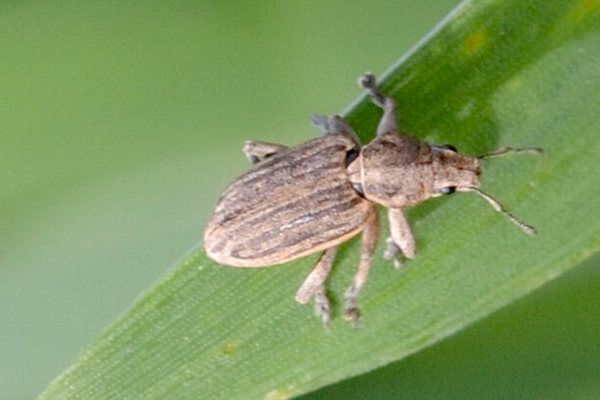
Grey corn weevil
For example, creeping thistle (Cirsium arvense L.), couch grass (Elytrigia repens L.), Bermuda grass (Cynodon dactylon L.) and speedwell species (Veronica ssp.) are a preferred food for the grey corn weevil, which is a dangerous pest of maize, but also attacks wheat, barley, sunflower, pea, bean, etc. Couch grass (Elytrigia repens L.) and Bermuda grass (Cynodon dactylon L.) are also hosts of ergot, which is the sclerotial form of the fungus Claviceps purpurea that mainly attacks rye. Some of the causal agents of root rot in wheat also attack the roots of couch grass (Elytrigia repens L.).
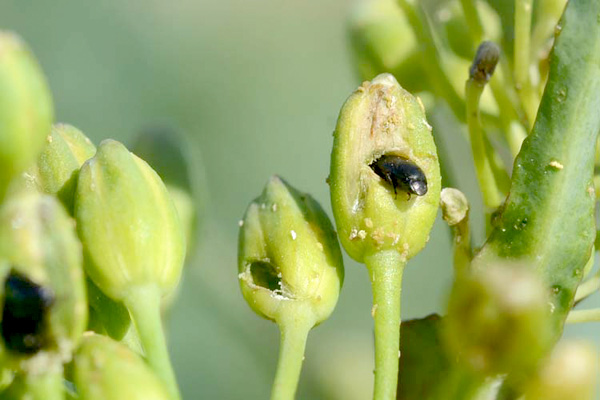
Rape blossom beetle
In recent years, areas with oilseed rape have been cultivated, and it should be noted that this crop is heavily attacked by the rape blossom beetle (Meligethes aeneus F*), which causes major damage to this crop. The rape blossom beetle also attacks cruciferous weeds – wild mustard (Sinapis arvensis L.) and wild radish (Raphanus raphanistrum L.), but does not prevent their seed formation. Flea beetles of the genus Phyllotreta and the cabbage stem flea beetle (Psylliodes chrysocephala L.) in autumn initially feed on cruciferous weeds wild radish (Raphanus raphanistrum L.), wild mustard (Sinapis arvensis L.), and later move onto rape plants and, when occurring in large numbers, are capable of causing significant damage. In rape fields, the cabbage aphid (Brevicorynae brassicae L.) parasitizes various weed and cultivated plants. Wild mustard (Sinapis arvensis L.) is also attacked by the causal agents of white rust and clubroot, which are dangerous diseases of cruciferous crops.
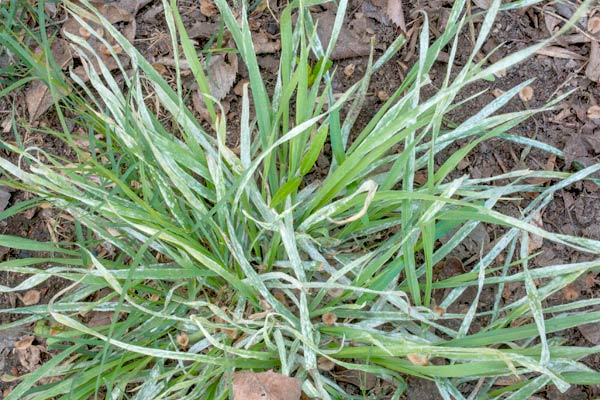
Powdery mildew
A number of grass weeds, such as ryegrass species (Lolium ssp.), brome species (Bromus ssp.), wild oat (Avena fatua L.), barnyard grass (Echinochloa crus-galli L.), etc., serve as a reservoir for the causal agents of some diseases of cereal crops (powdery mildew, fusarium diseases, wheat streak mosaic, wheat mosaic virus and others) and of some pests (striped cereal flea beetle, Hessian fly, black wheat fly, etc.). Timely and successful control of these weeds would greatly limit the spread of the pest and would assist in its control.
A large number of weeds are also hosts of aphids. The presence of creeping thistle (Cirsium arvense L.), field bindweed (Convolvulus arvensis L.), wild mustard (Sinapis arvensis L.), redroot pigweed (Amaranthus retroflexus L.) and shepherd’s purse (Capsella bursa-pastoris L.) represents so-called food hosts of the cotton aphid and the tobacco thrips and largely determines their occurrence and spread in agricultural areas.
Johnson grass (Sorghum halepense L.), couch grass (Elytrigia repens L.), green foxtail (Setaria viridis L.), yellow foxtail (Setaria glauca L.), brome species (Bromus ssp.), wild oat (Avena fatua L.) are hosts of the virus causing wheat mosaic virus. The yellow mosaic virus and potato Y virus have been identified on common purslane (Portulaca oleracea L.), broadleaf plantain (Plantago major L.), black nightshade (Solanum nigrum L.) and smallflower galinsoga (Galinsoga parviflora Cav.). Chickweed (Stellaria media L.) transmits cucumber mosaic virus to tobacco and pepper through its seeds, while common lamb’s quarters (Chenopodium album L.) is a host of the viruses causing bean yellow mosaic, alfalfa mosaic and beet mosaic.
Conclusion
To achieve a high agri-biological and economic effect in weed control, it is necessary to apply a scientific approach. The great biological diversity of harmful vegetation, their different sensitivity to modern herbicides and other control methods necessitate systematic assessment of weed infestation levels and making operational decisions to maintain lower weed density. Modern agriculture has at its disposal a large number of methods, each of which has specific possibilities for weed control. The most appropriate, economically most effective and environmentally safest approach is integrated weed control. It includes the application of various methods and means – mechanical, physical, chemical, biological, etc., which are combined in a differentiated way according to the composition of the weed vegetation, the economic thresholds of weed harmfulness and the specific agroecological conditions.
*The rape blossom beetle (Meligethes aeneus F) has an updated Latin name – Brassicogethes aeneus Fabr.
References
1. Dimitrov Ya., M. Dimitrova, N. Palagacheva. 2015. Weed associations in winter oilseed rape – an environment for multiplication of economically important pests of agricultural crops. Scientific Works of the University of Ruse, 54 (1.1), 152-155.
2. Dimitrova M. et al., 2004. Methodology for assessment and mapping of weed infestation in major field crops. MAF, NSPI, Sofia.
3. Kalinova Sht., I. Zhalnov, G. Dochev. 2012. Review of the indirect damage from weeds as hosts of diseases and pests of cultivated plants. Scientific Works, Agricultural University – Plovdiv, LVI, 296-300.
4. Serafimov, Pl., Tsv. Dimitrova. 2009. Determination of survivability and recovery ability of soybean stands under natural background of weed infestation. Journal of Mountain Agriculture on the Balkans, 12 (5), 1012-1026.
5. Stoimenova, I, Y. Kirkova. 1996. Competitive relationships between soybean and redroot pigweed under different water regimes. Plant Science, No. 7.
6. Tonev T., M. Dimitrova, Sht. Kalinova, I. Zhalnov, I. Zhelyazkov, A. Vasilev, M. Tityanov, A. Mitkov, M. Yanev. 2019. Herbology, Videnov i sin
7. Stoimenova, I., A. Mikova. 1993. Interference between Echinochloa crus-galli and soybean. Non chemical weed control Dijon, 5-9. VII, p.344-348.
8. Stoimenova, I., S. Alexieva. 2000. A competition between maize and weeds at mixed type of infestation. ISIAIT, 1-4. 12. 2000, Beijing, China. Progress of Agricultural Information Technology, 85-88