

![MultipartFile resource [file_data]](/assets/img/articles/заглавна-no-till.jpg)
Summary
No-till agriculture, also known as no-plough cultivation and regenerative agriculture, is defined as sowing crops without prior soil preparation or into an existing cover crop/plant residues and eliminating subsequent soil tillage operations.
This method of cultivation is considered to preserve soil and plant health. The practice is mainly focused on field crops such as wheat and maize; good results have been obtained and its application is recommended, as it provides favourable benefits for the soil and improves the productivity of agricultural land. The cultivation method is poorly studied in horticulture and it is time for more detailed research. Growing crops without soil tillage minimizes the destruction of soil structure, prevents soil compaction and protects against the formation of soil crust. Initial studies have been carried out on the productivity of the main vegetable crops for the country – tomato, pepper and head cabbage, grown under organic field conditions at the Maritsa Vegetable Crops Research Institute, Plovdiv in 2024.
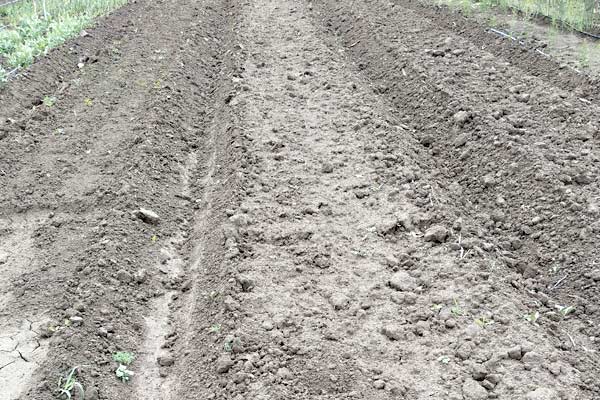
Tilled bed in spring, after ploughing and rough shaping, left as a variant for regenerative agriculture
Vegetable crops in the country are mainly grown on raised beds. Profiling of the soil surface is the penultimate step in a series of activities for soil preparation, which include deep tillage during winter, several cultivations with a disc/tooth harrow or rotary cultivator in spring, rough and fine shaping of the beds in summer, with the aim of creating optimal conditions for planting the crops and destroying weed vegetation. Following this sequence, it would be difficult to implement No-till technology in vegetable production. The experiment on the organic field was established after fallow with deep soil tillage, without disking, with subsequent rough and fine shaping of the beds in the period December – March.
The climatic conditions are favourable and create prerequisites for the emergence and multiplication of winter–spring and late spring weeds, while the principles of organic farming prohibit the use of herbicides, which is the main problem in the cultivation of organic vegetable crops. By the time of sowing tomato and pepper seeds (grown by direct seeding) at the end of May, wild radish, chamomile, shepherd’s purse, wild mustard and field pansy appear in the plots and, without timely and effective measures, heavy weed infestation will hinder the cultivation of the crop species.
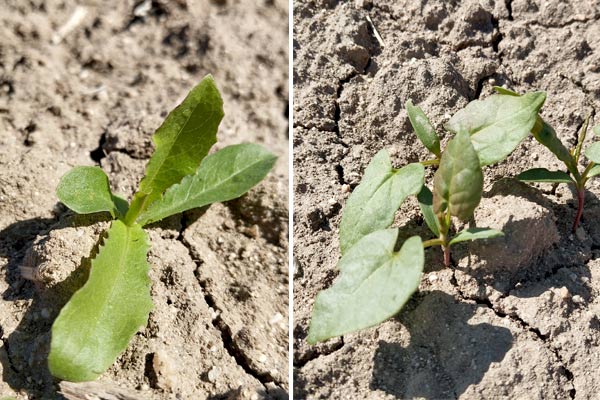
First spring weeds on the bed
Therefore, the weed vegetation was periodically removed mechanically. In the second half of spring, late spring weeds emerge, which form seeds at the beginning of summer. Representatives of this group are jimsonweed, black nightshade, gallant soldier, redroot pigweed and white pigweed. Purslane is also a common weed in the stands; it grows very rapidly and covers the soil surface under irrigated conditions. Sowing of the seeds was carried out in the presence of weed vegetation. After emergence of the crops, the weeds were mown at a height of 1–2 cm above the soil surface. This activity restricts their growth and they do not compete with the cultivated plants for light. Left on the soil surface, the mown weed vegetation dries out and serves as mulch, which retains soil moisture. Restricting weed growth and development by mowing does not allow them to reach flowering and seed formation stages and thus limits their spread in the following year.
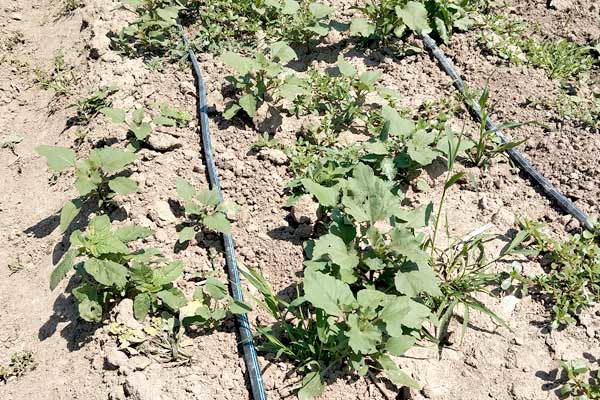
The bed before sowing the tomato and pepper seeds
Control of annual weeds is easily achieved by mowing at a certain time interval, but control of perennial grass weeds is much more difficult, the most dangerous of which is johnsongrass. Limiting the spread of this weed species can only be achieved by mechanical removal at an early stage of its development.
The cultivation of organic tomato, pepper and head cabbage according to the principles of regenerative agriculture is carried out under irrigated conditions using a drip system. For plant nutrition, an aqueous extract of vermicompost (Lumbrical) was used, applied to the soil during the vegetation period according to the following schemes, depending on the type of crop and its developmental stage:
Tomato
I fertilization – 200 ml/plant
II fertilization – 250 ml/plant
III fertilization – 100 ml/plant
IV fertilization – 100 ml/plant
Pepper
I fertilization – 100 ml/plant
II fertilization – 250 ml/plant
Head cabbage
I fertilization – 250 ml/plant
II fertilization – 250 ml/plant
The aqueous extract of vermicompost was prepared as follows: 1 L organic fertilizer was soaked in 10 L water for 24 hours. On the following day, without straining and without dilution, under constant stirring, the liquid fertilizer was applied to the soil close to the root system.
Differences were observed in soil temperature measured at two points in the two stands. At a depth of 0 to 10 cm, the temperature in the No-till bed was 2oC lower than in the bed with in-season tillage, and at a depth of 10 to 20 cm it was 1oC lower.
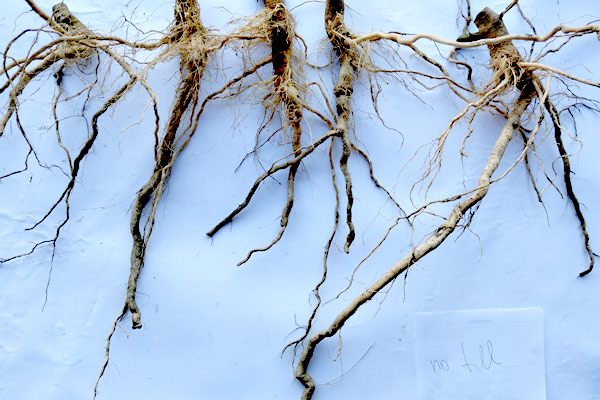
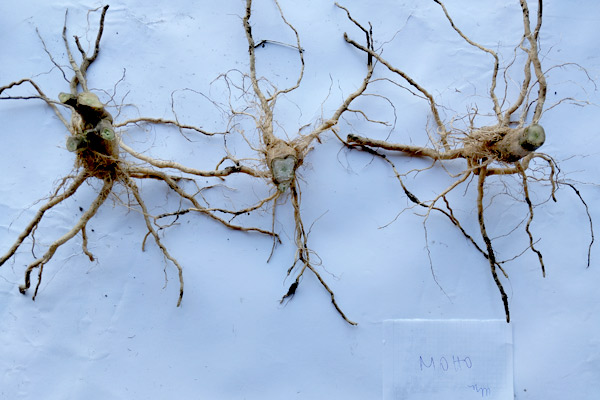
Root system of tomato plants grown on a bed without tillage
Differences were observed in the root system architecture of tomatoes grown under the two production systems. Analysis of the results shows that in the bed without tillage, plants form a deeper root system, penetrating to a depth of 35–40 cm and a diameter of about 70 cm.
Root system of tomato plants grown on the bed with in-season tillage
In the standard bed with soil loosening, the root system of the plants is located near the bed surface in the layer up to 20 cm, reaches a depth of up to 25 cm and forms a diameter twice smaller than in the no-till variant.
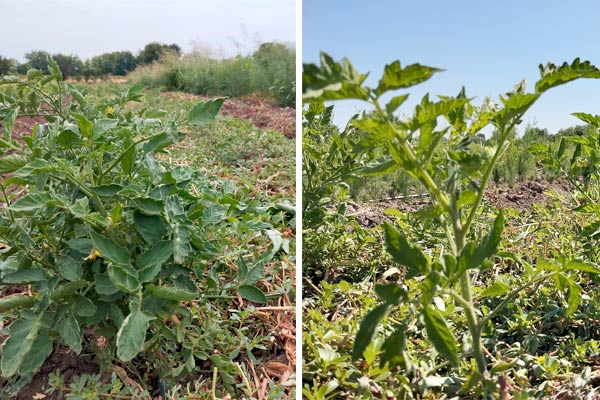
Tomatoes on the bed without tillage
In the No-till cultivation system, a delay of about two weeks in the commercial maturity of tomato and pepper fruits is observed compared to standard cultivation. Both crops, grown for late field production, are threatened by early autumn frosts. It is necessary to monitor the weather forecast and harvest the produce before they occur. From the tomatoes, green mature and pink fruits are harvested, which, after ripening off the plant, can be offered on the market for fresh consumption and generate additional income. Of the harvested produce, 3.87% were red fruits, 5.00% pink, 29.84% mature green and 61.33% green.
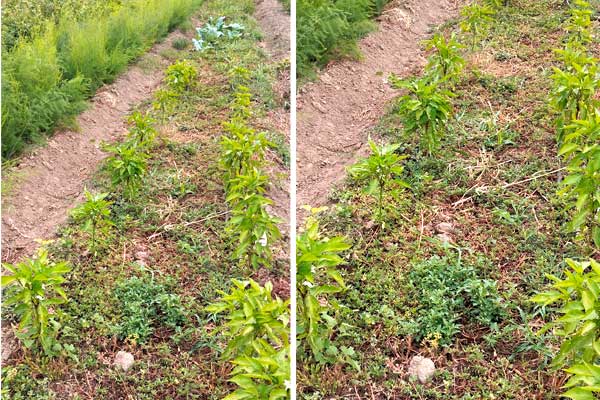
Pepper on the bed without tillage
The living mulch creates favourable conditions for pepper by preserving the soil moisture necessary for plant emergence. By comparison, in the variant with soil tillage the soil surface dries out quickly due to high air temperatures and intense solar radiation, which delays and hinders plant emergence. Compared to the standard cultivation method, the plants remain less developed, with smaller habitus and lower productivity.
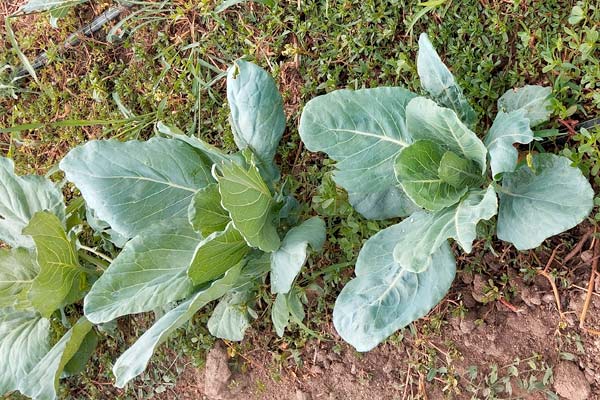
Head cabbage on the bed without tillage
In head cabbage, however, a very good effect of the living mulch on plant productivity is observed. The plants develop a more vigorous habitus and larger heads, which is due to the more favourable conditions near the soil surface, where more moisture is retained. Head cabbage is a crop that requires higher air humidity in order to fully express its productive qualities. The cultivation technology is extremely suitable for application, especially in view of the ongoing climate changes, characterized by long dry periods and high air temperatures. Under these changing conditions, smaller heads in terms of size and weight are formed. This is a problem both during seedling production and later when transplanting on well-tilled land, where moisture evaporates quickly and a large part of the plants die or remain poorly developed. When they are planted, however, in a bed with mown weed vegetation, they adapt and survive more easily under these extreme conditions. Plant productivity increases significantly, with the recorded yield being about 40% higher compared to cultivation with soil tillage.
Under organic field conditions and cultivation of vegetable crops on raised beds using No-till technology and maintaining a living mulch of weed vegetation, it was established that the cultivation of tomato and pepper is favourable, but to obtain better results, it is necessary to carry out earlier sowing of the seeds, at the beginning of May.
After the end of the vegetation period, the crop plants are removed from the bed so that pathogens are not preserved in the plant residues. The weeds that remain die as a result of low winter temperatures; the leaf–stem mass dries on the soil surface and protects it from strong winds and adverse winter conditions.
No-till agriculture provides a way to optimize productivity and ecosystem services, offering a wide range of economic, environmental and social benefits for the producer and for society. At the same time, no-till cultivation enables agriculture to respond to some global challenges related to climate change, soil and environmental degradation, and energy and production inputs.
Photos © Assoc. Prof. Tsventanka Dincheva, PhD, Assoc. Prof. Emil Dimitrov, PhD
References
1.Booker, B., 2009. No-Till Tomato Production. A Thesis, p. 80
2. Derpsch, R., Friedrich, T., Kassam, A., Hongwen, Li., 2010. Current Status of Adoption of No-Till Farming in the World and some of its Main Benefits. International Journal of Agricultural and Biological Engineering. 3. 10.3965/j.issn.1934-6344.2010.01.001-025.
3. Fiorini, A., Boselli, R., Amaducci, S., Tabaglio, V., 2018. Effects of no-till on root architecture and root-soil. European Journal of Agronomy 99:156-166
4. Kym, R., 2023. No till gardening keeps soil and plants healthy. Oregon State University.
5. Shuresh, G., 2020, No-till Vegetable Production, Extension News and publications, College of Agriculture, health and natural resources.