

![MultipartFile resource [file_data]](/assets/img/articles/листо-лоза.jpg)
The deficiency or excess of mineral elements causes disturbances in the vital processes of plants, which externally manifest as damage with specific characteristics. A specific feature of the symptoms of disorders related to mineral nutrition is their occurrence in foci and their relatively uniform manifestation. Nitrogen, phosphorus, potassium and manganese are mobile elements and move from the older to the younger leaves. The first symptoms are observed on the older leaves.
Macroelements
The elements that are required by the grapevine in large quantities are called macroelements (nitrogen, phosphorus, potassium, calcium).
NITROGEN
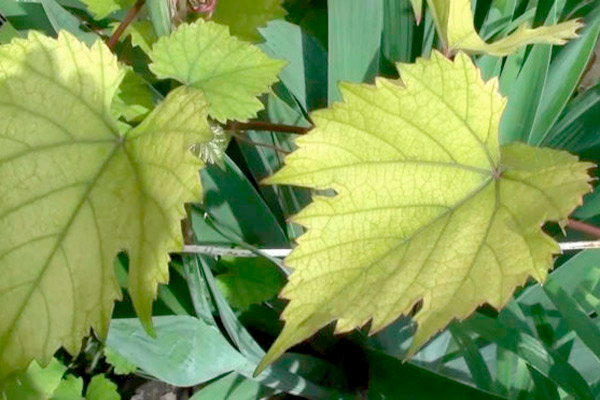
Nitrogen deficiency has an adverse effect on photosynthesis and protein synthesis, which leads to a reduction in chlorophyll content and leaf area, and to slowing down or even cessation of growth and development. The above-ground parts suffer more severely than the root system. Usually the damage first appears on the leaves located at the base of the shoots. The green colour of the leaves, petioles and shoots fades and changes to yellow, pale pink to light red. This colour change in the affected parts is most often observed when grape ripening begins. This is probably related to the translocation of nitrogen from the leaves to the clusters.
In the case of excess nitrogen, growth is enhanced and a large amount of vegetative mass is formed; the leaves are more succulent, while the mechanical tissues are less developed. As a result of these changes, plants are more susceptible to attack by phytopathogenic microorganisms, to damage from low temperatures and other stress factors. Under unilateral nitrogen fertilisation the vegetative parts of the vines have more vigorous growth and higher susceptibility to powdery mildew and low temperatures.
PHOSPHORUS
In the case of phosphorus deficiency, a delayed growth of the vegetative parts and the roots is also established. The first symptoms are observed on the basally located leaves, but the nature of the damage is different – the leaf blades are rough, darker in colour, with slight marginal necrosis; the petioles and main veins are purple-coloured due to the increased content of anthocyanin pigments. Phosphorus deficiency also affects the reproductive organs of the plants – flowering and ripening occur later; flower drop and poor fruit set are often observed.
Excess phosphorus also indirectly affects plants, as it hinders the uptake of iron and zinc.
POTASSIUM
Potassium participates in more than 60 enzymatic reactions related to all vital processes in plants. It influences the concentration of cell sap and the osmotic pressure in the cells, which are related to the opening of stomata in the leaves and thus to transpiration. It has been established that this element largely determines the reaction of plants to phytopathogens and their ability to adapt to environmental conditions, especially to unfavourable temperatures.

Potassium deficiency leads to a change in the colour of leaves exposed to direct sunlight, progressing from the leaf margins inwards, as well as to necrosis and drying of the affected tissues. Symptoms are observed on the leaves from the middle levels of the shoots. In grapevine this is the most common deficiency, since among all elements it consumes the largest amount of potassium. When potassium nutrition is insufficient, the content of sugars, aromatic and colouring substances in the grapes decreases, which leads to a deterioration in wine quality.
The nature of the symptoms depends mainly on the berry colour of the variety. In most red varieties, reddening and browning of the leaves is observed, bearing in mind that reddening may also be due to other causes (deficiency of another element, physiological disorders). In white varieties, the leaves turn yellow, and downward curling of the blades is possible. In hybrids, small, rusty to blackish spots appear on the leaves, very similar to the spots caused by downy mildew. Usually the symptoms are noticeable around the beginning of berry softening/veraison, which is related to the translocation of potassium from the leaves to the clusters.
Site conditions (climate, soil) and agronomic practices (pruning, crop load) are the factors that to a large extent determine the potassium nutrition of vines. Damage from potassium deficiency is most often established in the following cases:
- vineyards on clay and sandy soils;
- vineyards planted on areas previously occupied by leguminous crops;
- young vineyards allowed to bear fruit too early;
- overloaded bearing vineyards;
- vineyards fertilised with insufficient potassium and excessive amounts of nitrogen and magnesium;
- during drought.
MICROELEMENTS
Iron
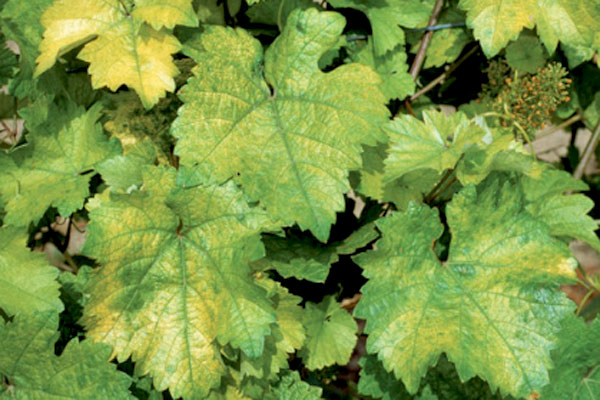
Iron belongs to the absolutely essential nutrients for plants, as it is involved in chlorophyll formation and is a component of various enzymes. In the soil it occurs mainly as ferric ions, in the form of water-insoluble and almost unavailable compounds – oxides, hydroxides, carbonates, phosphates and silicates. The content of iron compounds that are easily assimilable by plants and contain ferrous ions is insignificant. Iron deficiency, as well as the transformation of plant-available ferrous compounds into the unavailable ferric form, can lead to the occurrence of non-infectious chlorosis.
In diseased plants affected by non-infectious chlorosis, a number of adverse physiological and biochemical effects are recorded – chlorophyll content is reduced, transpiration is increased, carbon dioxide (CO2) uptake is reduced 2–3 times, the total nitrogen content in the leaves is nearly doubled, the content of malic and citric acids is increased, and peroxidase activity is reduced (Levkov, 1982). The manifestation of iron chlorosis leads to a decrease in yield quantity and quality – fruiting is absent or strongly reduced, and premature death of severely affected plants is possible.
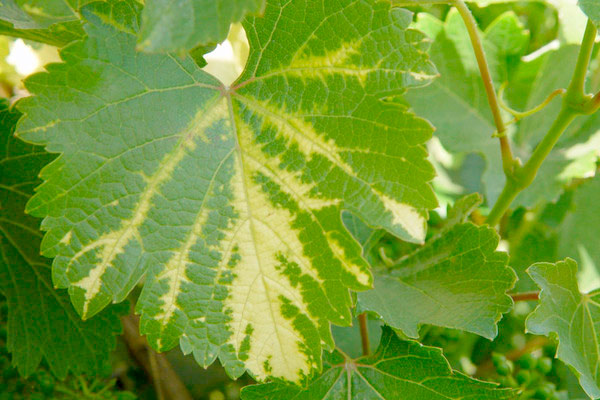
Chlorosis is a long-known disease. In our country it occurs only in areas with a high lime content and in vines grafted onto rootstocks with low resistance to calcium.
The external symptoms of non-infectious chlorosis may be observed on individual shoots or on all vegetative parts and reproductive organs, with the affected green parts fading and turning yellow. The first symptoms appear at the beginning of the growing season, and during active growth the disease progresses very rapidly. A specific symptom by which non-infectious chlorosis can be accurately diagnosed is the initial involvement of only the apical parts of the young shoots. Later, leaves from the lower levels may also show symptoms. Initially, only the tissues between the veins of the leaves fade and turn yellow, but subsequently these colour changes may also affect the venation itself. Severely affected leaves acquire a creamy-white colour, become necrotic, dry out and in some cases fall prematurely.
In addition to colour changes in the green parts, non-infectious chlorosis is accompanied by depressed growth (reduced leaf size, shortened internodes and thus shorter shoots), and the formation of small and millerandage-affected clusters (most often in the variety Muscat Ottonel).
In vineyards, individual vines are usually affected or the disease occurs in patches.
The occurrence and development of the disease depend on a number of factors, the most important of which are:
Content of plant-available iron compounds in the soil, which is determined by: soil solution reaction (pH); content of carbonates, calcium bicarbonate, phosphorus, heavy metals, oxygen, salts, etc.
At low pH values and low oxygen content, the assimilable form of iron – ferrous – predominates; with increasing values of these parameters, the content of the ferric form (the non-assimilable form of iron) increases, and solubility decreases drastically.
In most cases, non-infectious chlorosis affects vineyards planted on soils with higher calcium carbonate content and alkaline reaction (calcareous soils). The disease has also been recorded on poorly aerated acid and saline soils, usually with elevated copper, manganese and phosphorus content.
Amount of soil moisture
Waterlogged soils resulting from shallow groundwater or higher rainfall have impaired aeration, which favours the occurrence of non-infectious chlorosis. In some vineyards the disease appears only in years with higher rainfall during the growing season.
- Varietal characteristics
- Agronomic causes
In this case it may be due to: deep ploughing (subsoiling) of soils with a high carbonate content in the subsoil before planting the vines; root pruning during deep soil cultivation; irrigation with water rich in bicarbonates; inappropriate fertilisation with phosphorus and nitrogen fertilisers; fertilisation of calcareous soils with alkaline reaction using fertilisers containing calcium and sodium, etc.
Measures for control of non-infectious chlorosis
Control should begin even before the establishment of the vineyard:
Direct (biological) method – grafting onto rootstocks resistant to carbonates is a direct biological method for controlling chlorosis.
Before planting the vines, soil samples are taken from the area at a depth of 40–120 cm (where the vine roots develop). In specialised soil laboratories, the samples are analysed for nitrogen, phosphorus, potassium, active calcium and plant-available iron content. The results for active calcium and plant-available iron are used to determine the index of the chlorosis-inducing capacity of the soil. Where results show high active calcium content and thus high values of the chlorosis-inducing index of the soil, the vines must be grafted onto rootstocks resistant to calcium.
Indirect measures for limiting the disease:
- On poor soils, nitrogen fertilisation is recommended for diseased vines with depressed growth; in the case of alkaline soils, fertilisation is carried out with ammonium sulphate as a physiologically acidic fertiliser.
- In cases of more severe chlorosis, chemical means are applied.
Boron
Boron plays a role in carbohydrate metabolism and the transport of assimilates, as well as in the formation of nucleic acids and thus in the formation of meristematic cells and plant growth. When boron is present in the soil in an available form, it is absorbed by the roots and moves with the ascending sap flow. Its movement, however, from one organ to another is very limited.
Boron deficiency manifests externally as various types of damage depending on its severity. Symptoms most often appear on older leaves – fading, wrinkling, deformation, tearing in the form of deep incisions, and reduction in size. Young leaves appear glossy, while in older leaves mosaic-like colour patterns may occur. In cases of acute deficiency, the shoot tip dies, many lateral shoots are formed and the vine acquires a “broom” appearance; tendrils lose their ability to cling, without visible necroses, and subsequently die. Root growth is retarded and water uptake is reduced. Disturbances in fertilisation occur, with sterile ovaries dropping 2–3 weeks after flowering. It has been established that soil solution pH and organic matter content have a stronger effect on boron content/availability than soil type. Acid soils are well supplied with boron. At soil solution pH values greater than or equal to 6.5, plant nutrition with boron is severely hindered. There are reports of a strong reduction in boron solubility during drought periods in vineyards located on lime-rich soils.

Magnesium
A specific feature of the symptoms of magnesium deficiency in grapevine is their first appearance on the leaves located at the base of the shoots. Sometimes, at the beginning of the growing season (before flowering), necrosis is observed on the leaves in the form of brown-green spots. Most often, however, when grape ripening begins, the leaf colour changes – initially at the margins and subsequently between the main veins, with narrow green stripes always remaining around the veins. In white varieties the colouration is pale green to yellow, and in red varieties – red.
Damage from magnesium deficiency is usually established in vineyards when:
- they are planted on poor sandy soils, acid soils, or soils with higher calcium content;
- after heavy rainfall;
- when grafted onto rootstock 44-53.
Zinc
Zinc is involved in the synthesis of sugars and auxins, which is why deficiency of this microelement is observed as a reduction in size and deformation of the above-ground parts. The symptoms on grapevine have the following characteristics:
- the leaves are smaller in size, sometimes asymmetrical, with more pronounced teeth, a more widely open petiole sinus, and mosaic spotting with yellow or reddish spots, while thin stripes around the veins retain their green colour;
- internodes and shoots are shorter.
Manganese
This microelement plays a role in photosynthesis and respiration in plants and at the same time acts as an antagonist of iron.
The symptoms of manganese deficiency first appear on the young leaves at the shoot tips – chlorosis and discolouration of tissues, with green stripes remaining around the primary and secondary veins. Subsequently, depending on the berry colour of the variety, yellow or light brown spots with a mosaic appearance develop, as they are delimited by the leaf veins. Retarded vine growth and delayed ripening of the wood and grapes may also be observed.
For control of diseases caused by nutrient deficiencies, certain basic principles should be followed:
- Determining the content of nutrients in the soil before establishing the vineyard and, based on the data obtained, carrying out the so-called pre-plant (reserve) fertilisation.
- Carrying out leaf and soil analyses 6–7 years after planting the vines, to determine the nutrient status of the plants and soil with respect to macro- and microelements; determining fertiliser rates, bearing in mind that some elements are antagonistic (e.g. potassium and magnesium).
- Applying the required quantities of fertilisers.
- Enriching poor soils with organic matter.