

![MultipartFile resource [file_data]](/assets/img/articles/заглавна-Птолемаида.jpg)
The region of Macedonia in Greece is known not only for its lignite coal, which for many years has been the main livelihood of the population, but also for its orchards. In the west, a large part of the area is at an altitude above 600–700 meters with cold winters and warm summers, and in the south it borders the Aegean Sea.
The microclimate and mineral-rich soils are a prerequisite for the development of fruit growing in the region, which is aptly called by the locals “the largest fruit basket in Greece“.
The choice is vast; there are plantations with grapes, apples, strawberries, kiwifruit, pears, cherries, plums and figs. However, the fruit crop that ranks first here is the peach.
Exchange of experience and knowledge in organically managed orchards
At the end of January, in the land of the town of Ptolemaida, agronomist Eng. Stratos Tsakiris welcomed his guests from Bulgaria – the association of agricultural producers Semele* and the company Phyto Terra* in the apple orchards of the area.
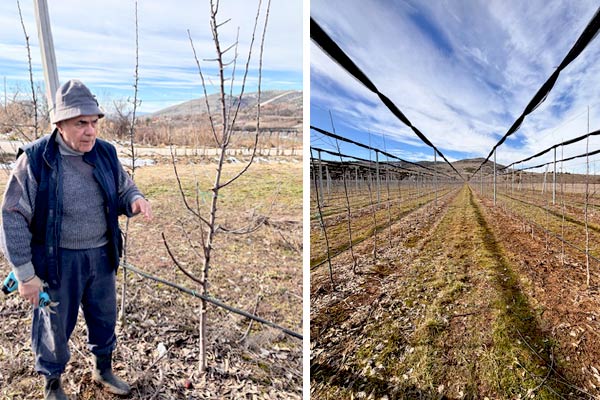
Agronomist Tsakiris has many years of experience in the cultivation of apple and cherry fruit species and his care for them is year-round.
“The region is orienting itself towards ecological and clean agriculture“, shares the Greek host. In order to maintain healthy apple, pear and cherry orchards, to improve yield and to ensure the long-term sustainability of the trees, the most important remain the agrotechnical measures such as pruning and fertilisation.
Sustainable pruning and fertilisation practices in apple orchards for optimising production
“Pruning improves air circulation and thus reduces the risks of diseases“, agronomist Tsakiris shares with his colleagues from Bulgaria. In addition, it improves light penetration into the plantation, which also guarantees better taste qualities of the fruit.
For apple plantations it is recommended to carry out pruning in the winter period until early spring (before bud break), in order to prevent frost damage.
For cherries it is advisable to carry out summer pruning – after harvest at the end of summer to minimise the risk of bacterial diseases.
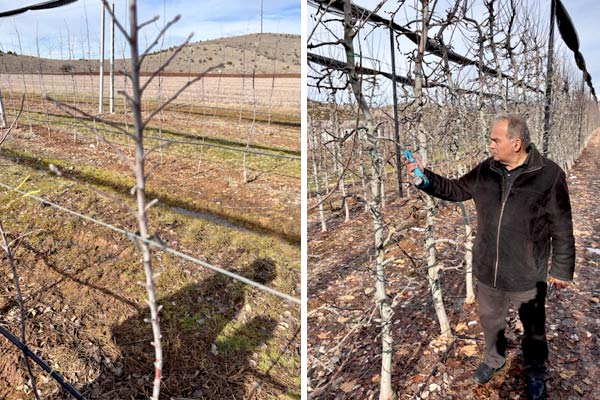
In the orchards managed by the agronomist, mainly hand tools are used and the remaining branches from pruning are cut into small pieces, which are left in the plantations, thus creating natural composting and enrichment of the soil.
Another important aspect of the fruit tree cultivation process is proper fertilisation. Conducting soil and foliar analyses annually prevents over-fertilisation. Their precise application ensures that nutrients are applied only when necessary, as well as that the required nutrient elements are provided for the specific crop. Reducing synthetic fertilisers in favour of organic and low-carbon ones is a key task in the orchards of the Greek agronomist. He uses various agricultural practices that improve soil health, such as compost, farmyard manure, biochar, which improves carbon capture and preserves soil moisture. Nitrogen fixation in the orchards is achieved through the use of microbial fertilisers with seaweed extracts and mycorrhizal fungi. Organic fertilisers stimulate the uptake of nutrients by plant roots and improve soil structure.
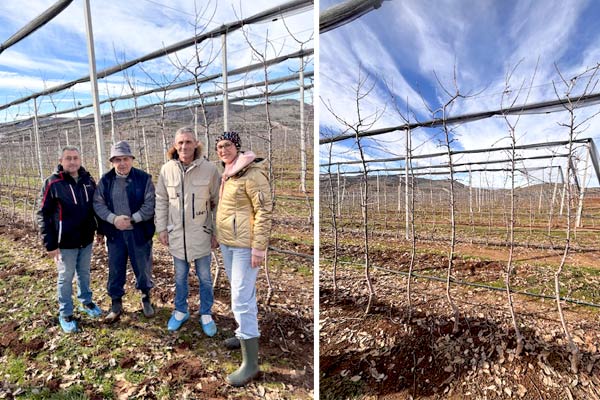
*Exchange of experience in the orchards in the area of the town of Ptolemaida. By invitation of the Greek agronomist Eng. Stratos Tsakiris, with the assistance of the company Sandros Greece (Sandros is present in Bulgaria through the company Phyto Terra, their official representative for Heinz seeds and seedlings as well as for Atlantica Agricola biostimulants and fertilisers), and on the Bulgarian side the association of agricultural producers Semele.
Additional practices that are successfully used in the holding managed by agronomist Tsakiris are agroforestry and the introduction of integrated pest management (IPM) with the aim of reducing the pesticides used. Disease-resistant varieties are also part of the mandatory fruit-growing programme of the agronomist. He also adds adherence to seasonal agronomic protocols, which ensure the optimisation of production.
Agronomic protocol for low-carbon production of apples, pears and cherries – practices and benefits
Winter (dormant season) – conducting soil analyses, pruning,
prevents excessive use of fertilisers.
Early spring – compost or organic fertilisers are used. Synthetic fertilisers are reduced in order to improve the soil microbiome.
Spring/Summer – introduction of cover crops, use of drip irrigation, which improves nitrogen fixation and reduces water loss.
Summer (after cherry harvest) – summer pruning, application of biochar and microbial fertilisers. This supports regrowth and improves soil structure.
Autumn – Mulch from pruned material is applied and the plantations are prepared for winter.
By introducing sustainable pruning and fertilisation techniques, producers of apples, pears and cherries can improve the productivity of their orchards while at the same time reducing their carbon footprint. The application of a structured agronomic protocol based on soil health ensures abundant and high-quality production.