

For apple trees, spraying against scab must be prolonged, as the risk of primary infections still exists. The release of ascospores typically continues for about two months, starting from the beginning of their maturation, which in the conditions of our country occurs at bud break. This year, in the main apple-producing regions, this period began at the end of March and the beginning of April for most varieties. The problem of protecting leaves and fruits from scab becomes more complicated if a primary infection has been allowed. In addition to scab, the sprays in June are also aimed at powdery mildew. Usually, during this month, two or three sprays are carried out against the two fungal diseases, depending on the development conditions of the pathogens. For simultaneous control of both diseases, one of the following fungicides is used: Stroby DF – 0.02%, Flint max WG – 0.02%, Score 250 EC – 0.02%, Sistan ecosom EV – 60 – 180 ml/decare, Stroby DF/Discus DF/ - 0.02%, Horus 50WG-0.03%, Shavit F 72WDG – 0.2%, Ardent 50SC – 0.02%, Luna experience – 20-75ml/decare or the fungicide mixtures: Stroby DF -0.02% plus Delan 700WDG – 0.035%, Delan 700WDG - 0.035% plus Bayfidan 250 EC – 0.015%, Dithane M-45 – 0.3% plus Bayfidan 250 EC – 0.015%.
To prevent the development of resistance in the fungus causing scab /Venturia inaequalis/, it is best to alternate fungicides with different mechanisms of action on the pathogen or to use fungicide mixtures for control.
For varieties highly susceptible to powdery mildew, green pruning should continue to remove infected shoots.
Scab-resistant varieties – Prima, COOP-10, Frolina, Liberty, Jonafree, Jonathan, Pioneer, Macfree, Pilot, Topaz, Novamac, Sava, Rubinola, etc., are sprayed only against powdery mildew, and for them, one of the following fungicides can also be used: Bayfidan 250 EC – 0.015%, Topsin M 70WDG – 0.12%, Kumulus DF – 0.2%. At high temperatures, do not spray with Kumulus DF, which is a sulfur-containing fungicide and can cause burns on some varieties.
In June, sprays are also carried out against the codling moth, San Jose scale, and aphids. Treatments against pests are combined with those against diseases. For control of the codling moth, the list of approved insecticides includes: Affirm 095SG - 0.3%, Vaztak new 100EC – 0.0125%, Voliam Targo 063SC – 75 ml/decare, Decis 2.5EC – 0.03%, Dykline 2.5EC – 0.03%, Deca EC – 0.03%, Dursban 4E – 0.2%, Nexide 015CS – 0.03%, Sumi alpha 5EC – 0.02%, Karate Zeon 5CS– 0.02%, Karate express WG – 60-100 g/decare, Calypso 480SC – 0.02%, Coragen 20SC - 0.016% Reldan 40EC – 0.12%, Pirinex 48EC – 0.12%, Supersect mega – 0.015%, Efcymetrin 10EC - 0.03%, Cyclone 10EC – 30 ml/decare, Cyperfor 100EC – 30 ml/decare, Sherpa 100EC – 0.03%.
For control of San Jose scale, the following insecticides are registered: Bi-58 0.2%, Dursban 4E – 0.15%, and Pirinex 48EC – 0.15%.
During this period, the population density of the European red mite usually increases, and upon reaching the economic threshold, spraying becomes necessary. One of the following acaricides is used: Vertimec 018 – 100 ml/decare, Voliram targo 063 – 0.075%, Envidor 240SC – 40 ml/decare, Ortus 5SC – 0.05%, Sanmite 20WP – 0.05%, Masai WP – 25 g/decare.
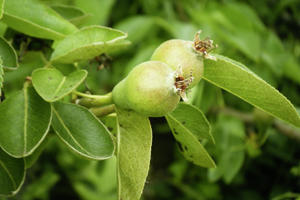
For pear trees, spraying against scab, white and brown leaf spots must continue. To control these diseases, one of the fungicides or fungicide mixtures indicated for scab control in apples is used. To protect pear fruits from worm infestation, the same sprays are carried out and the same insecticides are used as for apples.