

![MultipartFile resource [file_data]](/assets/img/articles/заглавна-aegilops.jpg)
Summary
Bulgaria is one of the countries on the Balkan Peninsula with a diversity of species from the genus Aegilops. They are a source of genes for resistance to biotic and abiotic environmental stress factors which, when introduced into the genome of durum and common wheat through hybridization, can improve their resistance. The interest in these species is also justified by the possibility of using them in breeding for broadening the genetic base of durum and common wheat. The wild relative of wheat, Aegilops triuncialis L., is an annual herbaceous plant known as barbed goatgrass. It is a tetraploid species (2n = 4x = 28) with a genomic constitution UUCC. The species is widely distributed in Bulgaria, where it also exhibits pronounced genetic variation in its plant forms. This provides grounds for an in-depth study of the genetic potential of Aegilops triuncialis L., distributed in the country, and its qualities for breeding purposes in wheat.
Countries of distribution: Afghanistan, Albania, Algeria, Bulgaria, Greece, Iran, Iraq, Spain, Italy, Kazakhstan, Cyprus, Kyrgyzstan, Crimea, Kuwait, Lebanon-Syria, Libya, Morocco, Pakistan, Palestine, Portugal, Italy (Sardinia, Sicily), Tajikistan, Tunisia, Turkey, Turkmenistan, Uzbekistan, the countries of the former Yugoslavia (Slovenia, North Macedonia, Croatia, Serbia, Montenegro, Kosovo and Bosnia).
The species has been introduced into: Germany, California, Maryland, New York, Pennsylvania.
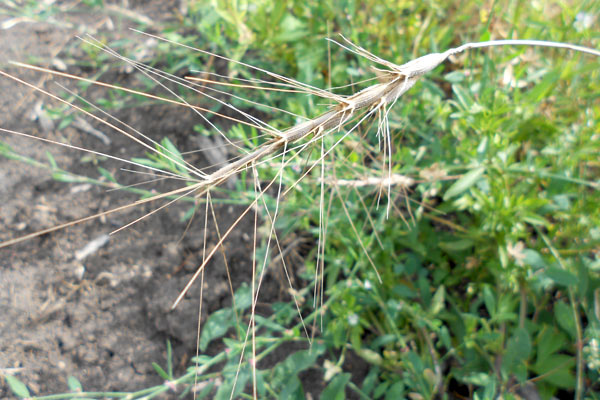
Botanical description and morphology
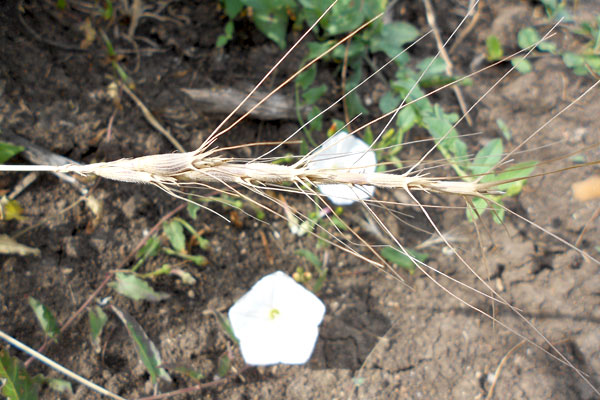
Winter annual tufted herbaceous plant, forming from several to many productive tillers. At the base the culms are semi-prostrate, and later become erect. The culm length is usually 15–45 cm. The leaves are linear-lanceolate, glabrous or pubescent, 2–3 mm wide and 5–10 cm long. The lowest and uppermost leaves are shorter than the remaining ones on the culm. Between the leaf sheath and the blade there is a short membranous ligule and pubescent auricles. The inflorescence is a compound spike, slightly tapering towards the apex, 3–6 cm long (without the awns) and 3–5 mm thick, consisting of 3–6 fertile spikelets arranged loosely and alternately along the main axis of the spike. The spikelets are sessile, 7–10 mm long and about 3–4 mm wide. The terminal spikelet is reduced, shorter and thinner, about 7 mm long and about 3 mm wide. In a spikelet there are 3–5 florets, of which the lower 3–4 are usually fertile, but there may be up to five fertile florets, which produce 5 grains per spikelet. The glumes of the lateral spikelets are ovate-elongate, 7–10 mm long, green to purple-green at heading and flowering, with a striated surface and unevenly wide veins (7–9), sunken into the surface, more or less parallel, with 2–3 awns, one of which is 10–60 mm long. The lemmas of the fertile florets are 7–10 mm long, elongate, five-veined, boat-shaped and folded lengthwise in the upper part. The outer lemma is longer than the glume. Awns on the outer lemmas occur only on the lateral spikelets and are three in number, 5–6 mm long. The palea is 2-veined with crowded keels. The inner lemma is narrowly ovate-elliptic, with 1 awn 5–6 mm long. The pistil is enclosed between the appressed outer and inner lemmas. Usually the uppermost spikelet of the spike is poorly developed, with awns equal to or longer than the spike. At fruiting, the spike usually breaks off at the base and falls as a whole, leaving sometimes only the rudimentary 1–2 sterile spikelets attached to the culm. When the spike disarticulates into separate spikelets, the spikelet detaches together with the adjacent rachis segment.
The fruit is a dorsiventral flattened caryopsis with a groove along the entire ventral side, pubescent at the apex. The grain colour is red. It reproduces by seeds.
Phenology: Flowering (April–August), fruiting (May–August)
Habitats: Uncultivated and heavily disturbed sites – fallow lands, roadsides, dry, sandy, grassy slopes, pastures. Distributed throughout Bulgaria at altitudes of 500–1200 m.
Ecology: Least affected or threatened species.
Taxonomy: Royal Botanic Gardens, Kew
Synonyms: Aegilopodes triuncialis (L.) Á.Löve, Aegilops elongata Lam., Aegilops triuncialis subsp. eutriuncialis Eig, Aegilops triuncialis subsp. typica Zhuk., Aegilops triuncialis var. typica Eig, Triticum triunciale (L.) Raspail, Aegilopodes triuncialis subsp. persica (Boiss. ex Hohen.) Á.Löve, Aegilops aristata Req. ex Bertol., Aegilops buschirica Roshev., Aegilops echinata C. Presl, Aegilops persica Boiss. ex Hohen., Aegilops squarrosa L., Aegilops squarrosa subsp. eusquarrosa Eig, Aegilops squarrosa subsp. typica Zhuk., Aegilops squarrosa var. typica Eig, Aegilops triaristata Req. ex Bertol., Aegilops triuncialis var. albescens Popova, Aegilops triuncialis var. assyriaca Eig, Aegilops triuncialis subsp. bozdagensis Cabi & Dogan, Aegilops triuncialis var. breviaristata Hack., Aegilops triuncialis f. brunnea (Popova) K. Hammer, Aegilops triuncialis var. brunnea Popova, Aegilops triuncialis subsp. caput-medusae Zhuk., Aegilops triuncialis var. constantinopolitana Eig, Aegilops triuncialis subsp. fascicularis Zhuk., Aegilops triuncialis var. ferruginea Popova, Aegilops triuncialis f. ferruginea (Popova) K. Hammer, Aegilops triuncialis var. flavescens Popova, Aegilops triuncialis f. flavescens (Popova) K. Hammer, Aegilops triuncialis var. glabrispica Eig, Aegilops triuncialis subvar. glauca Miczyn, Aegilops triuncialis subvar. hirsuta (H. Lindb.) Jahand. & Maire, Aegilops triuncialis f. hirsuta H. Lindb., Aegilops triuncialis var. hirta Zhuk., Aegilops triuncialis subvar. hispida Miczyn., Aegilops triuncialis var. leptostachys Bornm., Aegilops triuncialis var. muricata Zhuk., Aegilops triuncialis var. nigriaristata Flaksb., Aegilops triuncialis var. nigroalbescens Popova., Aegilops triuncialis f. nigroalbescens (Popova) K.Hammer., Aegilops triuncialis var. nigroaristata Flaksb., Aegilops triuncialis var. nigroferruginea Popova., Aegilops triuncialis f. nigroferruginea (Popova) K.Hammer., Aegilops triuncialis var. nigroflavescens Popova., Aegilops triuncialis f. nigroflavescens (Popova) K.Hammer., Aegilops triuncialis var. nigrorubiginosa Popova., Aegilops triuncialis f. nigrorubiginosa (Popova) K.Hammer., Aegilops triuncialis subsp. orientalis Eig., Aegilops triuncialis subsp. persica (Boiss. ex Hohen.) Zhuk., Aegilops triuncialis var. persica (Boiss. ex Hohen.) Eig., Aegilops triuncialis var. pubispica Eig., Aegilops triuncialis var. rubiginosa Popova., Aegilops triuncialis f. rubiginosa (Popova) K.Hammer., Aegilops triuncialis subvar. subglabra (H.Lindb.) Jahand. & Maire., Aegilops triuncialis f. subglabra H. Lindb., Triticum persicum (Boiss. ex Hohen.) Aitch. & Hemsl., Triticum squarrosum (L.) Raspail.
Significance of the species:
Aegilops triuncialis L., also known as barbed goatgrass, is a tetraploid species with the genomic formula UUCC (2n = 4 x = 28) and chromosome number (x = n = 7). It has been established that the U genome in this species contributed to the formation of cultivated wheats (Peng et al. 2011). Aegilops triuncialis L. is resistant to various stress factors, such as drought and salinity. The species may be a suitable candidate for crossing with bread wheat, as well as for the development of new breeding lines possessing high levels of drought tolerance (Colmer et al. 2006). This is one of the main reasons for studying the genetic diversity in accessions of Aegilops triuncialis L., which provides useful information for improving various traits in common bread wheat. Crosses between wheat and a closely related wild relative such as Aegilops triuncialis L. are being investigated by breeders and biologists to identify suitable combinations.
In a study on the sensitivity of different species to the application of ozone (O3) during plant vegetation, it was found that plants of Aegilops triuncialis L. are among the least affected and only slightly sensitive to high doses of ozone (O3), which are toxic to plant cells (Bermejo et al., 2003).
The species Aegilops triuncialis L. is widely distributed from Asia to Europe and is generally well known and studied, but recently researchers of this species have discovered and described a new subspecies called Aegilops triuncialis L. subsp. bozdagensis Cabi and Dogan. A distinguishing feature of this newly discovered subspecies is that the outer and inner glumes of the lateral spikelets lack awns, which differentiates it from the other two long-known subspecies Aegilops triuncialis subsp. persica and Aegilops triuncialis subsp. triuncialis. The distribution of the new subspecies is restricted to the southwestern region of Anatolia (Evren et al., 2018; Karatassiou et al., 2021).
Genotypes of the species may provide potential sources of physico-chemical traits for use in future breeding studies. It has been established that the species could be involved in breeding for increasing grain nutrients, grain number and grain mass, as well as in breeding for earlier flowering (Meimberg et al., 2010). Breeding for rust resistance includes conventional and molecular tools, such as mapping of loci for specific traits. Aegilops triuncialis L. is also used for developing new genetic resources and for understanding genetic diversity in order to diversify rust resistance (Tomar et al. 2014). A major gene, Lr58, responsible for conferring leaf rust resistance in wheat, is known; this gene was transferred from its donor Aegilops triuncialis L. into common bread wheat and was mapped on chromosome 2BL (Kuraparthy et al. 2007).
The C genome of Aegilops triuncialis L., its structure and significance, is also of interest. This genome is considered an important source for improving bread wheat (Molnár et al., 2015). Hybrids are also created by flow-sorted chromosomes with the diploid Ae. markgrafii (2n = 2x = 14; CC) and the allotetraploid species Ae. triuncialis (2n = 4x = 28; UtUtCtCt) and Ae. cylindrica (2n = 4x = 28; DCDCCCCC). The genome of Aegilops triuncialis L. has been used to generate more than 400 DNA elements, which are now routinely used for physical mapping of DNA-based markers. Line BTC17 is an interspecific derivative obtained from a 5U-5A substitution of chromosome 5U from Aegilops triuncialis L. into the bread wheat line WL711 (Singh et al., 2000). Line BTC17 is characterized by specific high-molecular-weight glutenins for improving starch quality in wheat (Giroux and Morris, 1997). A study conducted in 2020 identifies Aegilops triuncialis L. as one of the most tolerant species in the genera Triticum and Aegilops as a result of the activity of the gene TaHKT1;5 (Ahmadi et al. 2020). Various studies show that Aegilops triuncialis L. also possesses resistance traits to Hessian fly, which could be transferred to common wheat through transfer of H30, the gene responsible for this trait (Martin-Sanchez et al., 2003). It has been established that chromosome 3C of Aegilops triuncialis L. has a gametocidal function and induces structural changes in chromosome 4V of Haynaldia villosa L. (Chen et al., 2002). Chromosome 3C from Aegilops triuncialis L. in common bread wheat of the variety Norin-26 can induce variation in chromosome structure, in the search for useful traits within these variations (Tsujimoto et al., 1985; Endo et al., 1998; Endo et al., 1994; Endo et al., 1988; Endo and Gill, 1990).
Line TR-3531, which is the result of another cross between common bread wheat and Aegilops triuncialis L., carries the gene Cre7, which induces the production of protective enzymes in the root cells that act against the cereal cyst nematode, and is used for research as well as for breeding purposes (Maria et al. 2004).
Acknowledgements
The study was financially supported by the National Science Fund, Ministry of Education and Science, under project KP-06-H76/3 “Study of the genetic diversity of species of the genus Aegilops in the flora of Bulgaria”.
Photos © Institute of Plant Genetic Resources “K. Malkov” – Sadovo
References
Ahmadi J., A. Pour-Aboughadareh, S. Fabriki Ourang, P. Khalili, P. Poczai. 2020. Unraveling salinity stress responses in ancestral and neglected wheat species at early growth stage: a baseline for utilization in future wheat improvement programs, Physiol. Mol. Biol. Plants 26 (2020) 537–549.
Bermejo V., B.S. Gimeno, J. Sanz, D. de la Torre, J.M. Gil. 2003 Ecotoxicology of Air Pollution, CIEMAT (Ed. 70), Avda. Complutense 22, Madrid 28040, Spain.
Chen, Q.Z., Qi, Z.J., Feng, Y.G., Wang, S.L., and Chen, P.D. 2002. Structural changes of 4V chromosome of Haynaldia villosa induced by gametocidal chromosome 3C of Aegilops triuncialis. Acta Genet. Sin. 29: 355-358 (in Chinese with an English abstract).
Colmer TD, Flowers TJ, Munns R (2006) Use of wild relatives to improve salt tolerance in wheat. J Exp Bot 57 Oxford Academic:1059–1078. https://doi.org/10.1093/jxb/erj124.
Endo T R, Gill B S. 1996. The deletion stocks of common wheat. Heredity, 87, 295-307.
Endo T R, Shi F, Tsvetkov K S. 1998. Genetic induction of chromosomal structural changes of alien chromosomes in common wheat. In: Proceedings of the 9th International Wheat Genetics Symposium. vol. 2. Saskatoon, Canada. pp. 40-43.
Endo T R, Yamamoto M, Mukai Y. 1994. Structural changes of rye chromosome 1R induced by a gemetocidal chromosome. Japanese Journal of Genetics, 69, 13-19.
Endo T R. 1988. Induction of chromosomal structure changes by a chromosome of Aegilops cylindrica L. in common wheat. Journal of Heredity, 79, 366-370.
Endo T R. 1990. Gametocidal chromosomes and their induction of chromosomal mutations in wheat. Japanese Journal of Genetics, 65, 135-152.
Evren, C.A.B.˙I., Ekici, B., Do˘gan, M., 2018. Aegilops triuncialis subsp. bozdagensis (Poaceae), a new subspecies from South-Western Turkey. Acta Biologica Turcica 31 (2), 56–61.
Giroux, M. J., & Morris, C. F. 1997. A glycine to serine change in puroindoline b is associated with wheat grain hardness and low level of starch-surface friabilin. Theoretical and Applied Genetics, 95, 857-864.
Karatassiou, M., Giannakoula, A., Tsitos, D., Stefanou, S. 2021. Response of Three Greek Populations of Aegilops triuncialis (Crop Wild Relative) to Serpentine Soil. Plants 10 (3), 516.
Kuraparthy V, Sood S, Chhuneja P, Dhaliwal HS, Kaur S, Bowden RL, Gill BS. 2007. A cryptic wheat-Aegilops triuncialis translocation with leaf rust resistance gene Lr58. Crop Sci 2007;47:1095-2003.
María Jesús Montes, Isidoro López-Braña, Angeles Delibes (2004). Root enzyme activities associated with resistance to Heterodera avenae conferred by gene Cre7 in a wheat/Aegilops triuncialis introgression line J. Plant Physiol. 161. 493–495 (2004) http://www.elsevier-deutschland.de/jplhp.
Martín-Sánchez J.A., M. Gómez-Colmenarejo, J. Del Moral, E. Sin, M.J. Montes, C. González-Belinchón, I. López-Braña, A. Delibes. 2003. A new Hessian fly resistance gene (H30) transferred from the wild grass Aegilops triuncialis to hexaploid wheat, Theor. Appl. Genet. 106, 1248–1255.
Meimberg, H., Milan, N.F., Karatassiou, M., Espeland, E.K., McKay, J.K., Rice, K.J. 2010. Patterns of introduction and adaptation during the invasion of Aegilops triuncialis (Poaceae) into Californian serpentine soils. Mol. Ecol. 19, 5308–5319.
Molnár, I., Vrána, J., Farkas, A., Kubaláková, M., Cseh, A., Molnár-Láng, M., Doležel, J. 2015. Flow sorting of C-genome chromosomes from wild relatives of wheat Aegilops markgrafii, Ae. triuncialis and Ae. cylindrica, and their molecular organization. Ann. Bot. 116, 189–200. https://doi.org/10.1093/aob/mcv073.
Peng JH, Sun D, Nevo E. 2011. Domestication evolution, genetics and genomics in wheat. Mol Breed 28:281–301. https://doi.org/10.1007/s11032-011-9608-4.
Singh, H., Tsujimoto, H., Sakhuja, P. K., Singh, T., & Dhaliwal, H. S. 2000. Transfer of resistance to wheat pathogens from Aegilops triuncialis into bread wheat. Wheat Information Service, 91, 5-10.
Tomar SMS, Singh Sanjay K, Sivasamy M, Vinod. 2014. Wheat rusts in India: resistance breeding and gene deployment – a review. Ind J Genet Plant Breed 2014;74(2):129-156.
Tsujimoto H, Tsunewaki K. 1985. Gametocidal genes in wheat and its relatives. II. Suppressor of the chromosome 3C gametocidal gene of Aegilops triuncialis. Canadian Journal of Genetic Cytology, 27, 178-185.