

![MultipartFile resource [file_data]](/assets/img/articles/ден-почва-заглавна.jpg)
Soil degradation puts their fertility and food production at risk.
Highlights:
– Healthy soils are the foundation of life, ecosystem stability and effective climate change mitigation.
– Soils store about twice as much carbon as the atmosphere, which makes them a key natural buffer. Unsustainable agricultural practices, however, lead to the release of this carbon and intensify climate change.
– Sustainable practices such as regenerative agriculture, optimal crop rotation and energy-saving technologies are key to preserving soil health.
– The lack of a targeted strategy and public policy for soil protection in Bulgaria remains a serious problem that requires urgent action.
Until now, soils have rarely been considered as a significant factor influencing the climate. However, they change over time and the land farmers will work on in 10 or 16 years will be substantially different from today’s.
Soil is the primary home and supporting mechanism for plants, which makes it irreplaceable for agriculture. Its depletion not only represents a serious threat to the climate, but can also lead to severe consequences for agriculture and, from there, for our lives and well-being.
Why are soils important for climate change mitigation?
Climate change represents a serious threat to global food security. The agricultural sector is the most vulnerable to weather and its variability.
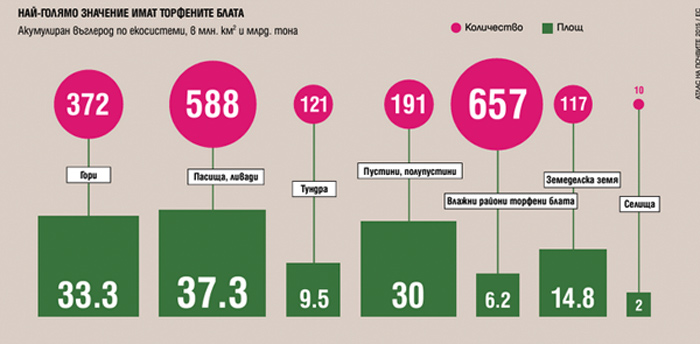
Figure 1: Accumulated carbon by ecosystems, in million km2 and billion tonnes. Source: Soil Atlas, Za Zemiata, 2020.
Soils are a natural reservoir for carbon, thereby reducing greenhouse gas emissions into the atmosphere. They contain approximately twice as much carbon as the atmosphere, and if inorganic carbon forms (free CO2) are included, this indicator increases to three times more. This capacity of the soil makes it an important natural buffer against climate change.
On the other hand, agriculture contributes significantly to negative climate trends through the emission of greenhouse gases. Unsustainable soil management and inappropriate agricultural practices lead to the release of carbon stored in the soil into the atmosphere in the form of carbon dioxide, which intensifies climate change.
What are the current challenges to soil health?
Soils are exposed to serious threats that jeopardize their resilience and their ability to sustain ecosystems.
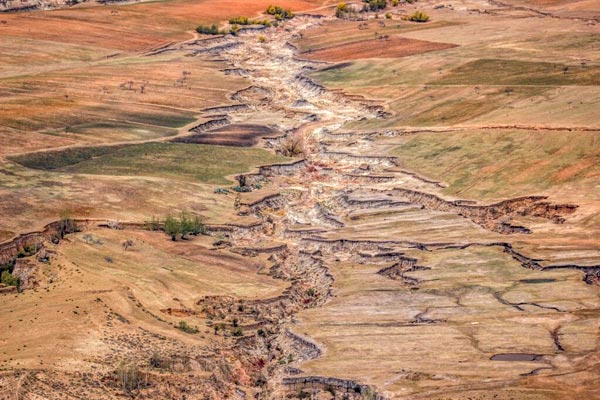
Photo 1: Soil degraded as a result of erosion. Source: Wikimedia
One of the main challenges is land-use change – the conversion of forests and grasslands into arable land or new pastures, which leads to a significant loss of soil carbon stocks. Globally, about 10% of total greenhouse gas emissions come precisely from this. In Europe, the greatest release of carbon dioxide from soil is observed in connection with land-use changes, bearing in mind that European soils currently absorb up to 100 million tonnes of carbon per year.
Other intensive agricultural practices such as the excessive use of agrochemicals lead to soil degradation, which encompasses physical, chemical, biological and ecological aspects of soil properties and causes erosion, acidification, desertification and pollution of soil resources. This leads to serious consequences such as reduced fertility and food production. Increased risk of landslides and floods is another part of the long-term consequences of agricultural land degradation, which affect food security and the resilience of ecosystems.
Healthy soils save financial resources and ensure better food security
Soil quality is factor number one for the productivity of agricultural crops and for our ability to meet the growing global demand for food. Soils rich in nutrients ensure healthy plant growth, high yields and crops with good nutritional value. Investments in soil health bring significant economic benefits. Healthy soils require less use of chemical fertilizers and pesticides, which reduces production costs and increases the long-term profitability of agriculture. In addition, they provide stable yields even under extreme climatic conditions, which protects farmers from losses.
With the increasing pressure on agricultural land, it is becoming ever more important to apply science-based soil conservation measures. For example, research shows that as air temperatures rise, yields may decrease, and with them the amount of carbon that returns back into the soil. This leads to a gradual loss of soil fertility.
Soil fertility models developed for different regions such as Tanzania, Brazil, Argentina, the Netherlands, France and Australia confirm these trends. The results indicate that increased carbon dioxide concentration in the atmosphere can partially offset yield losses, as it stimulates photosynthesis. However, this occurs at the expense of a reduction in the thickness of the humus layer, in which the main amount of carbon bound in the soil is found. Thus, when long-term processes are taken into account, this effect proves insufficient.
How can we save the soils?
The greatest threat to healthy soils is agriculture.
Since the Industrial Revolution, approximately 135 billion tonnes of soil have been lost from agricultural land through a combination of practices – deforestation, monocultures (growing a single crop year after year), overgrazing, tillage with heavy machinery and the misuse of fertilizers and pesticides.
Agriculture by its very nature affects the environment and natural biodiversity and, unfortunately, there are no completely benign practices. Different approaches vary significantly in the degree of their impact. The key is to find the balance that will allow us both to ensure adequate nutrition for 10 billion people and to maintain soil fertility at a sustainable level.
Modern methods of soil fertility management provide effective solutions. The introduction of better soil management practices and adaptive agricultural approaches – such as adjusting operations according to weather conditions instead of fixed schedules for planting, fertilizing and harvesting – will improve yields and reduce agriculture’s carbon footprint.
Some of the sustainable agricultural practices are:
- Regenerative agriculture: This is an important first step, in which changing agricultural practices can minimize soil degradation. It includes regular crop rotation, sustainable grazing (efficient use of pastures that preserves the long-term productivity of the land) and mixed-use farming methods such as agroforestry, which involves planting trees together with crops.
- Agroecological approach, which takes into account the complex relationships between soils, plants, animals and people. This approach includes increasing soil organic matter, promoting biodiversity and regular monitoring of soil condition.
- Energy-saving tillage technologies, such as no-till or minimum tillage agriculture, which reduces erosion and helps preserve soil structure.
- Optimal crop rotation, which prevents soil exhaustion and reduces the risk of crop diseases.
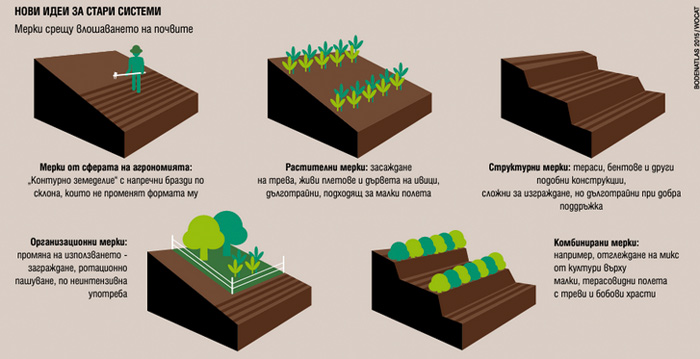
Figure 2: A combination of measures is the best solution. Even smallholders can significantly improve their yields. Source: Soil Atlas, Za Zemiata, 2020.
What is happening in Bulgaria?
In Bulgaria there is still no targeted strategy and consistent public policy that addresses the systematic protection of soils. Nevertheless, at local level some promising practices are beginning to be applied, serving as examples of good soil resource management. One of them is the concept of no-till (or minimum-till) agriculture, known as no-till, which is already being implemented on an experimental level in Bulgaria as well.
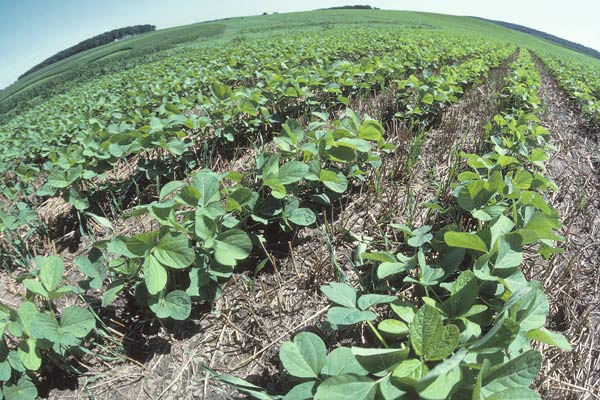
Photo 2: No-till soybean cultivation on wheat residues. Source: Wikipedia

In addition, organic farming is gaining popularity as an environmentally friendly approach that limits the use of synthetic chemicals and promotes natural processes for restoring soil fertility.
These practices are still limited, but they form the basis for larger-scale initiatives and integrated policies that include soil protection as part of national efforts to address global climate challenges.
Soil is at the foundation of almost every human activity — from the plants we grow to almost all the food we consume. That is why the necessary changes for its protection and restoration must be comprehensive and a priority. It is crucial to raise awareness of the importance of soil and the risks it is currently exposed to, so that soil health can take a central place in the environmental debate.
Until now, the richness and vitality of this invisible underground world, which is nonetheless decisive for the existence of all life on the planet, has often been neglected. All environmental goals we pursue are inextricably linked to the state of the soil. Without its protection, progress in other areas will be impossible — and we are still far from this essential breakthrough.
The article uses materials from:
1. Butovsky R.O. Soil Biodiversity and Global Climate Change/ Land use, biodiversity and climate change/ Proc. International Geographical Union (IGU) Commission Seminar. December 11-13, 2010. Guwahati. Assam. India.
2. Lal R. Soil carbon sequestration impacts on global climate change and food security. Science. 2004. V 304. P. 1623-1627.
3. Schils R., Kuikman P., Liski J. 2008. Review of exicting information of the interrelations between soil and climate change (cited by Assessment…2010).
4. UNDP Human Development Report 2007/2008. Fighting climate change: human solidarity in a divided world. UNDPPress. 384 pp.