

![MultipartFile resource [file_data]](/assets/img/articles/заглавна-царевичен-пробивач.jpg)
Summary
In our country, maize is a traditional crop. Very often it is grown as a monoculture, which leads to a massive increase of economically important diseases and pests, including the European corn borer (Ostrinia nubilalis Hübner), which in certain years is capable of causing significant damage. For this reason, it is necessary to be familiar with the morphology, biology, damage caused, and control measures for this pest.
In our country, maize is a traditional crop and provides the main part of the concentrated feed and silage for livestock farming. Under the conditions of Northern Bulgaria, it occupies a large share of the arable land in agricultural holdings (Palagacheva, 2019).
Maize is a crop that is attacked by many pests (Ivović., 2015).
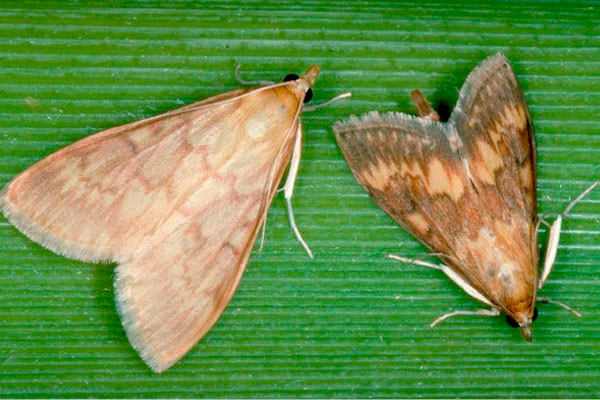
Female and male individuals of the European corn borer (Ostrinia nubilalis Hb.)
One of them is the European corn borer (Ostrinia nubilalis Hübner). The large-scale cultivation of maize in Europe has contributed to its rapid spread (Ivezić et al., 2020). Annual losses caused by the pest and the costs of control exceed one billion dollars (Calvin, 2024).
The European corn borer is one of the main pests of maize (Zea mays) in Europe, Asia and America.
Ostrinia nubilalis Hübner was first described by Hübner in 1796. The first reports of damage by the European corn borer on maize date from the end of the 19th century in France (Robin, 1884). In Russia the species was described as a pest of hops, millet and hemp. In the USA, Ostrinia nubilalis was recorded in the northeastern parts in 1900 (Caffery and Worthley, 1927). In our country, the species was reported by Popov (1936) in 1933-35.
Hosts
The European corn borer has a wide feeding specialization, attacking more than 223 plant species (Franeta, 2018) belonging to the families: Poaceae, Polygonaceae, Amaranthaceae, Solanaceae, Fabaceae, Malvaceae, Cannabaceae, Iridaceae, Cucurbitaceae and Apiaceae.
Morphology
There is a clearly expressed sexual dimorphism. Females are larger than males. The forewings are light brown. Two dark zigzag stripes run transversely across the wings. The hindwings are lighter with a pale white band. With wings spread, they reach 27-32 mm. Male individuals are smaller; the forewings are light brown with pale yellow stripes and fringes, and the hindwings are light yellow with a lighter broad band. With wings spread, they reach 20-26 mm.

Egg
The egg is milky white and flat. The egg masses are arranged like fish scales. Their chorion is transparent and through it the developing embryo can be observed (Lazarov et al., 1959).
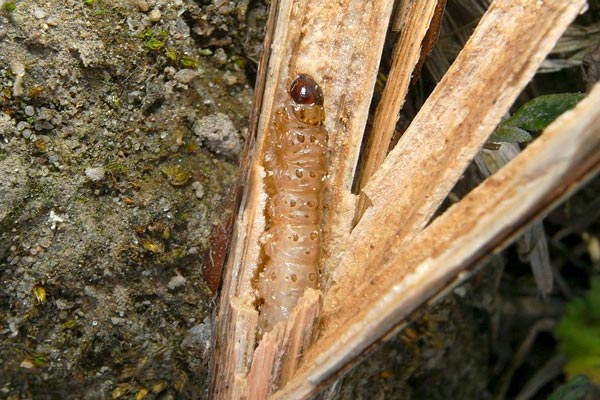
Larva
The larva is yellow-gray with a reddish tinge. A dark stripe runs longitudinally along the dorsal side. The head, thoracic and anal shields are brown.
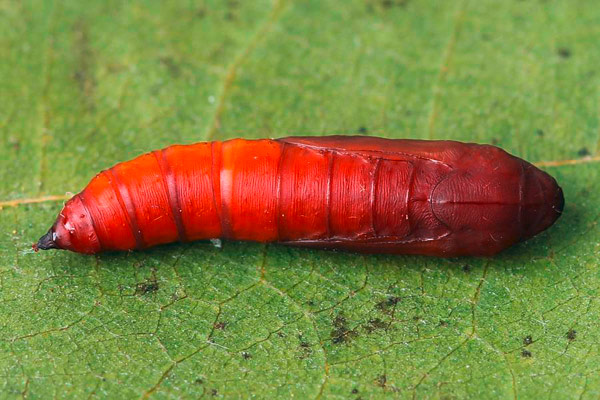
Pupa
The pupa is brown, with four projections at the end.
Biology
The European corn borer develops two generations per year and overwinters as a mature larva in maize stalks and in a number of weed plants. In spring, at mean daily temperatures of 15-16°C, the larvae begin to pupate. For normal pupation, the stalks must be moistened by spring precipitation or there must be high air humidity. Under severe drought conditions, they die. The pupal stage under normal conditions lasts from 10 to 25 days. The flight of the moths of the first generation begins in May at a temperature sum of 230°C (sustained temperatures above 10°C), and of the second generation in July at a temperature sum of 512 °C (above 15 °C) (Lecheva et al., 2003).
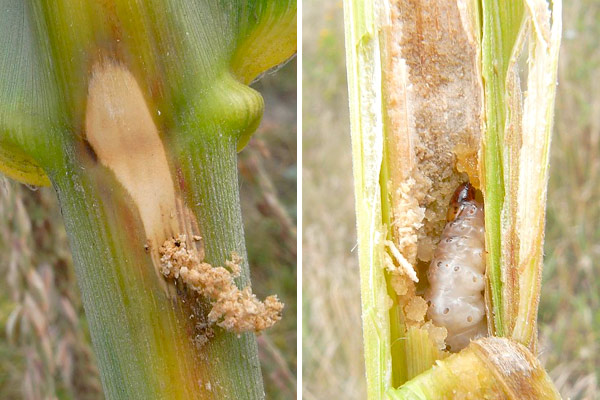
Females lay their eggs on the underside of the leaves, in groups of 16-18. The fecundity of a single female is up to 1200 eggs. After 3-12 days the larvae hatch. They feed in the leaf axils, after which they bore into the stalk where they complete their development. At the site of boring there are light brown excrements resembling sawdust (Szőke et al., 2002). When the larvae feed on the leaves, this leads to a reduction in assimilation, and when feeding inside the stalk, the physiological status of the plant deteriorates (Szőke et al., 2002). The larvae develop until maize harvest. They make a cocoon in the stalk and remain there to overwinter.
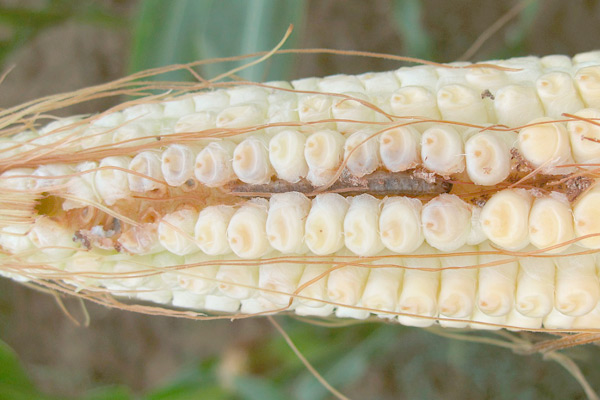
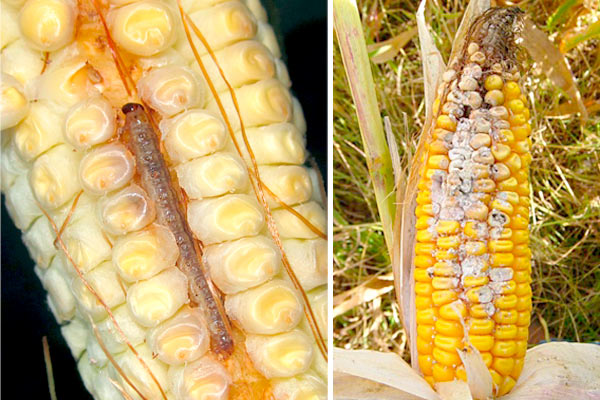
In damaged maize ears, conditions are created for the development of secondary pathogens of the genera Fusarium and Aspergillus (Szőke et al., 2002; Arias-Martín et al., 2021).
Control measures
• Phytosanitary monitoring
The density of overwintering larvae is determined in autumn before maize harvest. In a field of up to 50 ha, 100 maize plants are inspected at 25 locations × 4 plants, arranged in a checkerboard pattern in the field. When 25-30% of plants are found to be infested, the forecast is for low density (Andreev, 2021).
To monitor the flight dynamics of the European corn borer, the following are used:
• Pheromone traps
They are placed in maize fields at mean daily temperatures of about 15-16°C. One trap is placed per 100 ha and is checked once a week (Andreev, 2021).
To monitor the dynamics of oviposition, observations are carried out on maize plants in the field 2-3 days after the beginning of the flight. In the field, 50-100 plants are marked, taken along the diagonals or in a checkerboard pattern, and every 2-3 days the leaves are inspected from the underside (Nakov et al., 2007).
Control
In order for the control of the European corn borer to be effective, it must include a system of measures such as crop rotation, balanced fertilization, burning of plant residues, destruction of weed plants, etc.
Chemical control with plant protection products is carried out when density exceeds the economic threshold of harmfulness according to the following growth stages:
-6-8 leaf stage - the economic threshold of harmfulness is 10 egg masses per 100 plants for grain maize and 3 egg masses for seed production fields.
-tasseling - the economic threshold of harmfulness is 80-90% infested plants, and for seed production fields it is 10% infested plants.
It is advisable to conduct control against newly hatched larvae using contact insecticides. The following are registered: active substance lambda-cyhalothrin 50 g/l + chlorantraniliprole 100 g/l and the product Ampligo 150 SC at a rate of 30 ml/da; active substance chlorantraniliprole 200 g/l and the products Voliam, Coragen 200 SC and Shenzi 200 SC at a rate of 10-15 ml/da; active substance deltamethrin 25 g/l and the products Deka EC, Deltin, Dena EC, Decis, Desha EC and Poleci at a rate of 50 ml/da; active substance deltamethrin 15.7 g/l and the product Meteor at a rate of 60-80 ml/da; active substance deltamethrin 100 g/l and the product Decis 100 EC at a rate of 7.5-12.5 ml/da; active substance lambda-cyhalothrin 50 g/l + acetamiprid 100 g/kg and the product Inazuma at a rate of 20 g/da; active substance tebufenozide 240 g/l and the product Mimic SC at a rate of 75 ml/da; active substance cypermethrin 500 g/l and the products Poli 500 EC, Cyperkil 500 EC, Ciper T 500 EC and Citrin max at a rate of 15 ml/da.
Among biological means, the egg parasitoid Trichogramma sp. can be released, which is colonized 3-4 times at 6-8 day intervals at a rate of 18,000-20,000 individuals per decare.
Photos © www.lepiforum.org and Assoc. Prof. Dr. Nedyalka Palagacheva
References
1. Andreev, R. (2021). Agricultural entomology for all. Computer Reference.
2. Arias-Martín M., Haidukowski M., Farinós GP., Patiño B., (2021). Role of Sesamia nonagrioides and Ostrinia nubilalis as Vectors of Fusarium spp. and Contribution of Corn Borer-Resistant Bt Maize to Mycotoxin Reduction. Toxins (Basel). 2021 Nov 4; 13(11):780. doi: 10.3390/toxins13110780. PMID: 34822564; PMCID: PMC8620457.
3. Caffery J.D and Worthley, (1927). A progress report on the investigations of the European corn borer. United States Department of Agriculture Department Bulletin №1476 DC February 1927.
4. Calvin, W. (2024). University of Minnesota Dept. of Entomology, Postdoc Researcher Tatum Dwyer, University of Minnesota Dept. of Entomology, MSc Student Fei Yang, University of Minnesota Extension corn entomologist. https://blog-crop-news.extension.umn.edu/2024/02/european-corn-borer-new-pest-old.html chrome-extension://efaidnbmnnnibpcajpcglclefindmkaj/https://rimsa.eu/images/forage_production_vol_22-4_part_2_2019.pdf
5. Franeta, F.M. (2018). Uticaj insekticida na mortalitet i fiziološki stres gusenica kukuruznog plamenca (Ostrinia nubilalis Hbn.) i pojavu sekundarnih gljivičnih infekcija na kukuruzu, Novi Sad, Serbia.
6. Ivezić, A., Rugman-Jones, P.F., Thibaut, M., Ris, N., Ignjatović-Cupina, A. (2020). Molecular identification of Trichogramma species parasitizing Ostrinia nubilalis in corn and pepper in south-east border of Europe. Int. J. Pest Manag. 2020, 67, 346–357.
7. Ivović, D. (2015). Suzbijanje Kukuruznog Plamenca (Ostrinia nubilalis Hbn.) u Usevu Semenskog Kukuruza; Univerzitet u Novom Sadu, Poljoprivredni Fakultet, Departman za Fitomedicinu i Zaštitu Životne Sredine: Novi Sad, Serbia, 2015; 49p.
8. Lazarov, As., Popov,V., Dirimanov, M. (1959). Entomology. Zemizdat. 198 p.
9. Lecheva, I., Grigorov, S., Dimitrov, Y. (2003). Special entomology. Bubble Say Set-Eco. 101-102 p.
10. Nakov, B., Angelova, R., Nakova, N., Andreev, R. (2007). Forecast and signaling of diseases and enemies of cultivated plants. IMN - Plovdiv. 350 p.