

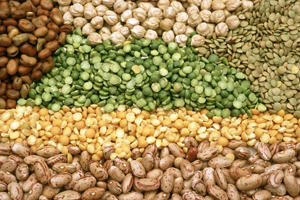
One of the new creative ideas of the EU for stimulating and developing agriculture during the new programming period (2014–2020) includes the production of protein crops within the System of Coupled Support* (direct area payments + the so-called "green payments"). EFA**: this is a new, multifunctional EU project with great impetus and powerful potential. This was the conclusion reached by the participants in the seminar held in Dobrich at the beginning of this year. Agricultural producers from the country received current initial information on the issue of protein crops from the team of the Dobrudzha Agricultural Institute.
What could be the benefits of implementing this project specifically in our country? First and foremost, our unfortunate dependence on imports of low-quality beans, lentils, chickpeas, peas, broad beans, and peanuts mainly from China, Turkey, and some other exotic destinations will cease. Let us recall. A quarter of a century ago, Bulgaria possessed a unique breeding collection of these "small" agricultural crops and produced ample quantities for its own needs, as well as for export. This fact is history and evokes nostalgic memories in some of us. Today we live in a completely different economic and political environment. Our agriculture is part of the unified European agricultural space, and the EFA project provides sufficient financial incentives and motivation for us to be able to restore production and turn it into a profitable business. Let's not forget: these crops have exceptional value for the balanced, healthy nutrition of the nation. Forage protein crops are also an important component in formulating rations for animal feeding.
From what positions does the EFA project start in Bulgaria? The breeding work, insofar as it has survived the shipwreck of our agricultural science, reached in the open sea by the turbulence of the economic tsunami after November 10, 1989, is in the two scientific units – the Dobrudzha Agricultural Institute and the Institute of Forage Crops in Pleven. In this case, securing authentic Bulgarian seed material is a MISSION IMPOSSIBLE! Let's assume that elite seeds could be produced in the institutes, if, of course, they receive adequate funding. But that's it. The national state system for seed production of certified sowing seeds was senselessly and totally swept away. A similar private system simply does not exist. What is the way out? We bid farewell to the unique native breeding and open the doors for the import of foreign genetics. This is not the biggest problem, because there are sufficiently powerful and authoritative world seed companies that will have no objection to selling us their production. In this connection, it should be added that there are also sufficiently successful global agrochemical companies that will strive as quickly as possible to make the relevant registrations in Bulgaria for their plant protection products for these crops. They haven't done it so far because there was no interest in these preparations in our country.
In other words: seeds, plant protection products, and fertilizers will soon be positioned on the domestic market. BASF is already setting the tone in this regard.
However, another problem remains "hanging" in the air. As mentioned at the beginning, protein crops have not been cultivated in our country for the last 25 years. Professional competencies and production habits are at level 0. What does it matter that the economic interest and benefit are present? Unfortunately, they have no relation to good production practices. To an even greater regret, the internet and mobile phone communications cannot replace the agronomic capital resource. What is to be done? Agronomy is not rocket science, but it has its own characteristics that cannot be neglected lightly. In other words: KNOWLEDGE IS NEEDED!
Can this key segment, which would give confidence in the success of the technological cycle, be solved? Or will the familiar scheme be activated: give me money, I don't want brains? The state has a sufficiently large number of informational, scientific, and educational-experimental formats to activate the correct scheme for acquiring knowledge and skills. The question now is, does this state realize (I mean first and foremost the Ministry of Agriculture and Food) that the realization of the EFA, this current and profitable project, depends to a very large extent on it? Or will everything again pass and go with the flow of standard indifference. Miracles do not happen. Everything gets sorted out when you take matters into your own hands!
* The right to receive European funding under the Coupled Support Scheme for protein crops is available to all Bulgarian agricultural producers who cultivate a minimum of 5 decares of the following protein crops (together or separately): beans, lentils, chickpeas, peas (forage and for grain), peanuts, soybeans, broad beans, alfalfa, sainfoin, vetch, clover, lupin, lupine, serradella.
** EFA – Ecological Focus Areas.