

![MultipartFile resource [file_data]](/assets/img/articles/обща-пшеница-болести.jpg)
Summary
Septoria diseases are among the main fungal diseases commonly found in wheat stands. They include leaf blotch and spring leaf blight. Their main impact on plants is yield reduction and deterioration of grain quality. Control is carried out through various agronomic measures and the use of fungicides.
Septoria diseases of wheat are gaining increasing importance for domestic wheat production, along with rusts and powdery mildew. The reasons for this are the favourable climatic conditions for the development of the pathogen, the cultivation of susceptible varieties, and improper agronomic practices. Septoria diseases include leaf blotch and spring leaf blight. They occur every year in wheat crops in our country and, although the yield reduction is lower compared to rusts, they should not be underestimated.
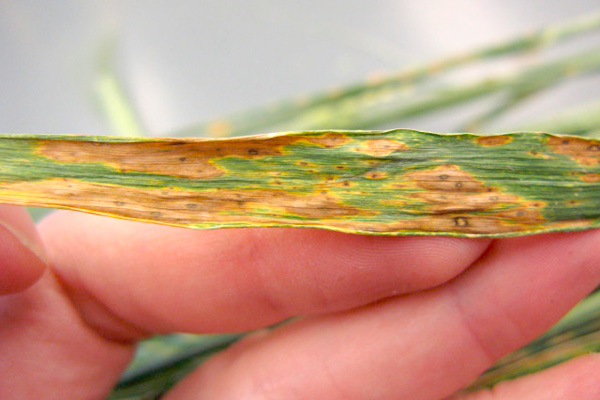
Leaf blotch, also called early leaf blight, is a fungal disease caused by Septoria tritici. Symptoms of the disease can be observed as early as autumn in the form of small grey‑green spots with indistinct margins, which may rapidly enlarge. Gradually, the central part of the lesions acquires a pale brown colour with small black dots (pycnidia) located in it. Similar symptoms can also be observed on the stems of wheat plants. Severely affected plants appear weak, and the grain subsequently obtained is small and shrivelled. In some cases, this may lead to the death of entire plants. Leaf blight develops on wheat simultaneously with diseases such as powdery mildew and brown rust.
The causal agent of the disease overwinters in infected plant parts in the form of mycelium and conidia and, in mild winters, is capable of continuous development. Favourable conditions for disease development occur at high air humidity (80–90%), prolonged rainy weather combined with air temperatures of about 20–22°C.
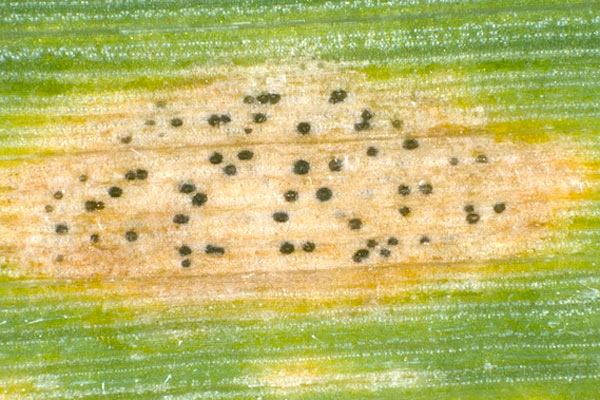
Spring leaf blight is caused by the fungal pathogen Septoria graminum, with symptoms observed in spring in the form of elliptical pale brown spots, which in some cases are delimited by a narrow brown border. Subsequently, numerous dark brown pycnidia appear in the lesions. Under severe infection the leaves scorch and dry out.
The pathogen overwinters as pycnidia in infected plant residues, and the spores formed in them cause new infections in spring. Prolonged rainy weather and high air humidity favour the development of the disease.
Control of the aforementioned phytopathogens is carried out through various measures, including adherence to a two‑ to three‑year crop rotation with spatial isolation from last year’s wheat fields, avoidance of early sowing, and destruction of plant residues and volunteer plants after harvest through soil tillage. Balanced fertilisation should be applied, and high nitrogen rates should not be used, as they make plants more susceptible to infection. Chemical control includes the use of fungicides preventively or when the economic threshold of harmfulness is reached.
Photos ©: C.Grau und B.Burrows
Literature:
- Ponomarenko, A., Goodwin, S., Kema, G. (2011), Septoria tritici blotch (STB). Plant Health Instr, 10.
- Fones, H., Gurr, S. (2015), The impact of Septoria tritici Blotch disease on wheat: An EU perspective, Fungal genetics and biology, 79, 3-7.
- Gilchrist, L., Dubin, H. (2002), Septoria diseases of wheat, Bread Wheat Improvement and Production, FAO Plant Production and Protection Series (30).
- Stavcheva, J. (2003), Atlas of diseases of agricultural crops, Volume 3 Diseases of field crops.
- https://ahdb.org.uk/knowledge-library/septoria-nodorum-disease-symptoms-in-cereals
- Prescott, J., Burnett, P., Saari, E., Ransom, J., Bowman, J., De Milliano, W., .Geleta, A. (1986), Wheat diseases and pests: a guide for field identification.
- Wolf, E. (2008), Septoria Tritici Blotch, Plant Pathology, EP133.
- Loughman, R., Thomas, G. (1992), Fungicide and cultivar control of Septoria diseases of wheat, Crop Protection, 11(4), 349-354.