

![MultipartFile resource [file_data]](/assets/img/articles/cop29-заглавна.jpg)
The largest annual climate change conference – COP29 – is being held in Baku, Azerbaijan. A central topic is the update of financing for mitigation and adaptation measures to climate change for developing countries – a goal set out in the Paris Agreement. During the first three days of COP29, a summit of world leaders took place at which agreement was reached on the rules for carbon credits. The fact that the forum is once again hosted by an oil-producing country with authoritarian governance remains problematic. For the second consecutive year, Bulgaria has its own pavilion and is participating with an official delegation of 72 people, led by President Rumen Radev.
Between 11 and 22 November, COP29 is being held in Baku, with more than 66,000 delegates from 200 countries taking part. Thousands of representatives of fossil fuel companies are once again present, which continues the worrying trend of the last few COPs and further undermines the negotiations. During the first three days, a high-level meeting of country representatives took place, aiming to lay the foundations for the forum’s decisions. So far, no agreement has been reached on most of the key items on the conference agenda, but it is likely that by its end a document with key calls will once again be signed.
Azerbaijan – an oil-producing country is once again the host
For the second consecutive year, the host of the COP is an oil-producing country. Azerbaijan is expected to significantly increase its fossil fuel extraction over the next decade and there is an agreement for its gas exports to the EU to grow by 17% by 2026.
For the first time this year, the conference presidency is shared among three countries – last year’s host (Dubai), the current one (Azerbaijan) and the next one (Brazil). It is also an alarming signal that two of them are oil-producing countries. Such moves are often a reason why these climate conferences fail to achieve sufficiently good results and are used for image laundering by states and companies. The President of Azerbaijan himself described fossil fuels as a “gift from God”, and the chief director of the Azerbaijani representation at COP29 was recorded arranging fossil fuel investments with potential investors.
This year, the negotiations are further overshadowed by the victory of Donald Trump in the US elections, who is known for denying climate change.
During his campaign he once again described it as a “big hoax”. The United States generates the most fossil fuel emissions after China. During his previous term, he withdrew from the Paris Agreement, and later Joe Biden reversed this action in 2021. Although Trump will not take office before January 2025, the current US administration cannot undertake commitments. Overall, it is expected that the United States will once again withdraw from the agreement and make a U-turn towards rolling back environmental protection policies in favour of fossil fuel extraction. The anticipated policies of the new administration could add 4 billion tonnes of greenhouse gases to the atmosphere, according to an analysis by Carbon Brief.
The wealthiest emit more carbon in an hour and a half than the average person does in an entire lifetime, said UN Secretary-General António Guterres in a statement, citing a new Oxfam report. He also stated that doubling the use of fossil fuels is absurd and that the clean energy revolution is here, and no group, no business, no government can stop it. “But (country delegates) must ensure that it is just and fast enough to limit the global temperature rise to 1.5 °C,” he added.
The summit concluded without clear-cut results
António Guterres opened the conference with an emotional statement.
“The sound you are hearing is the ticking of the clock. We are in the last moment of the countdown to limit the rise in global temperature to 1.5 degrees Celsius. And time is not on our side.”
“When it comes to climate finance, the world must pay or humanity will pay the price,” the UN chief stressed, telling world leaders that “you and your governments must be guided by one clear truth: climate finance is not charity, but investment; climate action is not voluntary, but mandatory.”
Financing adaptation and mitigation measures for developing countries is a central topic
Reaching agreement on negotiating the so-called “new collective quantified goal” (NCQG) for financing mitigation and adaptation measures to climate change in developing countries is a key topic of this year’s conference. This goal is required by the 2015 Paris Agreement, under which developed countries must provide climate finance to poorer ones so that they can reduce their greenhouse gas emissions and cope with the consequences of the climate crisis, such as more frequent and more intense extreme events.
According to the latest estimates, developing countries excluding China will need about 1.3 trillion US dollars annually – an amount that the group of developing countries (G77) is insisting on. Some economists estimate it even at 2.4 trillion US dollars. Almost half of this amount is likely to come from existing country budgets and from domestic private sector investment, and the remainder – about 1 trillion – will have to come from international climate finance.
Last year, the establishment of a separate “Loss and Damage” fund was finally confirmed, but according to most expert assessments, the initial financing of 700 million is far from sufficient – a fact also highlighted by António Guterres.
There is progress on carbon credits as well
On Monday, countries gave the green light to quality standards for carbon credits, which are crucial for launching a global carbon market backed by the UN under Article 6 of the Paris Agreement on climate, which will finance projects to reduce greenhouse gas emissions. If all goes well, the market could start operating as early as 2025.
In theory, carbon credits allow countries or companies to pay for projects, such as afforestation, that reduce carbon dioxide emissions or remove it from the atmosphere, and to use the credits generated to offset their own emissions.
Most environmental organisations traditionally criticise emissions trading schemes because they fear that, through this mechanism, companies may continue to pollute for a fee instead of implementing real measures to decarbonise their processes and production.
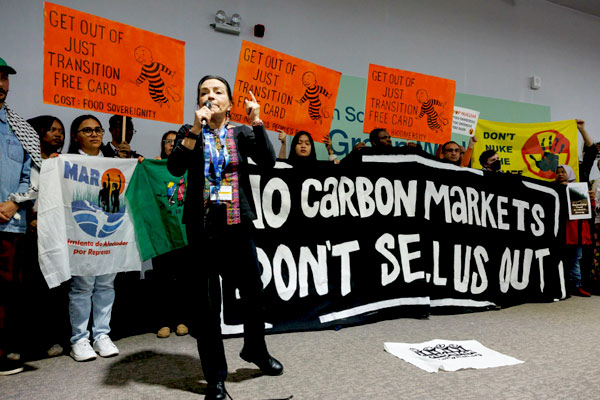
Protest by environmental activists during COP29 against carbon markets. Source of cover photo: Flickr.
As usual, activists are present at the forum this year as well, organising demonstrations to draw the attention of delegates and the public to the lack of sufficient measures to protect the environment and the climate.
The carbon market could be one of the ways for US companies to continue participating in global efforts to tackle climate change, even if the United States withdraws from the Paris Agreement. If this happens, US businesses will be able to continue purchasing credits to meet their voluntary targets.
Countries are obliged to submit new, more ambitious emission reduction targets by February 2025
Nationally Determined Contributions, which represent each country’s climate action commitments under the Paris Agreement, are traditionally an important topic at climate conferences, but this year they are of secondary importance.
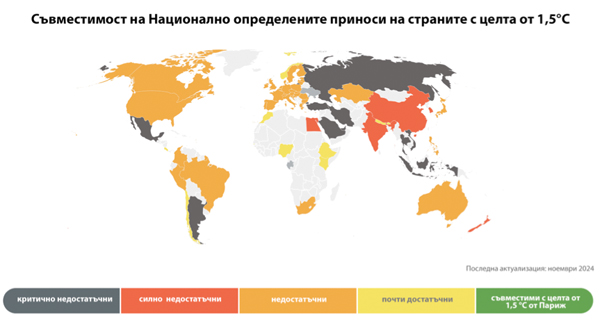
Assessment of the compatibility of countries’ Nationally Determined Contributions with the goals of the Paris Agreement. Adapted from: Climate Action Tracker.
However, the topic cannot be neglected, because the measures of most countries, including those of the EU, are insufficient to achieve limitation of global warming to below 2 °C (Fig. 2).
According to a new report by the UN Environment Programme (UNEP), by 2030 a 42% reduction in greenhouse gas emissions is needed, and by 2035 – 57%, in order to achieve the 1.5 °C target from Paris. If ambition is not raised in the forthcoming new Nationally Determined Contributions of countries and their implementation does not begin immediately, the world will head towards a temperature increase in the range of 2.6 – 3.1 °C this century.
At the same time, the World Meteorological Organization (WMO) has announced that 2024 is on track to be the warmest year in the history of meteorological observations.
Although last year’s conference achieved an unprecedented agreement on a “transition away from fossil fuels”, greenhouse gas emissions continue to rise, and the total for this year is expected to be about 0.8% higher than last year. Then, too, emissions reached a record level, Global Carbon Budget reported.
Ninety percent of the countries under the Paris Agreement have updated or replaced their initial contributions, but the majority of these improvements were made in 2021. Since the end of last year, only Madagascar, Namibia and Panama have updated their contributions, and of these only Madagascar has strengthened its 2030 targets. All other countries, including Bulgaria, are obliged to submit their new updates to the UN by February 2025, which will be reviewed at COP30 in Brazil.
Bulgaria participates with a delegation of 72 people, led by President Rumen Radev
For the second consecutive year, we also have our own pavilion, as well as participation in the Green Transition Forum for Central and Eastern Europe. President Rumen Radev is heading our official delegation of 72 people. He told participants at the Climate Summit in Baku that it is necessary to significantly increase ambition for mitigating the impacts of climate change and to adhere to the course of decarbonising global energy systems. This can happen only if we deploy all available technologies and significantly improve energy efficiency, develop energy infrastructure and keep energy security as our priority.
Bulgaria is determined not only to be part of initiatives for regional energy cooperation in Central and Eastern Europe, the Balkans and the Black Sea region, but also to strengthen ties between the European Union and non-EU countries that share our priorities for climate neutrality, a just energy transition, energy security and low-carbon technological innovation, the Bulgarian head of state underlined.
Our President places emphasis on green hydrogen produced through renewable energy and on the transmission of green energy through Bulgaria. He also supports and expresses optimism and hope for the signing of a declaration of intent on energy connectivity and the use of energy from renewable sources by many countries from Eastern and Central Europe. More specifically, Bulgaria has expressed interest in participating in the joint project “Green Energy Corridor”, which envisages an undersea cable for the transmission of energy from renewable sources between Azerbaijan, Georgia, Romania and the Black Sea, and then to Hungary and the rest of Europe.
Radev also met with the Prime Minister of North Macedonia, Gordana Siljanovska, where he discussed issues related to the country’s European integration. In addition, the energy ministers of Bulgaria, North Macedonia and Albania discussed strengthening energy interconnections between the countries.
Experience from past years shows that a final document with newly set targets will be signed at the last moment, likely even after the official end of the conference.
Until the end of COP29, thematic days are forthcoming, dedicated to finance, the energy transition in the context of peace, health, digitalisation, human development, food, transport, Indigenous peoples, and others. You can read the full programme here.
Nikolay Petkov is an author at Klimatekа. He holds a Master’s degree in “Meteorology” from the Faculty of Physics at Sofia University “St. Kliment Ohridski”. His Master’s thesis is on “Climate indices – analysis of the climate over Southeastern Europe in the recent past and present”. He works at the environmental association “For the Earth” as an expert and coordinator. He is currently studying for a Master’s degree in “Integrated Climate System Sciences” at the University of Hamburg in Germany.
Source Klimatekа