

![MultipartFile resource [file_data]](/assets/img/articles/заглавна-теди-интервю2.jpg)
We are once again speaking with Teodora Taseva from Fito Terra about the challenges in the processing tomato segment in Bulgaria, about the past season, the changing climate, the experience of the agronomists in their company, the role of tomato processing enterprises in agriculture, the difficult market realization, the latest technologies for plant nutrition and, last but not least, the satisfaction of being part of a cohesive team that is always prepared for surprises in the field.
Part II
Although in our previous conversations we have discussed more of the positive aspects and you have taken an optimistic position, you also hinted at some of the challenges encountered in the production of tomatoes for processing. Would you share a bit more from your experience?
I always look ahead and I am an optimist. But the challenges in agriculture are many, and the tomato sector is no exception. When you take on work in such a difficult and responsible segment, you must be aware that there can always be surprises. Global warming and abrupt climate changes do not bypass our latitudes either. As a team, Fito Terra is in the field every day. We monitor temperature changes, as this is important for our work and for the application of the various products. During the extremely hot days, which began in 2024 with the onset of June, we immediately alerted the farmers we work with that all spraying of the crops must be carried out only late in the evening or very early at dawn. We carefully selected the products and their dosages.
Our responsibility this year was even greater, as the areas, although slowly, are increasing and in the 2024 processing season reached a volume of 65,000 tons of tomatoes processed for industrial purposes in our country. For comparison, since 2012, when they were only about 20,000 tons, there has been a clear trend of an absolute increase in the cultivated areas with industrial tomatoes. In 2022 they reached 45,000 tons, with a slight decline in 2023 – 35,000 tons, and for 2024, 60–70,000 tons of industrial tomatoes have been declared. Most of the areas in Bulgaria are cultivated with Heinz varieties. In Europe for the 2024 season, Italy traditionally ranks first with 5,350,000 tons of tomatoes, and Greece has produced around 500,000 tons, with Heinz varieties accounting for almost 90% of the market share of industrial tomatoes in the country.
Fito Terra, or how tomato production for processing in Bulgaria can turn into a passion
Our work consists not only in checking the suitability of the transplanted material, but also in monitoring whether our protocols for agronomic activities and practices are strictly followed and how the products of Atlantica Agricola – the Spanish leader in organic fertilizers – are applied. We are constantly in the field together with the farmers to inspect the crops for possible problems – water shortage, excessive irrigation, accumulated moisture, soil deficiencies and even possible pest infestations. All these problems – just some of the many accumulated over the years – must be dealt with by producers, agronomists and all participants along the tomato-growing chain.
When does the preparation for the active season in industrial tomato cultivation begin?
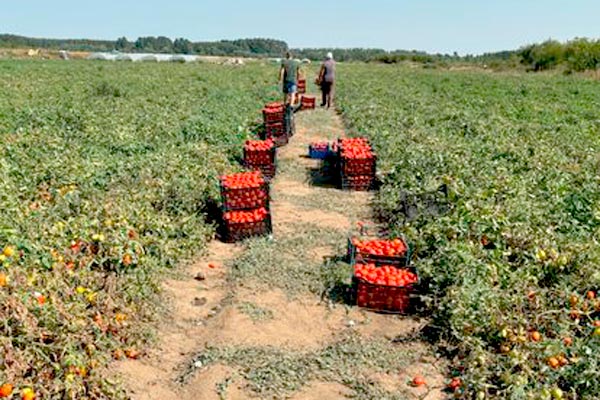
For me, the active season for preparing the planting of industrial tomatoes begins very early – as early as the end of January. At that time, we negotiate with agricultural producers the total area that will be planted with industrial tomatoes. In this way, we can deliver HEINZ seeds or seedlings in good time. The tomato varieties to be grown are also specified then, so that they meet the needs of the processing enterprises. It is also then that a tentative transplanting plan is drawn up, starting from the beginning of April until the end of May, so that the farmers’ crops can be harvested in stages and not all at once. It is also important for the processing enterprises to spread out the incoming production in such a way as to avoid bottlenecks and to be able to process throughout the entire active season from the end of July to the end of September and, in good weather, even until mid-October. A very careful analysis of the previous season is carried out, on the basis of which protocols are drawn up for the use of plant nutrition products – soil fertilization. Only in this way, taking into account the preceding crops in the field, is it possible to draw up maps for product application and protocols for agronomic activities. In addition to work and dedication, a farmer can grow healthy plants and harvest a rich yield with correctly applied fertilizers and plant protection products. Only in this way can they be prepared to cope with problems such as drought and excessively high temperatures, or very high humidity due to torrential rains.
How are so many tons of tomatoes harvested and where is this production marketed?
The marketing of fresh fruit and vegetables is quite difficult, especially when we talk about the industry and the scale of thousands of decares. It is a challenge for a farmer to own a transplanting machine for tomato seedlings, as well as a harvester for their collection. The costs of acquiring such machinery are enormous. It is alarming that it is almost impossible to secure spare parts if a breakdown occurs during the active raw material harvesting season. Another major problem is the perennial search for and shortage of labour. There are hardly any young people left, and those who have remained to work in the field cannot cope with the huge volume of obligations and activities. Let us not forget the bureaucratic obstacles in declaring areas, submitting and filling in documents, the lack of adequate crop insurance in the sector, etc.
On the positive side, industrial HEINZ tomatoes are in demand and preferred on the fresh market, but on the other hand it is regrettable that there are not enough processing enterprises ready to buy up the farmers’ production. Northern Bulgaria in this respect is lagging more than the South. Nevertheless, attempts are being made to change this. Investments are being made in equipment and more and more enterprises are modernizing and focusing on processing their own pesticide-free production. Many enterprises have already realized the advantage and privilege of processing clean Bulgarian raw materials and thus promoting and distributing their final product. They are looking for raw materials grown using new, modern technologies, with an emphasis on environmental protection.
Thus, the use of natural products is of great importance and the focus is on less invasive methods of pest control in the crops. From an economic point of view, it also matters whether a farmer will grow healthy, clean and profitable produce.
You mentioned not only the importance of fertilization, but also of pest control. What is the most significant tomato pest this season?
This year, in the 2024 season, we observed an exceptionally large population of mites. If in previous years two treatments against this pest were sufficient, now even three were not enough. They appeared very early – around 10 June the fields in the land of Plovdiv were already infested. This season the hot weather lasted quite a long time and this favoured the development of their colonies. For comparison, to understand how early this infestation occurred, I should clarify that some producers were still planting their last seedling roots of industrial tomatoes. This was also due to the prolonged rainy period that occurred in May 2024, which in turn hindered the activities of many farmers.
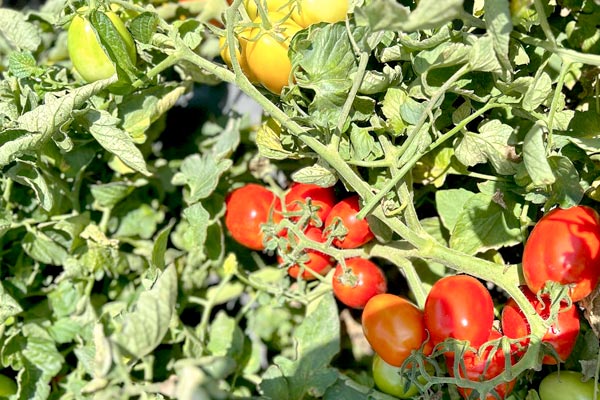
Another very dangerous parasite of tomato is broomrape – Orobanche. Beautiful at first glance, but a very insidious plant. Extremely persistent and rapidly spreading by wind. It requires particularly careful attention and eradication. Its seeds can remain in the soil and multiply quickly. It grows and attaches to the root system of the tomato. It penetrates it and prevents any further development. Something like slow suffocation. Unfortunately, there is still no tomato variety that is completely resistant to this plant. The challenge is to choose such a variety for our gardens and fields that it can be as resistant as possible. In this respect, Heinz is a good choice because the varieties are tolerant to diseases, hot weather and drought. This year as well, we managed to overcome the spread of broomrape in the fields despite the adverse weather conditions we also had to fight. A strong ally were some of the products of Atlantica Agricola. The nutrition of Heinz tomato plants with the fertilizers Fitomare, Razormin, Kelik and Glucocat led to exceptional results – strong and healthier plants, highly resistant to pests.
The numerous problems caused by heavy rainfall and sudden warming, as well as the early massive mite invasion and the occurrence of broomrape in some places, prevented farmers from reacting adequately and quickly to the emerging situation.
For this reason, we at Fito Terra believe that, in addition to pest control, we must also be ready to respond to adverse weather conditions. We focus on properly distributing the risk from planting to harvesting. We always use natural products preventively, which would help the plants to be more resilient and healthier and, accordingly, to yield a richer and cleaner harvest.
You constantly mention “cleaner”. How do the products you use affect the plants and what is your advice to farmers?
We strive to organize agronomic activities in such a way that there is no need, or at least we minimize the need, to use chemical plant protection products in the cultivation of vegetables and fruit. We always recommend natural products. In our segment, the choice has settled on Atlantica Agricola. These are extremely carefully selected ingredients, combined so that the elements in the soil can be better absorbed. They can be applied both through drip irrigation and by foliar spraying, depending on the farmers’ capabilities. These are products containing amino acids and/or seaweed, combined in such a way that they can be applied simultaneously with other products. We have farmers who for years have relied solely on the use of a complete protocol, drawn up specifically for their needs and crops, entirely with products for fertilization and support of the natural development of plants from Atlantica Agricola. We are grateful to each and every one who has placed their trust in us.
These are innovative products and we believe that future agriculture will increasingly use biostimulants and natural products. The best part is that a large share of the components used in Atlantica’s products are manufactured precisely in their plant in Spain, under the strict control of scientists. Thus we are sure that each new product is, first, carefully selected in terms of its ingredients and, second, repeatedly tested in its application.
What is your personal source of satisfaction in your work?
The feeling of assisting and being part of a very large chain is indescribable. My daily life is filled with many and always interesting farmers and different cases. Something is always happening in the field. Our agronomists take care not only of tomato crops, where our main focus lies, but with our help and advice and with the application of our Atlantica Agricola products, cucumbers, eggplants, zucchini, cherry tomatoes, peppers, melons, watermelons, cherries, vineyards, apples and pears, as well as cereal crops are also successfully grown, and some yards and gardens are beautifully adorned with flowers – again nourished with fertilizers proposed under our protocol. That is why the satisfaction and pleasure I derive from my work are immense and I would not trade it for anything else.
I would like to share yet another aspect of my work, namely our great success – the Association of Traditional Bulgarian Canned Foods – ATBK – an industry organization of processing enterprises for traditional Bulgarian products, among which tomato as a raw material, has been accepted as a full member of the global organization for tomato processing – AMITOM. Its members include countries such as Greece, France, Egypt, Iran, Italy, Turkey and Spain – all world leaders in tomato production and processing. Alongside them now stands Bulgaria – boldly stating its ambition to grow tasty tomatoes and to develop the industrial tomato sector.
For more information and details, we will visit you on site. Call us!
The Fito Terra team is expecting you!