

![MultipartFile resource [file_data]](/assets/img/articles/прогноза-ноември-2024.jpg)
In November, agrometeorological conditions will be determined by temperatures and precipitation close to the climatic norms.
The deepened drought in October impeded the sowing of winter cereal crops and part of the planned areas will be sown in November, after the agrotechnical deadlines. As a result of the below-normal October precipitation, soil moisture reserves in the 50 and 100 cm layers in most parts of the country, with the exception of some locations in the northeastern regions (Dobrich), are unusually low for mid-autumn – in some places below 50% of field capacity (agrometeorological stations: Knezha, Bazovets, Kyustendil, Sandanski, Plovdiv, Pazardzhik, Chirpan).
During the first half of the first ten-day period of November, no precipitation is expected and the limiting factor for the development of wheat, barley and winter oilseed rape in most of the arable regions remains the deficit of soil moisture.
After the above-season temperatures at the end of October and the beginning of November, a cooling and a change in agrometeorological conditions are forecast. During most days at the beginning of November, temperatures will be below the climatic norms, but above the biological minimum required for the vegetation of winter cereal crops. During the period, precipitation of economic importance is not expected and the limiting factor for the development of autumn-sown crops remains the deficit of soil moisture. At the beginning of November, in winter cereal crops sown by mid-October, the phases of emergence and formation of 1–2 leaves will be observed.
The risk from cereal flies never decreases
In the initial stages of vegetation of wheat and barley, the crops must be monitored for pests. Damage is caused by the common vole, the larvae of the wheat leaf beetle and cereal flies, and when their density exceeds the economic threshold of harmfulness, timely plant protection measures are required.
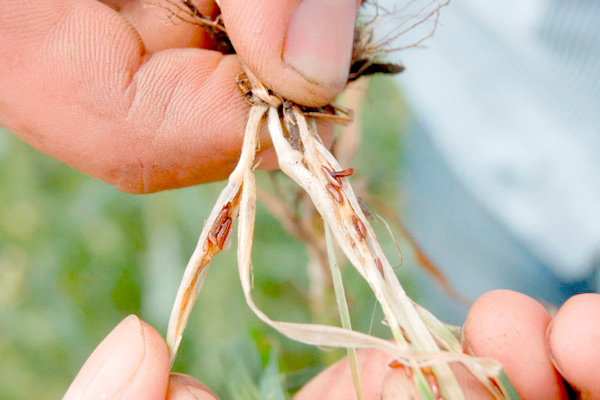
Larvae of Swedish fly
Precipitation and a gradual improvement of moisture reserves in the upper soil layers are expected during the second half of the first and during the second ten-day period of November.
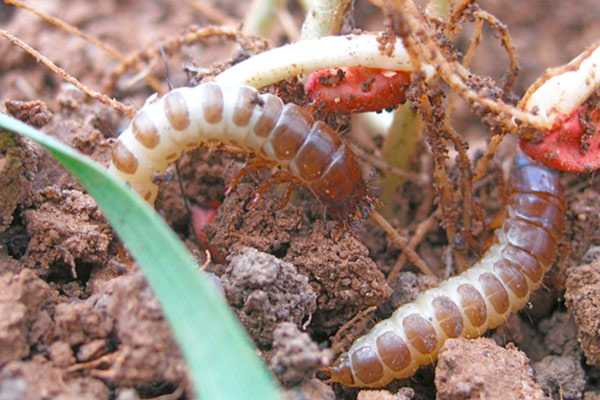
The most dangerous pest of cereal crops is the common wheat leaf beetle (Zabrus tenebrioides), which attacks wheat, barley, maize, oats and a number of grass species.
During the third ten-day period, the forecast values of the average daily temperatures, around and above the normal for the period, will exceed the biological minimum required for the vegetation of autumn crops.
At the end of November, wheat and barley will be at different growth stages – from emergence to 1, 2 and 3 leaves. The third leaf stage will predominate in winter cereals sown in October. In oilseed rape, only part of the crops will manage to enter the rosette formation stage (5–7 leaves) during November.
During the month, the forecast minimum temperatures, down to minus 7°C, are above the critical levels for winter cereal crops in the emergence stage.
In November, conditions for conducting autumn plant protection spraying in orchards will be suitable at the beginning of the month, in the middle of the second and during most days of the third ten-day period. For pome fruit species (apple, pear), to limit scab infections, treatment with a 5% urea solution is recommended. For stone fruit species, after mass leaf fall, spraying with a 2% Bordeaux mixture is necessary against the causal agents of shot-hole disease, early brown rot, peach leaf curl and other pathogens.
The second half of November is a suitable period for planting fruit trees.