

![MultipartFile resource [file_data]](/assets/img/articles/чесън-заглавна-2.jpg)
Garlic has more limited economic importance than onion. It is used mainly as a spice. The aboveground parts of the plant are sometimes used for food, especially while they are tender and young. It is grown for mature and green garlic.
The best preceding crops are those that vacate the field early, have been heavily manured with farmyard manure and leave the area free from weeds. Garlic is usually included in vegetable crop rotations after tomato, pepper, eggplant, watermelon, cucumber, garden bean, etc. In field crop rotations the most suitable preceding crops are vetch, wheat and barley.
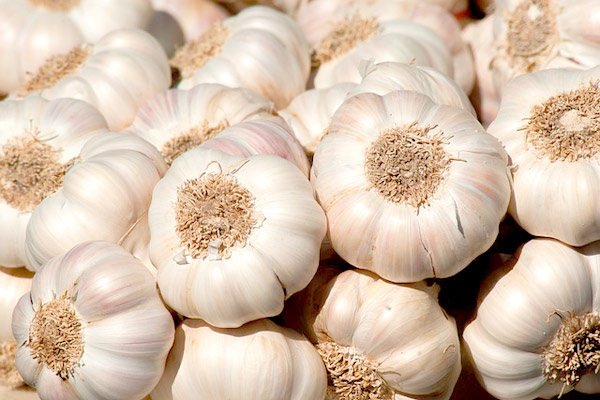
Production of mature garlic
Soil preparation is carried out immediately after harvesting the preceding crop for planting winter garlic, and ploughing at a depth of 15-18 cm for planting spring garlic. Before planting, cultivation or harrowing of the field is performed, depending on the soil condition and its weed infestation.
When growing garlic for bulbs, the best results are obtained when the preceding crop has been heavily fertilized with farmyard manure. Its residual effect, enhanced with mineral fertilizers, is sufficient to ensure high yields. Garlic does not tolerate fertilization with fresh farmyard manure, nor one-sided nitrogen fertilization, because this prolongs the vegetation period of the plants and deteriorates the quality of the bulbs. Before deep ploughing, depending on the soil nutrient status, basic fertilization is carried out with about 15-20 kg/da of potassium and phosphorus fertilizers. In spring, the field is cultivated at a depth of 10-12 cm. With this operation, 8-10 kg/da of nitrogen fertilizer is also applied. When garlic is grown on poorly supplied soils, it may be top-dressed with 15-20 kg/da of nitrogen fertilizer, applied during the first 1-2 hoeings. Top-dressing of garlic with nitrogen fertilizers must be carried out by the end of April, when vigorous leaf growth begins. Late top-dressing, after bulb enlargement has started, prolongs the vegetation period and delays bulb ripening.
In the country two main planting periods for garlic are practiced – in autumn and early in spring. For autumn planting, winter garlic varieties are used, and for early spring planting – spring garlic varieties and, by exception, winter ones. The reasons for this are the poor storability of winter garlic, which under ordinary storage conditions sprouts by spring, and a large part of the cloves rot. The most suitable planting time for winter garlic is mid-October, at a depth of 3-5 cm. Spring garlic is planted early in spring, usually in the second half of February to the beginning of March. Clove size has a substantial effect on yield. The highest yields are obtained when using the largest cloves, which are in the outer circle of the bulb. Preparation of the planting material begins with separating the cloves and sorting them by size immediately before planting, selecting those with an average weight of 2 g. Garlic is planted in a five-row strip according to the scheme 60+25+25+25+25/10 cm. Planting depth is 4-6 cm. For manual planting, furrows are made in advance, in which the cloves are arranged at a distance of 8-10 cm. The distance between the furrows is 15-20 cm. For planting spring garlic 120-150 kg of bulbs are needed, and for winter garlic – 150-200 kg of bulbs.
Crop management during the vegetation period consists of hoeing, irrigation and fertilization. The first hoeing is carried out early in spring, when the plants have just emerged. The number of hoeings is determined by the weed infestation of the soil. In the second half of May, soil cultivation is discontinued. Weed control can also be carried out using herbicides. For obtaining high yields of garlic bulbs, 4-5 irrigations are sufficient. At the end of the vegetation period, when drying of the lower leaves is observed, irrigation is stopped.
Winter garlic is harvested at the end of June, and spring garlic – at the end of July. Delay in harvesting should not be allowed, as it worsens the quality of the bulbs and their storability. The bulbs are lifted and dried in the field until the necks are dry, after which they are stored in well-ventilated places, laid in a layer 10-12 cm thick for final drying. They are stored in ventilated premises similar to onions. The yield from winter garlic is 800-1000 kg/da, and from spring garlic – 600-800 kg/da.
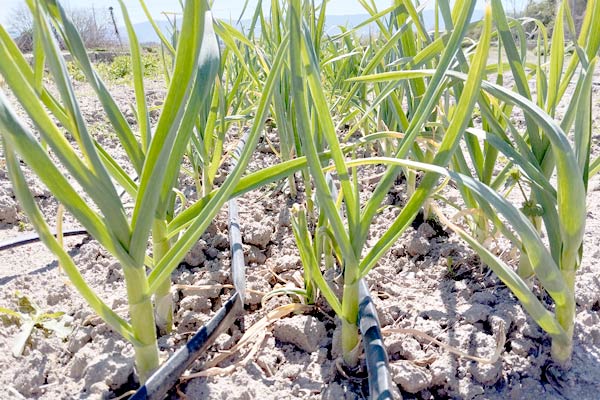
Production of green garlic
Soil preparation consists of pre-sowing fertilization with 3-4 t/da of semi-decomposed or decomposed farmyard manure and 30-40 kg/da of superphosphate and ploughing, followed by cultivation.
The production of green garlic is very similar to the production of green onions from large onion sets. Only winter garlic varieties are used as planting material. The most suitable planting time for green garlic is mid-October, so that by the onset of winter the plants can root well, which protects them from winterkill. Planting is done manually in furrows 5-6 cm deep, with 20 cm between rows and 5-7 cm between plants in the row. Depending on the clove size, 150-300 kg/da of planting material from winter garlic are required.
Early in spring, after the soil surface has dried, hoeing is carried out with top-dressing with 15-20 kg/da of nitrogen fertilizer. It is necessary to ensure irrigation of the plants.
Harvesting begins at the beginning of April. The pulled plants are cleaned of soil and dry leaves and are tied into bunches of 5-10 plants. From 6000 to 10 000 bunches/da of green garlic are obtained.
For weed control in garlic cultivation, the following herbicides can be used: AGIL 100 EC (75-120 ml/da against annual grass weeds at the 2nd-3rd leaf stage of the weeds and 150-200 ml/da against perennial grass weeds at weed height 15-20 cm), applied at the first leaf stage of garlic; BASAGRAN 480 SL (200 ml/da against annual broadleaf weeds), applied at the 3rd-4th leaf stage of the crop; ZETROLA 100 EC 100-150 ml/da against johnsongrass, at a johnsongrass height of 10-20 cm, at clearly visible first leaf of garlic; LENTAGRAN WP (200 g/da) against annual broadleaf weeds; LEOPARD 5 EC (100 ml/da) against annual grass weeds and (200 ml/da) against perennial grass weeds; LONTREL 72 SG (17-21 g/da) against broadleaf weeds; ORDAGO SC (300-500 ml/da against annual grass and broadleaf weeds) applied before emergence or shortly after emergence; PENDINOVA / ADMETO (400-600 ml/da against annual grass and broadleaf weeds) applied before crop emergence; PENDIGAN 330 EC NOV / ACTIVUS (0.4 l/da) against annual grass and broadleaf weeds before or after emergence; PROL AQUA (250-300 ml/da against annual grass and broadleaf weeds), applied after planting the crop, before stem emergence; ROUNDUP FUTURE (100-220 ml/da) against annual and perennial weeds; STOMP® AQUA – (250-300 ml/da against annual grass and broadleaf weeds), applied after planting the crop, before stem emergence; FOCUS ULTRA / STRATOS ULTRA (200 ml/da) against annual grass weeds and volunteer cereals (wheat, barley) and perennial grass weeds, incl. johnsongrass from rhizomes; FUSILADE FORTE 150 EC (80-200 ml/da) against annual and perennial grass weeds; FUSILADE MAX 125 EC (100-250 ml/da) against annual and perennial grass weeds; CHALLENGE 600 SC (400 ml/da against annual grass and broadleaf weeds), applied after sowing before emergence.