

![MultipartFile resource [file_data]](/assets/img/articles/арпаджик-2.jpg)
Among the bulb crops, onion has the widest distribution and economic importance. It is consumed as green onions and as bulbs. It is grown mainly in open fields – using two technologies for obtaining bulbs: two-year cultivation from sets and one-year cultivation by direct sowing. Production of green onions is also practiced.
When onion is grown on small areas, it is included in vegetable crop rotations, with the best predecessors being early potatoes, legumes and cucurbits, tomatoes and pepper. On larger areas, good predecessors are cereal crops – wheat, barley and others.
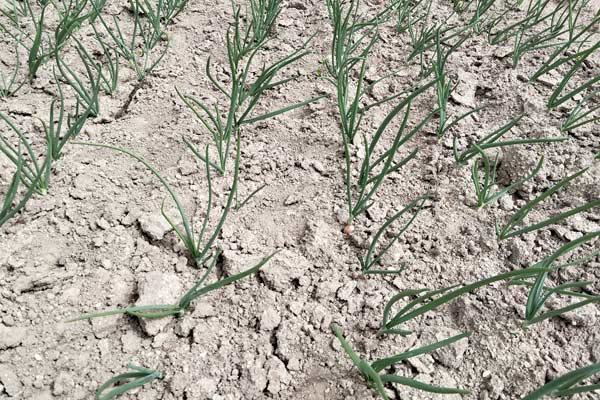
Technology for two-year cultivation from onion sets
First year – production of onion sets. Growing onion by means of sets is the most widespread method in the country. Suitable soils are sandy-loam, fertile, rich in organic matter and free from weeds. Soil preparation starts immediately after harvesting the preceding crop. Stubble disking is carried out when the predecessor is a cereal crop, and deep ploughing after vegetables. The area is ploughed to a depth of 28-30 cm, after applying about 25-30 kg/da triple superphosphate and 15 kg/da potassium sulfate. Until the onset of winter, the soil is disked or cultivated in order to destroy the weeds. Before sowing, depending on the soil condition, it is cultivated or rotavated and 15-20 kg/da ammonium nitrate are applied. Fertilization is carried out in accordance with the soil nutrient status.
Sowing is carried out from 20 February to 10 March – at the first opportunity to enter the field. It is done with a row seeder, in bands at a distance of 50 cm between the bands and 8-9 cm between the rows. The sowing depth is 2-3 cm. The seeding rate is 8-10 kg/da.
In many places in our country and on small areas, the old method of producing sets on high beds is still preserved. The beds are 1 m wide and of length according to the size of the area. Paths 50-60 cm wide are left between the beds and are used for irrigation. The seeds are sown broadcast and covered with 2-3 cm well-rotted, sieved farmyard manure.
The most important care during the vegetation period is timely and regular weed control, since initially the young plants develop very slowly. The first true leaf appears only after 3-4 weeks. During the growing season, when sowing in rows, 1-2 loosenings of the soil are carried out. Weed and pest control is implemented.
Usually the onion sets complete their vegetation at the end of July – beginning of August. The most suitable stage for harvesting is the mass lodging of the pseudostems. The leaves turn yellow from the tip towards the base. The lifted sets are spread in a thin layer under a shelter to dry. The yield is 700-1000 kg/da when sown on beds and 600-900 kg/da with mechanized sowing. Additionally, about 200-300 kg/da large sets (pop fraction, with bulb size 15-22 mm in diameter) are obtained.
Second year – production of onion bulbs from sets. For production of onion from sets, structural, fertile and weed-free soils are selected. Open and well-aerated areas are suitable, where the soil dries quickly and the risk of downy mildew is lower. Soil preparation is similar to that for sets. The most favourable time for planting sets is the second half of February – beginning of March. A suitable scheme for growing onions is a five-row band 60+25+25+25+25/6-8 cm and planting depth of 4-5 cm. Depending on the size of the sets, the planting rate is 80-100 kg/da.
The main practices during the vegetation period are: soil loosening, weed control*, top dressing with mineral fertilizers and irrigation. At the first hoeing, top dressing with 10-15 kg/da ammonium nitrate is applied. Later top dressing leads to prolongation of the vegetation period and delays bulb ripening. Irrigation is carried out by gravity or drip irrigation.
Onion is ready for harvesting when the pseudostem of the bulb has softened and about 25% of the plants have lodged. The lifted plants are arranged under a shelter in a well-ventilated place.
Technology for one-year production of onion bulbs by direct sowing
One-year onion growing by direct sowing has a number of advantages over the two-year method. The production cycle is shortened, conditions are created for a higher degree of mechanization and for obtaining more produce per unit area. It is suitable for semi-pungent and sweet onions and is characterized by a shorter vegetation period of 95-100 days.
The areas must have a good structure, be fertile and suitable for irrigation. Heavy soils that easily form a crust, as well as very light sandy soils that dry out quickly, are not suitable.
When the preceding crop is a cereal, depending on the degree of weed infestation, one or two diskings of the area are carried out. In autumn, the area is ploughed to a depth of 28-30 cm, immediately before which the basic fertilizers are spread, depending on the soil nutrient status (an agrochemical analysis is carried out). In the case of late autumn weed infestation, cultivation of the area may be carried out until the onset of winter. Early in spring, at the first opportunity, if the soil is loose and weed-free, harrowing is carried out, and if it is compacted and weedy, cultivation is done at a depth of 6-8 cm. Fertilization rates are higher and are determined on the basis of an agrochemical soil analysis. At medium soil supply with nitrogen, phosphorus and potassium, 45 kg/da ammonium nitrate, 40 kg/da triple superphosphate and 30 kg/da potassium sulfate are recommended. Before deep ploughing, phosphorus and potassium fertilizers are spread, and in spring, during the operation before sowing, half of the ammonium fertilizer is applied.
The most suitable sowing period is from mid-February to mid-March, using a scheme of cultivation on a high flat bed, in five strips 60+25+25+25+25 cm and a seeding rate of 0.6 kg/da. The seeds are sown at a depth of 3 cm.
During the vegetation period, the crops are hoed, top dressed and irrigated. Weed and pest control is carried out. At the 3rd-4th leaf stage, onion is top dressed with 15-20 kg/da nitrogen fertilizer. Irrigation is a mandatory condition. One-year onion cultivation in our country is guaranteed only under irrigated conditions. Depending on the amount of precipitation during the year and on the variety, the irrigation rate for the vegetation period is from 160 to 300 m3/da of water, supplied with 5-10 irrigations. For normal seed germination during drought, optimal moisture is maintained with regular irrigations with small irrigation rates. Drought should not be allowed during onion growth and development, nor should overwatering occur. For good bulb ripening and improved storability, irrigation is stopped two weeks before lifting the bulbs.
The time of harvesting the bulbs is of great importance for their productivity, quality and storability. It is most appropriate to lift the onions when about 25% of the pseudostems have lodged. If lifting is delayed after complete drying of the pseudostems and in the presence of rainfall, new growth begins.
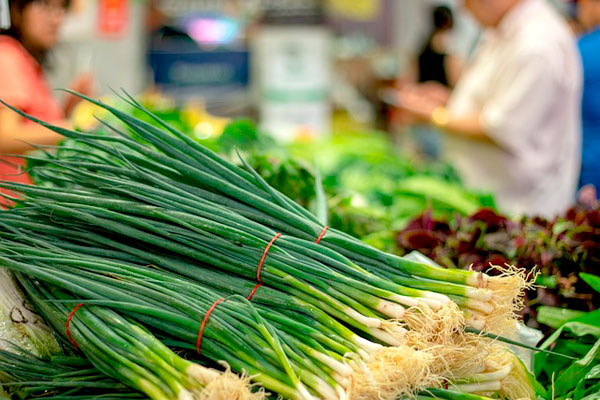
Production of green onions in protected structures and in the open field, depending on the season
During the winter months it is carried out in polyethylene greenhouses, where green onion is grown as a preceding crop. For planting material, the baluchka (pop) fraction or non-standard bulbs – small, deformed, sprouted, but not diseased or rotten – are used. The appropriate time for planting in polyethylene greenhouses is the end of October – beginning of November. The crop is harvested in the period 1-15 March. Green onion is grown on high beds 1.0-1.50 m wide, in rows with a distance of 12-15 cm between them. In the row, the distance between the bulbs is 5-6 cm for baluchka, and non-standard bulbs are planted next to each other. The planting material is planted at a depth of 6-7 cm. During the vegetation period, several hoeings and regular irrigations are carried out. The use of a drip irrigation system is recommended. Top dressing is done with 15-20 kg/da ammonium nitrate. Pest control is carried out.
In the open field, production of green onion is carried out by successive planting. The planting time is determined depending on when green onion needs to be supplied to the market. The first planting period is 1-10 September, and the second is the pre-winter period – at the end of November or in December. The third period is the early spring one, which is carried out as early as possible – at the end of February or beginning of March. Green onion is grown as a preceding crop for medium-early tomatoes, pepper, eggplant, cabbage, celery and others. In this way, green onion is supplied to the market from the beginning of April to mid-July. For planting material, large non-standard sets are used. About 300-400 kg/da sets of the pop fraction are needed. The bulbs are planted at a distance of 10-12 cm between the rows and 6-7 cm within the rows, at a depth of 5-6 cm. Crop management is the same as for one-year onion growing.
The following herbicides can be used for weed control in onion cultivation: AGIL 100 EC (75-120 ml/da against annual grass weeds at the 2nd-3rd leaf stage of the weeds and 150-200 ml/da against perennial grass weeds at a weed height of 15-20 cm), applied at the first leaf stage of the onion; BASAGRAN 480 SL (200 ml/da – against annual broadleaf weeds), applied at the 3rd-4th leaf stage of the crop; DIPOL (125 ml/da against annual grass weeds), applied at the 1st-3rd leaf stage of the weeds, after crop emergence; ZETROLA 100 EC (75-120 ml/da) against annual and perennial grass weeds, including couch grass from rhizomes; CLIOPHAR 600 SL (25 g/da) against a limited number of annual broadleaf weeds and creeping thistle; LEOPARD 5 EC (100 ml/da) against annual grass weeds and (200 ml/da) against perennial grass weeds; LONTREL 600 SL (25 ml/da) against some annual broadleaf weeds and creeping thistle (Cirsium arvense); LONTREL 72 SG (17-21 g/da) against broadleaf weeds; ORDAGO SC (250-400 ml/da against annual grass and broadleaf weeds) in onion (direct sowing), applied before emergence or shortly after emergence; in onion (from sets) it is applied before transplanting; PENDINOVA/ADMETO (300-500 ml/da against annual grass and broadleaf weeds), applied before crop emergence; PENDIGAN 330 EC NOV/AKTIVUS (0.4 l/da against annual grass and broadleaf weeds), before emergence/transplanting; PROL AQUA (350 ml/da against annual grass and broadleaf weeds) in onion (from sets), applied at the beginning of the crop vegetation and up to the 2nd leaf stage of the weeds; ROUNDUP ENERGY (80-470 ml/da against annual, biennial and perennial weeds), treated after planting and before onion emergence (to be applied up to 3 days after planting); ROUNDUP CLASSIC PRO (0.1-1.0 l/da) against annual, biennial and perennial weeds; ROUNDUP FUTURE (100-220 ml/da) against annual and perennial weeds; WISH TOP (83-125 ml/da against annual and perennial grass weeds), applied at the 3rd-4th leaf stage of the weeds; STOMP® AQUA (350 ml/da against annual grass and broadleaf weeds), in onion (from sets) it is applied at the beginning of the crop vegetation and up to the 2nd leaf stage of the weeds; FOCUS ULTRA/STRATOS ULTRA (200 ml/da) against annual grass weeds and volunteer cereals (wheat, barley) and perennial grass weeds, including couch grass from rhizomes; FUSILADE FORTE 150 EC (80-200 ml/da against annual and perennial grass weeds), not applied to spring onion; FUSILADE FORTE 150 EC (80-200 ml/da) against annual and perennial grass weeds; FUSILADE MAX 125 EC (100-250 ml/da) against annual and perennial grass weeds; CHALLENGE 600 SC (250 ml/da against annual grass and broadleaf weeds), applied in onion by direct sowing.