

![MultipartFile resource [file_data]](/assets/img/articles/рапица-заглавна.jpg)
Rapeseed is sown at the end of August–beginning of September. It is a demanding crop with regard to soil – it requires soils rich in nutrients with good water regime. The best preceding crops are wheat, barley, early potatoes, etc. It is infested by several types of weeds: winter–spring, early spring and root-suckering weeds. Early destruction of weeds reduces competition with the crop and contributes to uniform stand establishment and rosette development.
Main rapeseed diseases in autumn
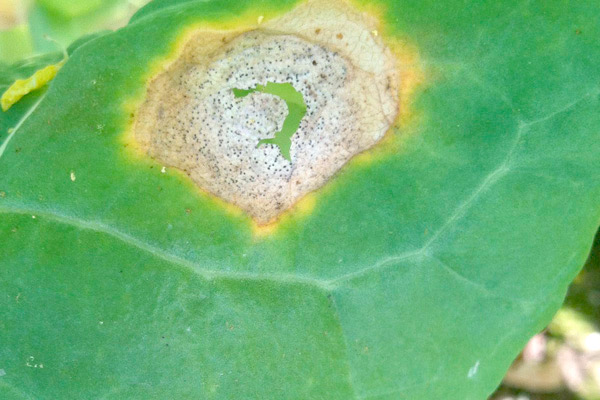
Dry stem rot (Phoma lingam)
The disease in rapeseed manifests itself from plant emergence to the “6th leaf” growth stage. On the lowest leaves irregular rounded, greyish-green spots are formed, with small black dots on them (pycnidia of the causal agent). The spots gradually become necrotic and extend to the petioles and stem. Infection of the stem occurs directly at or just above the soil surface. Phoma also attacks the root collar, causing dark spots which lead to drying out and death of the plants. The disease develops in patches within the stand and, under favourable conditions, very quickly spreads over the entire field.
Therefore, regular autumn monitoring is necessary and treatment should be carried out when the first light-yellow spots appear on the leaves.
The pathogen survives in plant residues and partly in rapeseed seeds. The development of phoma is favoured by rainy and humid weather and an optimal daytime temperature of 22–24 degrees.
Control
For control of the disease, balanced fertilization should be applied and pests in rapeseed should be controlled, since their damage serves as an entry point for infection. It is particularly important to pay attention to the control of the cabbage stem flea beetle, which transmits diseases.
For successful disease control, autumn application of fungicides should be carried out, which will significantly reduce the incidence and severity of infection, as well as the risk of winterkill of the plants.
Measures for the control of dry stem rot also include proper crop rotation and destruction of plant residues.
Dangerous pests in autumn are:
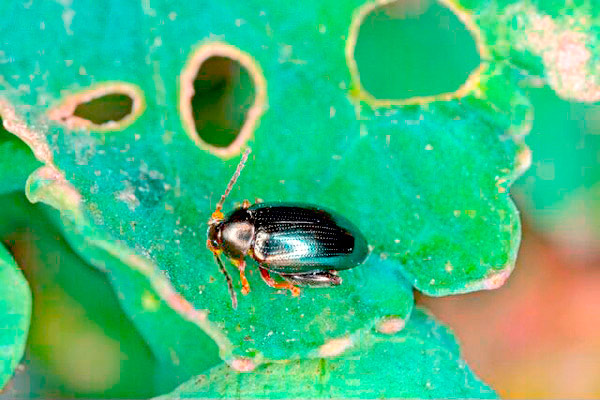
Cabbage stem flea beetle (Psylliodes chrysocephala)
The cabbage stem flea beetle is widespread everywhere and, at high population density, causes enormous damage. The pest develops one generation peryear. It overwinters as egg, larva and adult insect.
In September and October the adults start to feed intensively and from the end of September to mid-December they lay their eggs. The hatched larvae initially bore into the epidermis of the stems, and later into the petioles and main veins of the leaves. Part of the larvae hatch in spring.
A related species to the cabbage stem flea beetle is the small cabbage stem flea beetle. Other harmful flea beetle species on rapeseed are the black, light-legged, wavy-striped, flax, hemp and other species of ground flea beetles.
Control
It causes damage in autumn by feeding on the leaves, making small holes which, as the leaves grow, turn into larger perforations. It can be found in the crop already at plant emergence, therefore continuous monitoring is necessary and, when 2 adults/m² are detected at growth stage 3rd–9th leaf or more leaves, chemical control should be implemented.
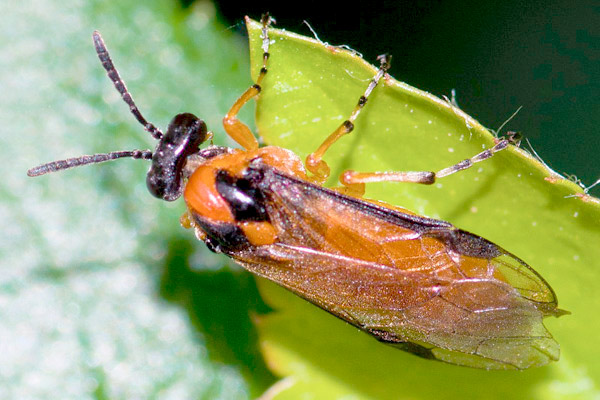
Rapeseed leaf sawfly (Anthalia rosae)
It develops three generations per year, with the greatest damage caused by the larvae of the third generation in autumn – they consume the entire leaf blade, leaving only the main vein. Chemical control is carried out at an economic threshold of 2–3 larvae/m².
In autumn the third generation of the pest develops. Adult sawflies fly until the end of October and lay their eggs on the cotyledons and the first true leaves. Young larvae feed on the underside of the leaves, gnawing them in the form of small pits. As they grow, they chew holes in the leaf blades, which gradually en
large, cause marginal feeding damage and later consume the entire leaf blade, leaving only the main veins. After completing their development, the larvae burrow into the soil and remain there to overwinter.
Control
Control of the rapeseed sawfly is carried out at an economic threshold of 2–3 larvae/m² or 2–3 damaged plants/m².
Aphids (Brevicoryne brassicae)
Adults and nymphs suck sap from the leaves and stems of the crop. The plants are weakened and stop their development. Aphids are vectors of many viral diseases.