

![MultipartFile resource [file_data]](/assets/img/articles/apples-7536537_640.jpg)
The fruit-growing tradition of the Kyustendil region, passed on as experience and culture from generation to generation and from family to family, will once again be presented this year at the autumn festival of the region, the “Festival of Fertility”, from 27 to 29 September. Within the framework of the festival, one of the oldest agricultural institutes in Kyustendil will mark its 95-year history, filled with challenges and scientific achievements.
The “Festival of Fertility” in the town of Kyustendil is a legacy of the First National Fruit-Growing Competition, held back in 1896 precisely in the town of Kyustendil.
In its current format, the autumn festival has been held annually since 2008 and is organized by the Kyustendil Municipality, in cooperation with the Institute of Agriculture – Kyustendil, which each year presents prospective apple varieties grown and cultivated in the region.
Apple varieties bred at the Institute of Agriculture – Kyustendil, resistant to scab
The autumn diversity of the fertile Kyustendil region will be showcased in a rich artistic programme and in colourfully arranged stands with fruit and vegetables. The programme includes a competition for the most beautifully arranged stand and the largest apple, in which representatives of various non-governmental organizations from the entire municipality take part. Every year culinary experts from around the country are special guests of the event. Visitors to the “Festival of Fertility” enjoy sports areas and thematic art workshops with animators.
Artisans and traders from Kyustendil and the region present their artistic works, while agricultural producers sell their clean and healthy produce directly to consumers.
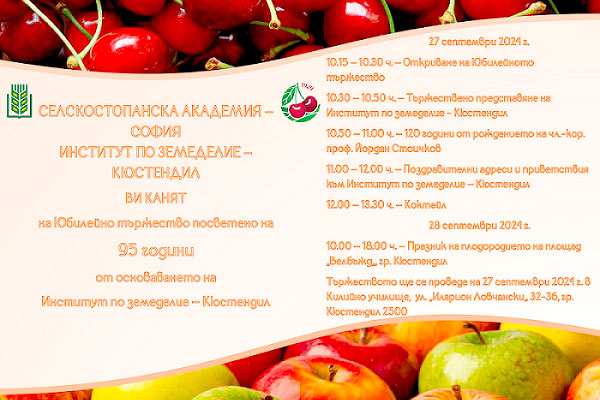
95 years Institute of Agriculture – Kyustendil
The Institute of Agriculture in Kyustendil is the legal successor of the Fruit-Growing Experimental Station in Kyustendil, established by Order of the Ministry of Agriculture and State Property No. 2646/19.12.1929. It is located in Southwestern Bulgaria in a region with favourable natural and climatic conditions for growing fruit species. It is the first centre not only of practical, but also of scientific fruit-growing thought in our country. It began its activity under the direction of Senior Research Fellow First Degree Todor Zahov (1929–1939). Two Decrees signed by Tsar Boris III were issued for the allocation of 283 decares of land from the territory of the village of Nikolichevtsi near Kyustendil to the Experimental Station. At the end of 1944, the Experimental and Control Station was transformed into the Fruit-Growing Testing Institute. Three departments were established: Breeding and Variety Study, Agrotechnics and Plant Protection. Variety and agrotechnical trials were initiated on irrigation, clonal rootstocks, plant protection and others.
In the period 1962–1967 the director of the Institute was Corresponding Member Professor Yordan Stoichkov, who made efforts to modernize the material base (laboratories, greenhouses, etc.) and to enhance the qualification of the scientific staff and auxiliary personnel. The area of land managed by the Institute increased by 1000 decares. Three decares of greenhouses were also established.
In 1965 the Fruit-Growing Department of the Complex Experimental Station in the village of Negovan, Sofia region, was incorporated into the Institute. The first pot experiments with fruit plants were initiated and studies began on the root system of apple, pear and plum, as well as on determining the fertilizer requirements of fruit plants through leaf diagnostics. The first experiments in Bulgaria were conducted to establish the effect of aerial spraying against scab, codling moth and mites on apple. Studies were initiated on the biology and control measures for powdery mildew on apple and leafrollers on cherry. New varieties were approved: pear – Pautalia, and cherry – Pobeda, Kyustendilska Khrushtyalka and Cherna Konyavska.
In the period 1967–1970 more than 250 fruit varieties were introduced from the USA and Canada. The foundations were laid for virological research on cherry and sour cherry, as well as for the targeted use of induced mutagenesis to accelerate the breeding process. The Institute became a centre for the implementation of scientific and technological progress in fruit growing and assumed responsibility for the development of cherry, sour cherry and pear production throughout the country and of apple production in Southwestern and Northwestern Bulgaria. After 1982, when the Agricultural Academy was established in Sofia, the Fruit-Growing Institute in Kyustendil was included in its structure as an independent scientific unit.
Work began on issues related to mechanization in fruit growing, a competition was announced and a research associate was appointed. In 1985 a drip irrigation system was built on an area of 90 decares and a complex of experiments was established with apple varieties, variety–rootstock combinations, irrigation, fertilization and soil surface management. The following were built: a complex with installations for rooting mature and green cuttings and a complex for “tissue cultures” with a laboratory, adaptation facilities and an experimental plot. The following laboratories were equipped and put into operation: two agrochemical laboratories, as well as laboratories of virology, cytology, physiology and microbiology. Bilateral agreements for scientific and technical cooperation were concluded and implemented with related institutes from Russia, Ukraine, Moldova, Germany, Poland, Hungary, the Czech Republic, Slovakia, Serbia, North Macedonia, Greece and others. Introductory activities, as well as the exchange of technologies and scientific and technical achievements, increased significantly.
After the year 2000
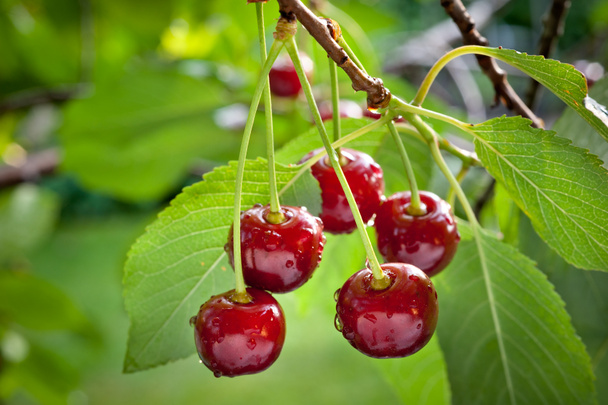
The Fruit-Growing Institute in Kyustendil and the Experimental Station for Fruit Growing and Canning in Kostinbrod were transformed into the Institute of Agriculture. In 2006 the Variety Testing Station in the village of Bagrentsi was incorporated into the Institute and the arable land increased by a further 120 decares. The establishment of gene banks for apple, cherry, sour cherry and plum began. The cherry varieties Danelia and Stefania and the rootstocks for cherry and sour cherry – IK-M8 and IK-M9, as well as the plum variety Kyustendilska Krasavitsa, were approved. At the international exhibition “AGRA” 2013 the Institute of Agriculture in Kyustendil was awarded gold medals and certificates for innovation for the new apple variety Besapara, and in the section “Machinery, equipment and technologies for crop production” for the “Technology for efficient and sustainable production of apple fruit” and the “Technology for cultivation of cherry orchards”. Six apple and four cherry varieties were approved.
At the Sixth National Exhibition – INVENTIONS, TRANSFER, INNOVATIONS – ITI – 2015, the new self-fertile cherry variety Dima was awarded a gold medal and a diploma for innovation.
The apple variety Siyana was awarded a Gold Plaque and a Diploma for Innovation by AGRA 2023 in the category “Plant varieties, animal breeds, organic crop production and viticulture”.
As a result of the introduction and breeding work carried out, a rich gene pool of over 800 varietal accessions has been collected. More than 1500 hybrids are under study, of which 63 have been selected as promising in apple, 59 in cherry, 8 in sour cherry, 5 in strawberry, 4 in blackcurrant and 3 in grape. The apple variety Monroe has also been selected as promising, as well as the sour cherry varieties Feracida and Dwarf Reach, and the cherry varieties Ohridska and Priusadebnaya. The varieties Chachanska Najbolya, Chachanska Lepotitsa, Valevka, Ashatan and Pacific have been selected for their field resistance to sharka (plum pox virus). Two new cross-incompatible groups have been identified among the cherry varieties Kozerka and Germersdorfska with Balgarska Khrushtyalka and Bing, Napoleon, Lambert and Star with Ohridska. The harvesting period of sour cherry fruit has been extended from 35 to 75 days. Tissue culture and embryo culture methods are used for breeding new varieties with early and very early ripening, varieties resistant to abiotic stress factors and for their rapid propagation. The most suitable forms and rates of mineral nitrogen fertilization in cherry have been determined. An improved technology for cherry cultivation has been proposed with three technological solutions – black fallow with organo-mineral fertilization, black fallow with mineral fertilization and bush-type crown. The latest raspberry varieties Lyulin and Samodiva are offered with specific technologies as a fully developed scientific product. Work is at an initial stage on collecting and establishing a collection planting of dessert grape varieties, studying them under the ecological conditions of the region, and on technologies for growing broccoli.
Two scientific products have been validated for implementation in practice – the establishment and cultivation of an apple orchard and a cherry orchard.
Immediately after its establishment, this scientific institution became the first centre not only of practical, but also of scientific fruit-growing thought in our country. At various times, eminent scientists in the field of fruit growing have worked here.
Today, the researchers and specialists strive to meet all the challenges facing agricultural science and practice.