

![MultipartFile resource [file_data]](/assets/img/articles/черна-златака-заглавна-1.jpg)
Summary
The flatheaded root borer Capnodis tenebrionis (L.) is a key pest and causes significant losses in the countries of the Middle East and is becoming increasingly important in Europe and Bulgaria. The management of this insect continues to be challenging due to: the lack of effective monitoring tools; the lack of effective insecticides and the possibility of important insecticides being banned in the future; the ineffectiveness of insecticide applications against feeding larvae, the most harmful stage, which are protected in their galleries; the lack of resistant rootstocks; the scarcity of predators and parasitoids; the absence of some entomopathogens of C. tenebrionis, which are still under investigation and optimization for field application. Training of farmers and workers for dissemination is essential: Adequate training and technical support should be a priority and should focus on the identification of C. tenebrionis, understanding of its life cycle, monitoring of adult populations, management options and identification of affected trees.
Global warming may affect several biological aspects of this thermophilic insect, leading to increased survival of overwintering stages, reduced larval development time, earlier adult emergence, increased adult dispersal, higher fecundity and larger population size. These factors may also favor an annual life cycle of C. tenebrionis instead of a two-year cycle.
The flatheaded root borer has a long life cycle. Adults can live for more than 1 year and can overwinter twice. Adults are thermophilic and become active in spring when the weather warms up, and they begin to feed on young shoots, twigs, buds and petioles. Adult feeding usually occurs on fruit-bearing trees, but significant damage is also observed in nurseries and young trees. Females lay their eggs during summer in dry soil near the trunks of weakened trees. The number of eggs per female varies and depends mainly on temperature. Oviposition can begin in spring when the temperature reaches 23°C and can continue until September. However, most eggs are laid during the period of optimal temperature (30–34°C), which usually occurs in July or August. Under optimal conditions, 1 female can lay more than 1000 eggs per year.
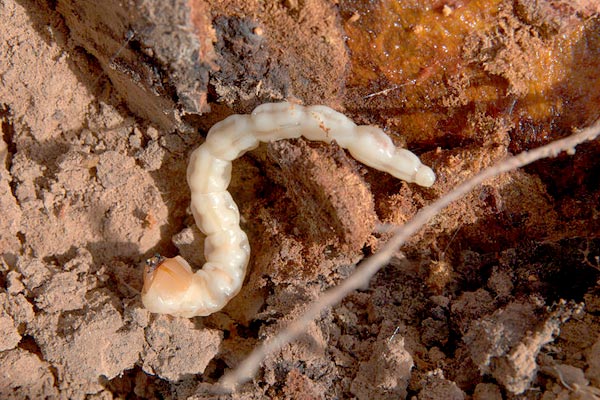
Larva of Capnodis tenebrionis (L.)
Newly hatched larvae penetrate the roots and begin feeding on the bark. The larvae cause the main damage by making “galleries” in the roots and the lower part of the trunk. Several larvae can destroy a large tree in 2 years. Larval development may take from 6 to 18 months under field conditions, depending on temperature and rootstock. After completing their development, the larvae make an exit hole in the wood, usually at the base of the main stem, for pupation. The overwintering stages of C. tenebrionis are adults and larvae of various ages.
The management of this insect continues to be challenging due to:
- the lack of effective monitoring tools
- the lack of effective insecticides and the possibility of important insecticides being banned in the future
- the ineffectiveness of insecticide applications against feeding larvae, the most harmful stage, which are protected in their galleries
- the lack of resistant rootstocks
- the scarcity of predators and parasitoids
- the absence of some entomopathogens of C. tenebrionis, which are still under investigation and optimization for field application.
CHEMICAL CONTROL
Limiting the harmful activity of C. tenebrionis is highly dependent on chemical insecticides. The excessive reliance on chemical control of this pest has led to several negative consequences, such as adverse effects on non-target organisms, development of insecticide resistance and rejection of fruit consignments due to high levels of insecticide residues. These problems have necessitated the search for alternative management strategies such as biological control, resistant rootstocks, cultural practices, etc. Since 2000, several researchers have been investigating the potential of alternative management options. Among these options, biological control with entomopathogenic nematodes and fungi is potentially important. Laboratory and semi-field tests have shown that several isolates/strains of these biological control agents are highly pathogenic to the larvae and adults of C. tenebrionis. In addition, some nematode strains have been found to be effective against this pest under field conditions. Achieving sustainable management of C. tenebrionis requires the adoption of an integrated management approach. This approach includes several management methods, organized in a way that circumvents their limitations and ensures their sustainability. However, there is little information on integrated management of this pest. Moreover, the implementation of integrated management of C. tenebrionis is hindered by the challenge of convincing farmers to adopt alternative management options instead of relying solely on chemical control, especially in developing countries, and by knowledge gaps in some aspects of management, such as monitoring and trapping, field efficacy of some biocontrol agents, timing of biological and chemical control and appropriate formulation of biological control agents.
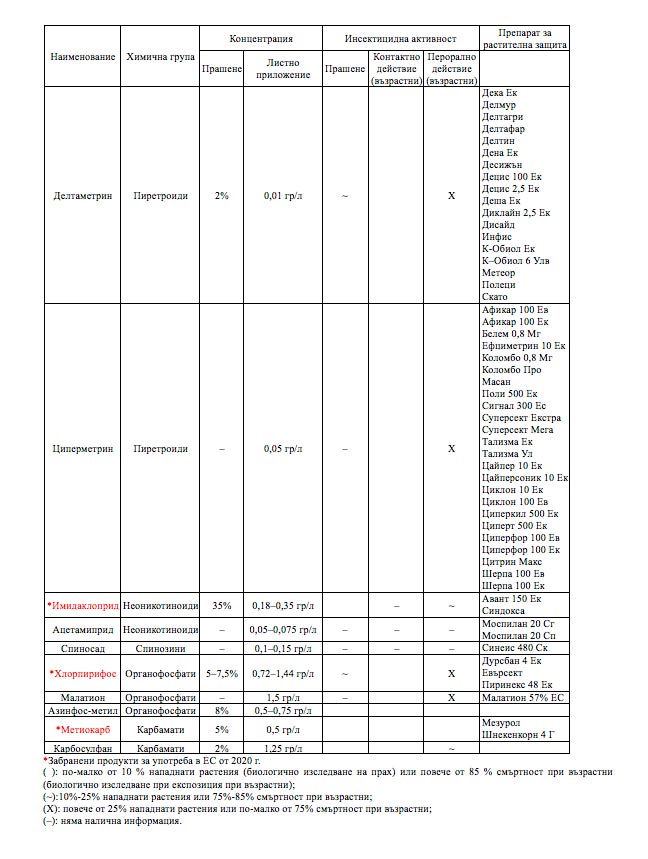
Chemical insecticides have been considered the only feasible option for the management of C. tenebrionis for many years. Organophosphate and carbamate insecticides are commonly used. These insecticides are applied against adults or newly hatched larvae before they penetrate the roots. Accordingly, two types of treatment are used: 1) foliar application to kill feeding adults; and 2) soil treatment around tree trunks (dust) before the onset of oviposition. Repeated foliar applications throughout the entire period of adult activity are not recommended, since the period of adult activity overlaps with fruit harvesting. Therefore, to avoid unacceptable levels of insecticide residues on the fruit, one or two applications of an approved insecticide can be carried out in spring (April–May) to target adults leaving their overwintering shelters and starting to feed vigorously on the foliage. In addition, a final application can be made at the end of summer to kill newly emerged adults of the current year. Several insecticides have been used for foliar application. Some of them, such as deltamethrin, cypermethrin and chlorpyrifos, show high contact toxicity against C. tenebrionis adults but are not effective by ingestion. Other compounds, such as methiocarb, carbosulfan and azinphos-methyl, are highly toxic to adults both by contact and ingestion. Systemic neonicotinoid insecticides, for example imidacloprid and acetamiprid, are used for foliar application. Imidacloprid, however, is no longer used in the EU. Currently, acetamiprid is the only approved insecticide for foliar application against C. tenebrionis in Spain. Spinosyns, which are natural compounds obtained from the fermentation of the soil bacterium Saccharopolyspora spinosa, are also used for foliar sprays. Currently, two spinosyns (spinosad and spinetoram) are the only registered insecticides for foliar application against C. tenebrionis in Italy. They are also approved for use in organic stone fruit orchards. Soil treatment has the advantage of avoiding contact with the tree and therefore can be carried out regardless of fruit harvest time. However, it requires the application of a large amount of insecticide. In bioassays with dusts, methiocarb 5%, carbosulfan 2% and azinphos-methyl 8% provide complete protection and prevent infestation of apricot seedling roots by larvae. Deltamethrin 2% and chlorpyrifos 5% are also effective and significantly reduce root infestation. In another study, soil treatment with chlorpyrifos 7.5% caused 83.3% larval mortality with good residual efficacy. Most of these insecticides, however, have been banned in the EU, including chlorpyrifos, which was banned in 2020. Currently, in Bulgaria there are no approved insecticides for soil treatment against C. tenebrionis. Injection of systemic insecticides into the main stem is a potentially important method of application and requires further study.
Chemical control of C. tenebrionis is hampered by several challenges, including the difficulty of determining the correct timing of application, insecticide residues on fruit, adverse effects on non-target organisms and the environment, development of insecticide resistance and lack of available insecticides, especially after the banning of many previously used compounds.
AGROTECHNICAL MEASURES
Manual collection of C. tenebrionis adults is carried out as a control measure in some countries. Adults can be collected in spring, as they will be less active, unable to fly and easy to catch. At this time of year, they are usually found on the sunny parts of the trees, orienting their bodies toward the sun to absorb heat. This method is labor-intensive and is not suitable for large orchards or in the case of high density of C. tenebrionis. Females of Capnodis tenebrionis prefer weakened trees for oviposition. Therefore, good cultural practices (adequate irrigation and nutrition) are important for maintaining healthy trees. Orchards should be kept clean, with branch residues removed after pruning and dead or heavily infested trees uprooted and destroyed, as C. tenebrionis larvae can still survive in such trees. Female individuals of Capnodis tenebrionis prefer dry soils for egg laying, and moist soils reduce egg hatch rate, with no eggs hatching in 100% water-saturated soils. Good water supply and switching to sprinkler irrigation are associated with reduced severity of this pest. Conversely, switching to drip irrigation and reducing irrigation after completion of fruit harvest are accompanied by an increased frequency of C. tenebrionis outbreaks, as drip irrigation systems can lead to some dry areas around tree trunks suitable for egg laying. However, this problem can be solved by increasing the number of drip emitters per tree and adjusting the irrigation schedule according to weather conditions. The pest exclusion technique, which involves the use of physical barriers to prevent pests from reaching their hosts, is increasingly used in fruit production. However, no information is available on the use of this technique against C. tenebrionis. Theoretically, the use of physical barriers to cover the soil around the base of the tree may prevent female C. tenebrionis from laying eggs and capture newly emerged adults. Mulches or non-woven materials can be used for this purpose. Although relatively labor-intensive and more suitable for small orchards, this technique has several advantages and can reduce or eliminate the need for additional interventions. Therefore, more research is needed to evaluate the efficacy of this technique in preventing root damage caused by C. tenebrionis. Trap trees are another technique used for monitoring and controlling some pests, but their potential has not been investigated against C. tenebrionis. This technique is based on the fact that females prefer weakened trees for oviposition; therefore, girdling several trees in the orchard (by making a ring in the main stem deprived of bark and phloem) would make them more attractive to females. These trees will serve to attract the population and can be treated with high doses of systemic insecticide or destroyed before completion of larval development.
BIOLOGICAL CONTROL
The search for biological control agents against this pest is due to the complexity of chemical control, its negative impact on the environment and the need for alternative management approaches in organic fruit production. According to available data, predators and parasitoids have little impact on this pest.
Predators and parasitoids. Data on predators and parasitoids of C. tenebrionis are scarce, and the currently known natural enemies are not sufficiently effective to provide good control of this pest.
Entomopathogenic nematodes. Entomopathogenic nematodes from the families Heterorhabditidae and Steinernematidae are effective biocontrol agents against many soil-dwelling insects. As far as is known, there are no available data on the efficacy of foliar application against C. tenebrionis. Foliar application has been successfully applied against some insect pests under different climatic conditions, including for grasshopper control in dry conditions. This approach would be an attractive alternative to foliar application of insecticides for the control of C. tenebrionis. Therefore, investigating the efficacy of foliar sprays against adults is well justified.
Entomopathogenic bacteria. Several isolates of Bacillus thuringiensis (Bt) have been found to be effective against C. tenebrionis larvae under laboratory conditions. These Bt isolates cannot be used as insecticidal applications against larvae in the field. However, they are potentially important for highlighting candidate Bt genes for the production of genetically modified stone fruit rootstocks. On the other hand, there are currently no reports of effective Bt isolates against adult C. tenebrionis. In this regard, commercial formulations of B. thuringiensis (Tenebrionis and Kurstaki EG2424), which are active against other pests, have been found to be completely ineffective against adult C. tenebrionis.
The following guidelines can be used to develop an IPM programme for C. tenebrionis:
Practices with long-term effect:
- Training of farmers and workers for dissemination: Adequate training and technical support should be a priority and should focus on the identification of C. tenebrionis, understanding of its life cycle, monitoring of adult populations, management options and identification of affected trees.
- Obtaining healthy seedlings from certified nurseries and grafting onto resistant rootstocks.
- Sprinkler irrigation systems are preferred over drip irrigation systems. However, in areas experiencing drought conditions or with limited water supply, drip irrigation systems can be used with some modifications to improve water coverage around the trees. This may include increasing the number of drip emitters per tree, applying mulch around the base of the trees and adjusting the irrigation schedule according to weather conditions.
Practices with short-term effects:
- Monitor orchards to detect the presence of adults and make appropriate management decisions. In addition, trees should be inspected for signs of infestation, such as gummosis or tree decline.
- Avoid nutritional and water stress, since this pest prefers stressed trees.
- In nurseries and small orchards, manual collection of adults can reduce infestation levels.
- Soil treatment around tree trunks with entomopathogenic nematodes and bacteria in spring (April–May) will allow them to establish and adapt to soil conditions before the onset of oviposition. Therefore, they can provide additional protection to the roots.
- Maintaining adequate soil moisture around the trees during the oviposition period can significantly reduce both egg laying and egg hatching. Adequate soil moisture during this period can also enhance the development of entomopathogenic bacteria and increase the viability of entomopathogenic nematodes.
- Dead or heavily infested trees should be uprooted and destroyed.
- Foliar application of approved insecticides, based on survey and monitoring of adult populations, can be carried out from April to May to target adults from the previous year and from August to October to destroy adults of the current year. In this way, insecticide residues on the fruit can be eliminated or reduced.
References
Nasouri, H. (2024). Capnodis tenebrionis (Coleoptera: Buprestidae), an important pest of stone fruits in the Mediterranean basin: current management strategies and prospects for integrated pest management. Journal of Integrated Pest Management, 15(1), 20.
Aydın, E. G., & Sezen, K. (2023). The isolation and characterization of bacteria isolated from Capnodis tenebrionis L. and their biological control potential against some insect pests. Türkiye Biyolojik Mücadele Dergisi, 14(2), 85-104.
Baradaran, G., Farashiani, M. E., & Poormirzaii, A. (2024). Pests and diseases monitoring in forests and rangelands of Turani, Iran zone in Kerman province. Iranian Journal of Forest and Range Protection Research, 21(2), 374-367.
Karaca, Z., & Demirel, N. (2021). Seasonal population fluctuations and damage rates of Capnodis tenebrionis L. and Capnodis carbonaria L.(Coleoptera: Buprestidae) in apricot orchards in Malatya province. Mustafa Kemal Üniversitesi Tarım Bilimleri Dergisi, 26(3), 661-669.
Bonsignore, C. P. (2012). Effects of environmental temperature on Capnodis tenebrionis adult phenology. Psyche: A Journal of Entomology, 2012(1), 586491.