

![MultipartFile resource [file_data]](/assets/img/articles/торене-броколи-заглавна.jpg)
Summary
Head cabbage is one of the main vegetable crops in the country, ranking fourth in production after potatoes, tomatoes, peppers, cucumbers and gherkins, while broccoli is a less commonly grown crop.
For the proper cultivation of brassica crops and the production of healthy food, nutrients are of essential importance and at the same time a vital component of sustainable agriculture. Yield increase depends both on the main nutrients and on the type of supplementary fertilizers, which may be mineral, organic and microbial, each characterized by specific advantages and disadvantages with regard to crop growth and soil fertility.
Good fertilization management should aim to ensure both improvement and protection of the environment; therefore, a balanced fertilization strategy combining the use of mineral, organic and microbial fertilizers must be developed and assessed.
The production of cabbage and broccoli with integrated use of mineral and organic fertilizers proves to be extremely beneficial. Combining fertilizers improves soil properties and increases yields, while at the same time reducing the need for larger quantities of chemical fertilizers in crop production. Organic fertilizers contain macro- and microelements, growth-stimulating factors indole-3-acetic acid (IAA), gibberellic acid (GA), beneficial microorganisms and increase production in ways similar to chemical fertilizers.
The application of only organic fertilizers also has a beneficial effect, and a good responsiveness of brassica crops to them has been established.
Plant nutrients are essential for plant cultivation, for obtaining healthy food and are a vital component of sustainable agriculture. Yield increase largely depends on the type of fertilizers used to supplement the main plant nutrients. They may be mineral, organic and microbial fertilizers, each having its advantages and disadvantages with regard to crop growth and soil fertility.
Good fertilization management should seek to ensure both the improvement of growth conditions and the protection of the environment; therefore, a balanced fertilization strategy is required that combines the use of mineral, organic and microbial fertilizers.
The different fertilization sources and their duration of use affect the growth vigour during the vegetation period of vegetable crops, the uptake and distribution of nitrogen and the nitrate content in the produce.
Two fertilization schemes are recommended for head cabbage and broccoli, with cultivation of the crops at a spacing of 100+60/60 cm (2083 plants/da) under conventional farming conditions. For a better assessment of the fertilization effect, optimal mineral fertilization has been used. Variant 2 is applicable for late field production of head cabbage and broccoli, but is also recommended for early spring cultivation of head cabbage.
Variant 1:
– optimal mineral fertilization - 50 kg/da phosphate fertilizer, 40 kg/da potassium fertilizer and 30 kg/da nitrogen fertilizer
– combined fertilization with microorganisms, organic and foliar fertilizer
Mineral fertilizers are applied to the soil according to the following scheme:
- ½ of the nitrogen fertilizer with the first hoeing, about 10 days after planting
- ½ of the phosphorus and potassium fertilizer with the second hoeing, about 15-20 days after planting
- ½ of the nitrogen fertilizer with the third hoeing, 20-25 days after planting
- ½ of the phosphorus and potassium fertilizer with the fourth hoeing, 30 days after planting
- 30 kg/da calcium nitrate with the fifth hoeing, 30–35 days after planting
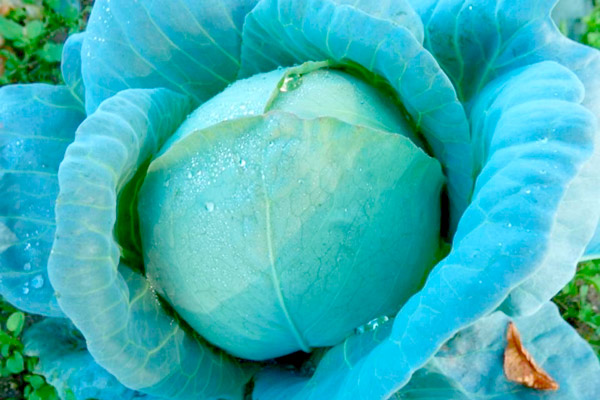
Combined fertilization - cabbage
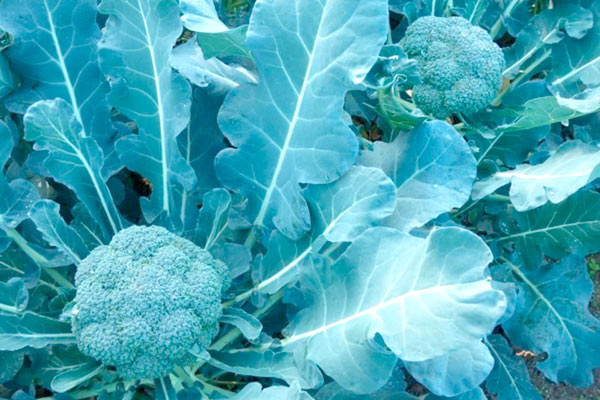
Combined fertilization - broccoli
Combined fertilization - double soil application of liquid fertilizer based on microorganisms - 30 days and 50 days after planting through a drip system, organic fertilizer - three times through a drip system - 40, 60 and 70 days after planting, and foliar fertilizer, applied twice - 30 and 50 days after planting.
With the primary tillage of the area in June, 25 kg/da triple superphosphate and 20 kg/da potassium sulphate are applied to the soil.
Description of the products
Amino acid fertilizers
Soil organic fertilizer Stimac P. It contains amino acids, polypeptides, organic acids and soluble biopolymers.
Foliar fertilizer Stimac. Amino acid fertilizer. Organic matter content – 40% (18% amino acids).
Microbial fertilizer Simargal. It contains the microorganisms: Trichoderma asperellum T6; Bacillus amyloliquefaciens 2/7A and Pseudomonas fluorescens TUR12.2
Properties possessed by the microorganisms used
The microorganisms applied in the preparation are isolated from agricultural soils, and their selection is based on their ability to support the growth and development of cultivated plants. All of them are able to actively stimulate the growth of the root and aboveground parts of the plant. As a complex of microorganisms, they are able to facilitate plant nutrition and supply plants with available forms of the nutrients they require.
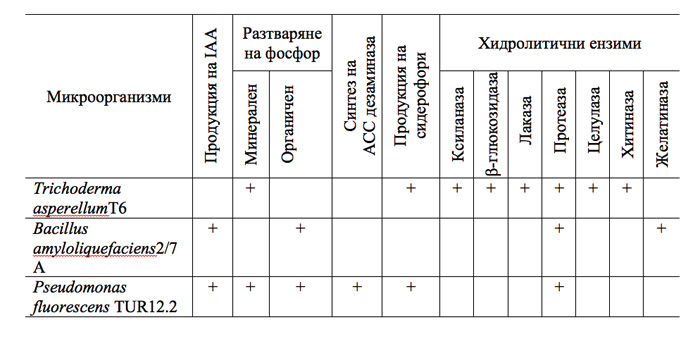
The listed properties enable the combination of microorganisms included in the preparation “Simargal” to actively colonise the rhizosphere, mutually providing each other with the nutrients necessary for their growth and development. Plants inoculated with these microorganisms receive exogenous hormones (IAA) involved in the hormonal balance of growth. They also receive increased amounts of available phosphorus for their development in soils containing sources of insoluble mineral phosphates and organic phosphorus. They have increased resistance to stress factors that raise the level of ethylene in plant tissues (ACC deaminase). The ability of the microorganisms to produce specific chelating agents (siderophores) has a positive effect on improving their competitive ability in relation to the existing soil microorganisms in the competition for iron. At the same time, this facilitates the availability of iron and other microelements to plants. The hydrolytic enzymes produced by the microorganisms participating in the preparation lead to easy and rapid colonisation of the substrate around the plant root, increased overall biological activity of the rhizosphere and displacement of microorganisms harmful to plants.
As a result of the use of combined fertilization with microorganisms, organic and foliar fertilizer, the plants form a marketable part with higher values of the indicators than the control, where granular mineral fertilizers were used. Under the influence of liquid fertilizers applied through the drip system and foliar treatment, together with plant protection products, the plants form heads with 29.85% greater mass and 9% larger diameter compared to the control.
The yield of head cabbage from the variant with mineral fertilizers (1396.478 kg/da) is significantly lower than with combined fertilization (1828.700 kg/da). The yield increase is 31.01% as a result of the use of liquid fertilizers applied to the soil through a drip system and foliar application during the vegetation period of the crops.
In broccoli, the decisive importance of fertilization lies in its effect on the consumable part and its parameters. The central flower heads of plants grown under the combined fertilization variant have a higher mass – 0.358 kg, exceeding those from the mineral fertilization variant by 46.73% (0.244 kg). The central flower head of plants from this variant has 46.72% higher mass and 25.82% larger diameter compared to the control.
Broccoli responds positively to combined fertilization during the vegetation period. Yields reach 746.364 kg/da and are significantly higher than the control variant - 508.359 kg/da. As a result of the use of liquid fertilizers applied to the soil through a drip system and foliar treatment during the vegetation period, a significant increase in broccoli yields has been established, which is 46.85% higher than the control variant with mineral fertilization.
Brassica crops grown under a technology for late field production and drip irrigation respond positively to combined fertilization with microorganisms, organic and foliar fertilizer. A more significant effect has been established in broccoli.
Variant 2:
– optimal mineral fertilization - 50 kg/da phosphate fertilizer, 40 kg/da potassium fertilizer and 30 kg/da nitrogen fertilizer
- Vermicompost – 600 kg/da
- Vermicompost + Humustim - – 300 kg/da + 60 ml/da
- Humustim - 120 ml/da
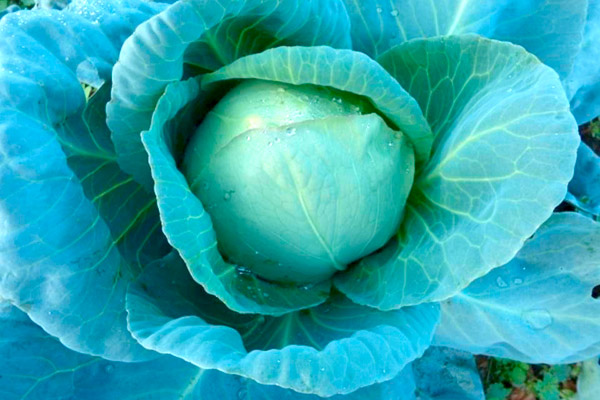
Mineral fertilization - cabbage
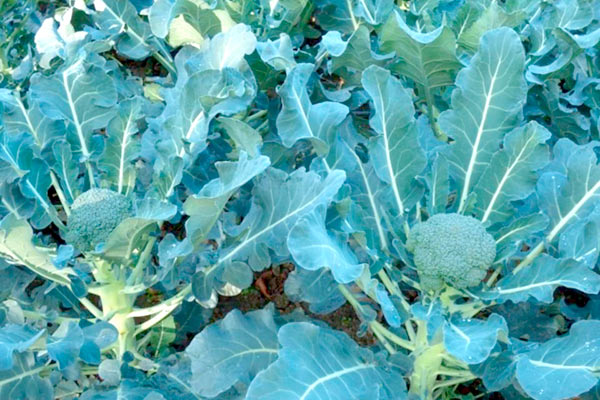
Mineral fertilization - broccoli
Mineral fertilizers are applied to the soil according to the following scheme:
- 1.½ of the nitrogen fertilizer with the first hoeing
- 2.½ of the phosphorus and potassium fertilizer with the second hoeing
- 3.½ of the nitrogen fertilizer with the third hoeing
- 4.½ of the phosphorus and potassium fertilizer with the fourth hoeing
- 5.30 kg/da calcium nitrate with the fifth hoeing
Vermicompost is applied to the soil twice during the vegetation period: ½ of the fertilizer rate with the first hoeing of the plants and the remaining ½ part 14 days later.
Humustim is applied three times by foliar treatment: after plant establishment, at the beginning of head formation and 10-12 days after the second treatment of the plants. In broccoli it is applied after plant establishment and at 14-day intervals.
Fertilization with mineral fertilizers applied to the soil has a better effect on the plants compared to organic fertilizers, where the mass is 1.335 kg. The use of organic fertilizers has a weaker effect and an average mass of 0.923 to 1.194 kg has been recorded. Vermicompost has a better effect than Humustim and as a result of its use the average head mass is 1.194 kg, while as a result of foliar application of Humustim it is 0.923 kg. The combined application of the two fertilizers at fertilizer rates reduced by half has the weakest effect on this indicator, with head mass of 0.852 kg.
With regard to broccoli nutrition, the best effect is observed in the variant with mineral fertilization, where the average mass of the central flower head is 0.213 kg. In the variants with organic sources this indicator ranges from 0.122 to 0.139 kg.
Under organic farming conditions, it is advisable to apply Vermicompost in an amount of 600 L/da, to the soil twice during the vegetation period: ½ of the fertilizer rate with the first hoeing of the plants and the remaining ½ part 14 days later. The plants form heads with a mass of 2.40 kg and a diameter of 20.00 cm, and the yield reaches 2522 kg/da.
Fertilization is the determining factor for yield value, but other factors also have a significant effect, such as: choice of cultivar, cultivation scheme and plant density, irrigation method (drip system or sprinkler irrigation), and the specific characteristics of soil and climatic conditions.
References
1. Chen, J.H. 2006 The combined use of chemical and organic fertilizers and/or biofertilizer for crop growth and soil fertility. Proceedings of the International Workshop on Management of the Soil-Rhizosphere System for Efficient Crop Production and Fertilizer Use, October 16-20, 2006, Bangkok, Thailand, pp: 1-11
2. Dincheva, Ts. 2013. Yield of some broccoli cultivars influenced by bioproducts for fertilization. Ecology and Future, Vol. XII, No. 2, 38-44
3. Todorova, D., Hr. Boteva. 2015. Effect of top dressing with organic poultry manure on the yield and quality of head cabbage. Plant Science, 3, 52-57