

![MultipartFile resource [file_data]](/assets/img/articles/заглавна-ябълки.jpg)
The apple (Malus × domestica Borkh.) belongs to the genus Malus, which is part of the family Rosaceae. The genus comprises more than 33 species, but the wild crab apple (M. silvestris Mull.), Caucasian apple (M. orientalis Uglitz), early apple (M. praecox Borkh.), Kyrgyz apple (M. kirghisorum Al. Et An. Fed.), Turkmen apple (M. turkmenorum Jut.) and Siberian crab apple (M. baccata Borkh.) are considered to be the progenitors of the cultivated varieties grown in Europe. In the countries of Western Asia (Southern Kazakhstan, Kyrgyzstan, Tajikistan and China) its wild-growing ancestors can still be found. Dessert apple cultivars belong to the species Malus domestica or its hybrids. There are more than 10,000 apple cultivars worldwide, but only a relatively small number are represented in large-scale production. More than 10,000 cultivated varieties are known.
It is a fruit species with high ecological plasticity and is grown in countries with temperate and subtropical climates, located between 35°C and 50°C in the Northern Hemisphere and 25°C – 50°C in the Southern Hemisphere.
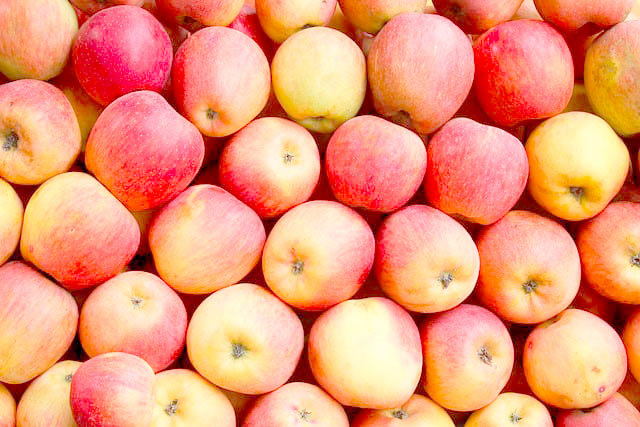
Its fruits contain valuable nutrients (pectin, sugars, organic acids, biologically active compounds, minerals, vitamins, enzymes, cellulose, etc.) and rank among the best fruit foods for humans. By area and fruit production on a global scale, it ranks fourth – after grapes, citrus crops and bananas.
In recent years, the apple-growing areas in Bulgaria also rank fourth – after cherries, plums and walnuts, but in terms of fruit output apple is in first place.
In Europe, the most popular cultivars are Golden Delicious, Gala, Idared, Red Delicious and some of their variants (mutations). In Bulgaria, in addition to these cultivars, Melrose, Granny Smith, Florina and others are also widely represented. Most of them are highly susceptible to diseases and do not meet the modern requirements of growers and consumers, which is why breeders continue to develop and introduce into practice new cultivars with improved biological and economic traits. The most important requirements for new apple cultivars are high fruit quality, good and regular bearing, and resistance to abiotic and biotic stress factors.
The choice of a suitable cultivar is of primary importance for the rational use of the potential of soil and climatic conditions in a given geographical region. Globally, there is a trend towards replacing the assortment in order to respond to constantly changing climatic conditions and consumer preferences. This requires that new cultivars be selected very carefully, following prior study and comprehensive agro-biological assessment.
When testing new apple cultivars, breeders focus mainly on tree productivity and fruit quality (size, colour, appearance, organoleptic and technological characteristics), as well as on flowering time, ripening and storability. Another breeding objective is for the trees to have good and regular bearing, moderate vigour and, where possible, practical resistance to the economically most important diseases and pests.
The climatic conditions in most European countries, including Bulgaria, are favourable for the development of apple scab (Venturia inaequalis (Cke.) Wint.) and powdery mildew (Podosphaera leucotricha (Ellis et Everhart) Salmon), which are among the most important fungal diseases of apple and affect most commercially grown cultivars. They can cause a significant reduction in yield and deterioration of fruit quality, weaken the trees and reduce their resistance to winter and spring frosts. These two diseases are controlled by numerous treatments – preventive or curative applications of fungicides, depending on meteorological conditions, but this is associated with additional financial costs and, in many cases, residues may be detected in the produce, as well as contamination of the environment. A reliable method for controlling scab is the development and cultivation of resistant cultivars possessing the Vf gene. In the 1970s, as a result of breeding programmes in a number of countries, a significant number of apple cultivars resistant to scab were registered, but many of them did not meet the expectations of growers and consumers. Most of these cultivars are characterised by low yields and insufficiently acceptable fruit quality.
Cultivation of cultivars with low susceptibility or resistance to scab is possible with reduced use of plant protection products, and in some years even without the use of fungicides, which is their main advantage and a good prerequisite for establishing new highly efficient orchards.
As a result of long-term breeding and improvement activities at the Institute of Agriculture – Kyustendil, a significant hybrid gene pool of apples has been created. This made it possible in recent years to select and register in 2010 five new cultivars (Besapara, Gorana, Elegia, Marlena and Martinika – bred by Assoc. Prof. Atanas Blagov, PhD) and one more cultivar (Siyana – bred by Assoc. Prof. Atanas Blagov, PhD and Prof. Dimitar Sotirov, PhD), which received a certificate from the Patent Office in 2019. All of them are practically resistant to scab and are suitable for organic fruit production.
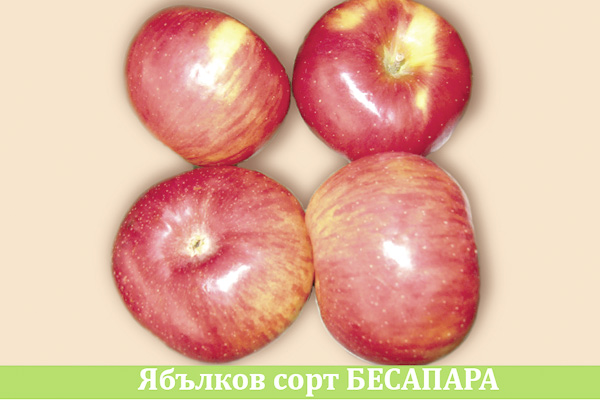
Besapara cultivar
The cultivar is obtained from a cross between Florina and McFree. The fruits are medium-large to large (180-200 g), broadly globose, slightly ribbed. The fruit skin has a light green ground colour, almost entirely covered by a light red overcolour. The flesh is firm, juicy, with very good quality. The fruits ripen in the second half of September and store well. The tree has moderate vigour, is productive and resistant to scab. It bears regularly, mainly on one- and two-year-old wood.
The cultivar is the winner in the Innovation Competition, section “Varietal seeds and planting material“ and was awarded a Diploma and a gold medal by AGRA – 2011.
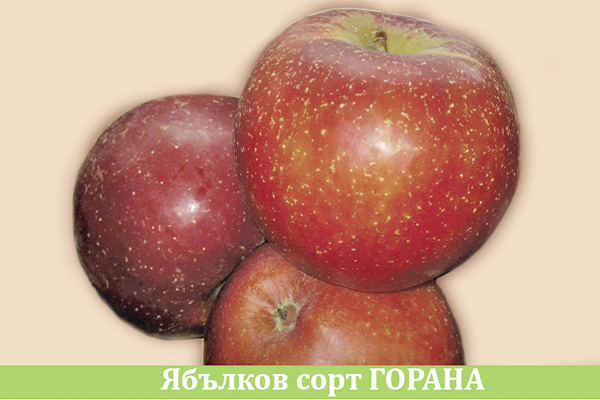
Gorana cultivar
It is obtained from a cross between Prima and Cooper 4. The fruits are large (180-225 g), globose-conical, with a slight waxy bloom. The fruit skin is greenish-yellow, covered with a dark red overcolour. The flesh is firm, cream-coloured, juicy, aromatic, with very good quality. The fruits ripen between 20 and 30 September and under normal conditions store well until the end of January. The tree has moderate vigour and low susceptibility to scab. Fruiting is mainly on one- and two-year-old wood and is regular.
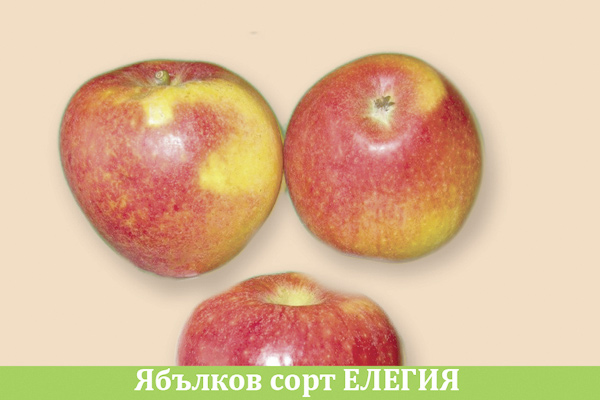
Elegia cultivar
Obtained from the combination Prima × Cooper 4. The fruits are medium-large to large (170-180 g), conical with a slight waxy bloom. The fruit skin has a green-yellow ground colour, covered with diffuse red blush. The flesh is firm, with a slightly pronounced greenish tint, juicy, aromatic and with very good taste. The fruits ripen in the second half of September, about 15 days after those of Cooper 4. They store very well until the end of February. The tree has moderate to strong vigour and forms a relatively broad crown. It shows low susceptibility to scab. It bears regularly and is highly productive.
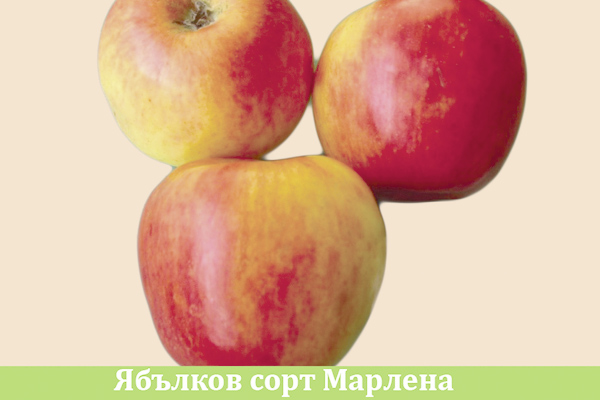
Marlena cultivar
It is obtained from a cross between Florina and McFree. The fruits are medium-large to large (170-210 g), rounded-conical to globose, with a slight waxy bloom. The fruit skin is greenish-yellow, almost entirely covered with a light red overcolour. The flesh is firm, with a slightly pronounced yellowish hue, juicy and of very good quality. The fruits ripen in the second half of September and can be stored until January. The tree has moderate vigour and is practically resistant to scab. It forms a compact crown, which later, as a result of heavy fruit load, opens and becomes rounded. It has high and regular productivity. On MM 106 rootstock it comes into bearing as early as the second year after planting and has regular and good to very good productivity.
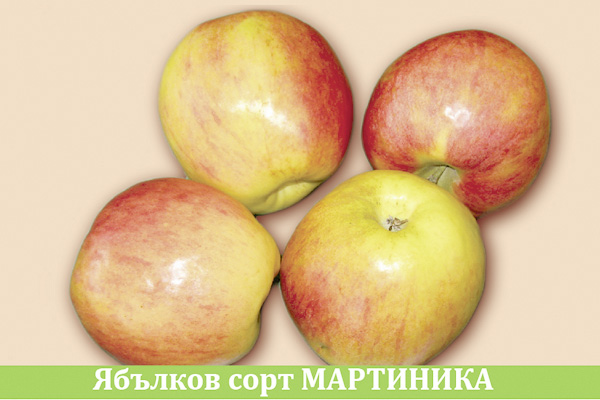
Martinika cultivar
It is obtained from a cross between Prima and Sekai Ichi. The fruits are medium-large to large (175-200 g), globose-conical. The fruit skin is light green, partially covered in patches and streaks with red overcolour. The flesh is firm, crisp, whitish to yellow, juicy, with a slight aroma and very good quality. The fruits ripen towards the end of September and store well until January. The tree has moderate to strong vigour, forms a broad crown and is resistant to scab. It bears regularly and gives high yields.
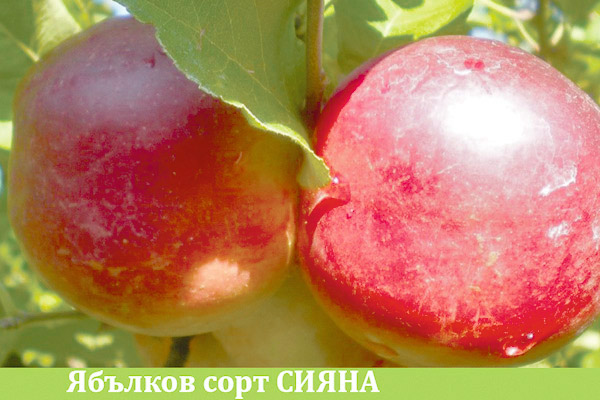
Siyana cultivar
The cultivar is obtained from a cross between Florina and McFree. On MM 106 rootstock, the trees start bearing in the second year after planting. The tree has moderate vigour – lower than that of Florina and similar to that of McFree. The fruits are medium-large (130-150 g), conical-globose, uniform in shape and size. The ground colour of the fruit skin is greenish to yellow-green, and the overcolour is evenly distributed over the entire fruit surface. It is light red, becoming darker red on the sun-exposed side. The fruits are covered with a slight waxy bloom (inherited from Florina). The flesh is creamy, tender, juicy, with a slight aroma and very good quality. The fruits ripen around 20-25 September and have a long storage life – almost like that of Florina. The trees have good productivity. During the study period, no scab infection was detected on the trees.
The cultivar was awarded a Gold Plaque and a Diploma for Innovation by AGRA 2023 in the category “Plant cultivars, animal breeds, organic crop production and viticulture“.