

![MultipartFile resource [file_data]](/assets/img/articles/заглавна-плевели-1.jpg)
![MultipartFile resource [file_data]](/assets/img/articles/заглавна-плевели-2.jpg)
Summary:
Chemical weed control is an indispensable element of the technology for intensive agricultural production of a number of crops. The proper use of herbicides enables the crop to be freed in due time from weed competition. Arbitrary and improper mixing of different herbicide combinations carries a potential risk of reducing their efficacy or of the occurrence of possible phytotoxic symptoms.
Weed control is more effective when agronomic and chemical measures are combined. Among the agronomic measures, crop rotation is of major importance. If heavy infestation with perennial weeds has been established in the field, wheat and barley are included in the crop rotation, as they vacate the land earlier and this creates an opportunity for suitable soil cultivation. In addition, mineral fertilization must be balanced, sowing must be carried out within the optimum time limits and as soon as possible after the last pre-sowing tillage. After sowing, rolling is recommended for uniform emergence of the plants, whereby clods are broken up, the soil surface is levelled and thus uniform distribution and effectiveness in the application of soil herbicides are ensured.
Weeds are strong competitors of oilseed rape and weed infestation leads to many adverse consequences. They not only significantly reduce yield and sometimes may even lead to ploughing up of the stands as early as in the autumn or early spring, but they also reduce the winter hardiness of the crop.
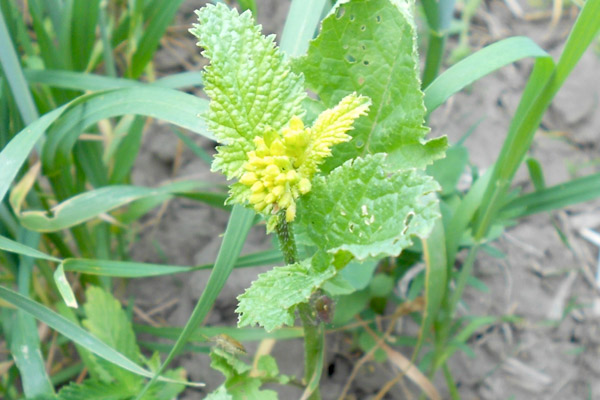
Charlock
The most dangerous and widespread weeds in oilseed rape stands are charlock and wild radish.
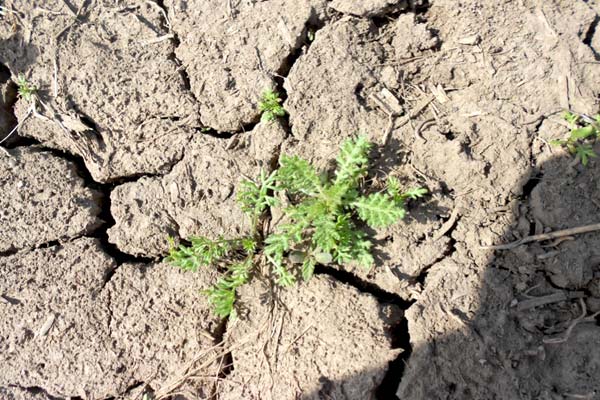
Field speedwell
Species of ryegrass, redroot amaranth, dead-nettle, field speedwell, cleavers, larkspur species, field poppy, field veronica and others are also very common. Autumn herbicide treatment has a major advantage over spring treatment, because rape plants are freed in time from weed competition for light, water and nutrients. If autumn treatment has nevertheless been omitted, spring treatment may be carried out, which to a certain extent is a compromise solution.
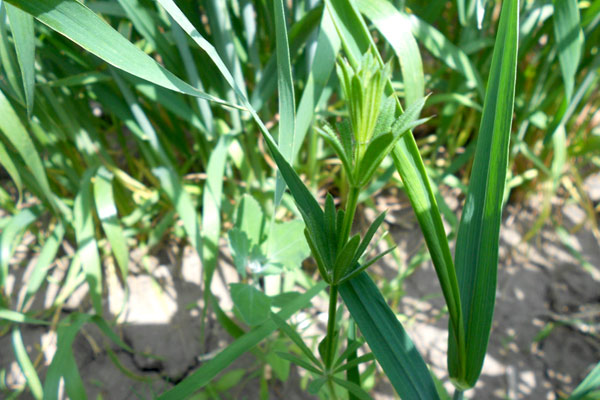
Cleavers
Against annual grass and broadleaf weeds, the selective soil herbicide Butisan 400 SC – 400 ml/ha may be applied. It can also be applied post-emergence up to the 2-leaf stage of the weeds, i.e. it has a long application period. Another product is Sultan 500 SC – 300 ml/ha. Butisan 400 SC and Sultan 500 SC successfully control volunteers from cereal crops preceding rape, the main grass weeds in rape and field poppy, chamomile, cleavers and other species of decisive importance for rape. These herbicides are applied to the soil after sowing and before crop emergence. Teridox 500 SC is applied at a rate of 200 ml/ha after sowing, before the emergence of the crop and weeds. It effectively controls annual grass weeds, including volunteers from cereal crops, and important broadleaf species in rape – field speedwell, amaranth species, chamomile, chickweed, ivy-leaved speedwell, common lambsquarters, black nightshade, purslane and others. If the herbicide is applied to well-prepared soil, with proper sowing and adequate soil moisture, it has a partial effect against wild mustard as well.
Early in the spring, during the vegetation of oilseed rape, one of the post-emergence graminicide herbicides can be applied:
Fusilade Forte – 50–60 ml/ha against annual grass weeds and cereal volunteers up to the 4th–5th leaf stage, irrespective of the growth stage of the rape;
Agil 100 EC – at a rate of 50–80 ml/ha in the earliest growth stages of grass weeds and cereal volunteers;
Pantera 40 EC (Rango 40 EC) – 80–150 ml/ha for control of cereal volunteers and grass weeds.
For the control of broadleaf weeds – creeping thistle, chamomile, field speedwell, smartweed, coriander volunteers and others, rape stands may be treated with Lontrel 300 EC at a rate of 30–50 ml/ha.
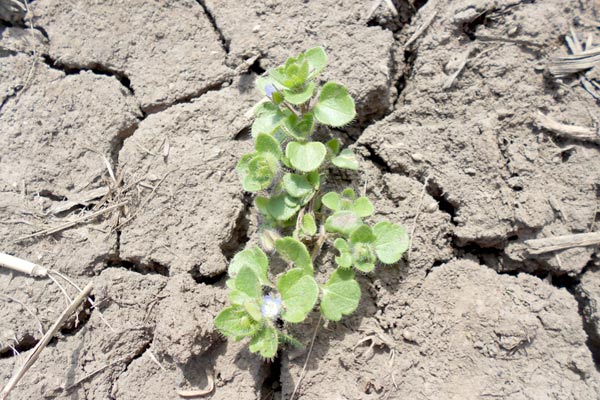
Speedwell
In oilseed rape, it is cost-effective to combine spring herbicide treatment of the stands with the application of foliar fertilizers. The herbicide Belkar™ EC – for autumn post-emergence treatment of rape – is a reliable solution for the control of broadleaf, including cruciferous weeds in rape. The recommendation for application of Belkar™ is at a rate of 50 ml/ha at the stage when 90% of the crop has reached the 6th fully expanded leaf for the control of a wide spectrum of weeds: cleavers, speedwell, chamomile, cornflower, wild poppy, geranium, shepherd’s purse, as well as difficult-to-control weeds such as chickweed, and also ALS-herbicide-resistant weeds and cruciferous weeds (wild mustard).
Another relatively new herbicide, but already proven in practice, is Nero™ EC. To ensure optimum efficacy and maximum selectivity for the crop, Nero™ EC must be applied immediately after sowing and before the emergence of rape. Warm weather and good soil moisture are essential for increasing the efficacy of the product. It controls grass and broadleaf weeds. Application rate – 300 ml/ha – after sowing, before the emergence of rape.
In mixed infestations with annual grass and broadleaf species, pre-emergence treatment in combination with soil and post-emergence herbicides is effective. High and stable yields of oilseed rape can be obtained with the correct choice of herbicides and timely implementation of agronomic measures. These guarantee success in weed control.
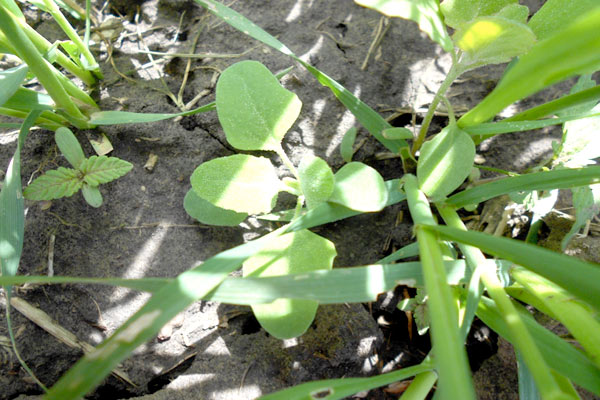
Common lambsquarters
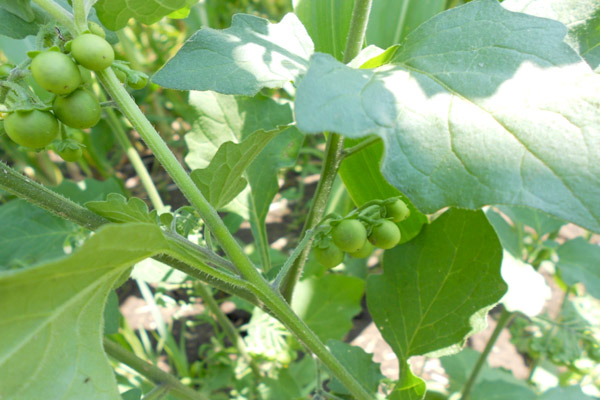
Black nightshade
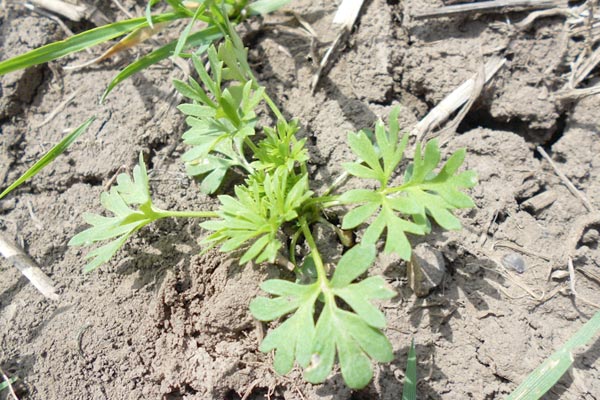
Larkspur
Photos: Chief Assistant Professor Dr. Zornitsa Petrova, DAI-General Toshevo
References:
- Lenkov, L., 1990, Agronomist’s Handbook, Zemizdat, Sofia, 600 p.
- Tonev, T., 2000, Guide for Integrated Weed Control and Crop Management, Higher Agricultural Institute, Plovdiv, 275 p.
- Tonev, T., A. Nikolov, G. Singalevich, 1999, Guide for the Application of Chemical Agents in Plant Protection, 299 p.
- Tonev, T., M. Dimitrova, Sht. Kalinova, Iv. Zhalnov, V. Spasov, 2007, Herbology, 222 p.
- Tonev, T., M. Dimitrova, Sht. Kalinova, Iv. Zhalnov, Il. Zhelyazkov, A. Vasilev, M. Tityanov, A. Mitkov, M. Yanev, 2019, Herbology, 860 p.
- Oilseed Crops Soybean, Rapeseed and Sunflower, 2003, Agronom, No. 3, pp. 8–11.
- Handbook with a List of Plant Protection Products Authorized for Placing on the Market and Use, 2024.