

![MultipartFile resource [file_data]](/assets/img/articles/заглавна-овошки-септември-1.jpg)
Towards the end of the vegetation period, the development of diseases slows down, but does not cease completely.
The forecast precipitation during the second and the first half of the third ten-day period will increase the risk of development of fungal pathogens on the ripening fruit crop – late brown rot, late scab on the fruits of late varieties of fruit trees.
The pest population density decreases significantly. Many of them have entered inactive stages – pupae, eggs. Nevertheless, late-hatched larvae of the second generation of fruit moths continue to cause fruit worminess. Other pests are also harmful. Therefore, plant protection activities continue during the month.
In orchards
Fruit storage facilities are disinfected. This is carried out by a specialist!
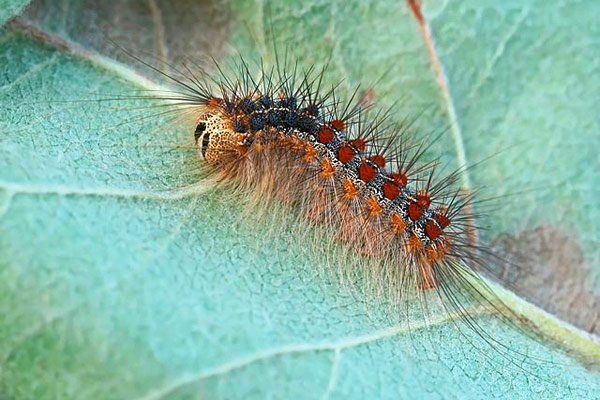
Gypsy moth – Lymantria dispar
To determine the overwintering population of gypsy moth, the egg masses on the trunks and thick branches of 40–60 trees are counted, and for the lackey moth – the egg rings on two-, three- and four-year-old twigs.
Peach fruits are inspected at handling points to detect the oriental fruit moth in areas where it has not yet occurred.
About two weeks before harvest, apple and pear orchards whose fruits are intended for storage are treated with Captan 80 WG (150–180 g/da) to protect them from late scab and other diseases that develop in fruit storage facilities.
To determine the population density of the pear bud weevil at the end of the month, 10 trees per 500 decares, scattered throughout the orchard, are shaken – initially every other day, and after the first insects are found, every day.
Chestnut trees are sprayed at the beginning of the month, before egg laying, with Coragen 20 SC (18–30 ml/da) or another contact insecticide for the control of the chestnut weevil. Spraying is repeated twice more at 7–10 day intervals.
In strawberry plantations
Before transplanting, for weed-free stands, strawberry plantations are treated with Roundup Energy (300–500 ml/da for annual and biennial weeds and 500–800 ml/da for perennial weeds).
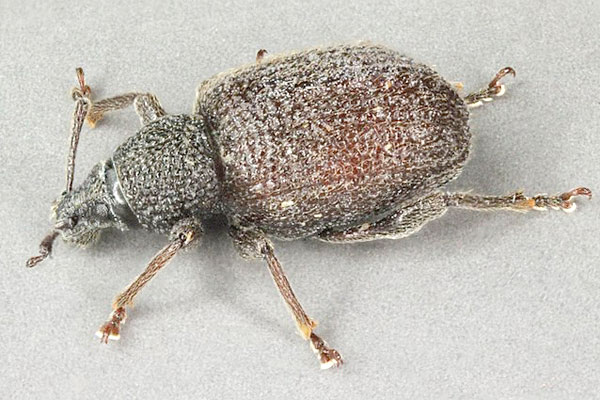
Strawberry root weevil
Strawberry plantations are irrigated with one of the insecticides – Decis 100 EC (17.5 ml/da) or another deltamethrin-based product, Mospilan 20 SP (30 g/da), Naturalis (300 ml/da) until the soil is moistened to a depth of 15 cm against the larvae of root weevils.
Strawberry planting material is inspected for diseases and pests that are transmitted with it – white and purple-brown leaf spots, root weevils, strawberry nematode, strawberry mite, viral diseases, etc.
Strawberry runners are disinfected if they are infested by strawberry mite or strawberry nematode by immersing them for 13–15 minutes in water at a temperature of 45–50 oC.