

![MultipartFile resource [file_data]](/assets/img/articles/Corylus_avellana.webp)
Abstract
Hazelnuts are among the most important nut fruit crops, with their production and consumption increasing drastically due to their high nutritional and economic value. Diseases and pests are among the main problems in the cultivation of this crop. In 2024, a survey was conducted to determine the species composition of pests on the territory of Plovdiv region. The main pests and the methods for their control are described.
The common hazel (Corylus avellana L.) is widespread in Europe, North Africa and Asia Minor. It occurs mainly in mixed broadleaf forests and develops well both on sites with intense sunlight and in shaded locations. It grows well on slightly acidic and neutral soils (Hicks, 2022).
The largest hazelnut producers in the world are Türkiye, Italy, Azerbaijan, the USA, Iran and Georgia. In 2021, global yield reached 1.1 million tonnes, with Türkiye being the leading producer, followed by Italy and the USA. In Bulgaria, hazelnut orchards cover 2700 ha, from which 463 kg of production were obtained in 2023.
Hazelnuts are grown mainly for their kernels, which are rich in proteins, fatty acids, vitamin E, iron, phosphorus and magnesium. The kernels can be consumed raw or roasted. They are widely used in the food industry for the production of chocolate, chocolate candies, protein bars, etc. (Gantner, 2000).
Hazelnut attracts a large number of pests, such as aphids, mites, beetles and moths, which in some parts of the world contribute to yield reductions of up to 20%.
Hazelnut weevil (Curculio nucum L.)
The hazelnut weevil is distributed throughout the country and is found mainly in the areas of cultivated and wild hazel. It attacks primarily cultivated and wild hazel, but can also be found on chestnut.
The species develops one generation per year and overwinters as a larva in the soil. The larvae pupate in spring, and the adults emerge during the first half of June. The beetles gnaw the leaves and green nuts. After reaching sexual maturity, the beetles mate and begin oviposition. The females make a small hole with their rostrum, into which they insert one, rarely two, eggs. Depending on the temperature, embryonic development lasts from 8 to 10 days. The larva feeds on the kernel and the attacked fruits darken. Usually they remain in the husk or fall off. Upon completing its development, the larva makes a round exit hole in the shell, after which it moves into the soil, prepares an earthen chamber and remains there to overwinter.
Soil cultivation around hazelnut bushes can significantly reduce pest density. Chemical control is directed against adults before oviposition, and treatments can be carried out with Coragen, which is registered against this pest.
Hazel longhorn beetle (Oberea linearis L.)
It is distributed throughout the country, but is more frequently found in Southern Bulgaria. It mainly attacks hazel, but also occurs on elm, willow and beech.
The species has a two-year development cycle and overwinters as a larva at the sites of damage. The larvae pupate in the galleries of the damaged shoots, and the adults emerge in May and June. The females lay one egg each under the bark of the shoots. Embryonic development lasts from 10 to 14 days. The young larvae bore into the wood and make galleries filled with frass and excrement. The attacked shoots dry out and break at the oviposition site. Later, the larvae make wider galleries up to 40 cm in length, in which they remain to overwinter. The following spring they continue to feed and extend the galleries. They remain to overwinter a second time and pupate in spring.
Control is carried out in autumn or early spring by cutting out and destroying all infested twigs.
Southern green stink bug (Nezara viridula L.)
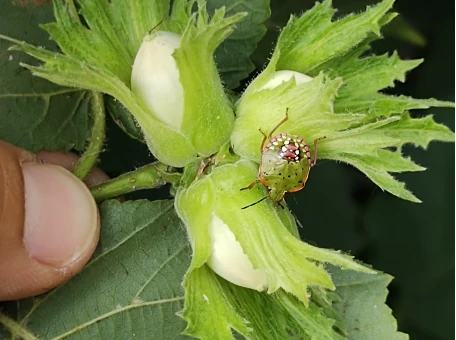
Fifth-instar nymph on hazel
The species is polyphagous and is widely distributed throughout the country.
The pest develops two generations per year and overwinters as an adult under plant residues, in old buildings and structures, etc. The adults leave their overwintering sites at the end of March and the beginning of April. After copulation, the females lay their eggs on the underside of the leaves of the host plants. Damage to plants is caused by the nymphs and adults. They suck sap from all parts of the host plants, but prefer buds and fruits.
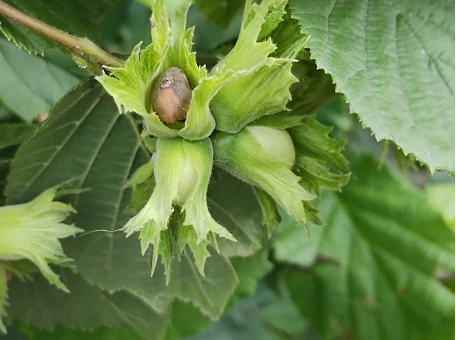
Damage to hazel
On hazelnut, the stink bug attacks the green nuts by sucking sap from them. The damage is expressed in the formation of spots or depressions on the kernel, as well as in premature fruit drop (Fig. 1 and 2).
Brown marmorated stink bug (Halyomorpha halys Stål)
The pest was recorded for the first time in Bulgaria in 2016. Today it is widely distributed throughout the country and occurs together with the southern green stink bug.
The species is polyphagous and attacks vegetable, leguminous, fruit and ornamental species.
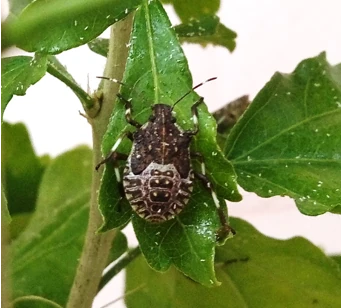
Fifth-instar nymph of the brown marmorated stink bug
In Bulgaria, the brown marmorated stink bug develops one generation per year and overwinters as an adult under plant residues, in industrial buildings and structures and other sheltered places. Damage to plants is caused by the nymphs and adults, which feed mainly on buds and fruits (Fig. 3). In crops such as hazelnut, stink bugs can cause damage throughout the entire vegetation period. Feeding of stink bugs on unformed kernels leads to interruption of kernel development, and the shells remain empty. In enlarging kernels, deformations are observed, while in fully developed kernels the damage is expressed in the formation of corky and necrotic spots.
Control of stink bugs is directed against the nymphs, since they are less mobile and more sensitive to insecticides (Decis 100 EC).
European fruit lecanium (Eulecanium corni B.)
The European fruit lecanium is found throughout the country, but its density is highest in plum-growing regions.
The species is polyphagous, but causes the most severe damage to plum, peach, grapevine and hazel.
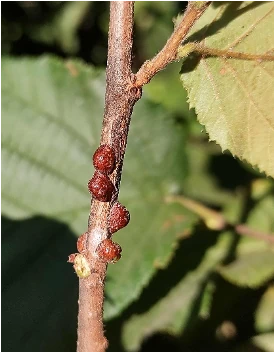
Eulecanium corni adult
The pest develops one generation per year and overwinters as a second-instar nymph on the cracked bark of branches and twigs, at the base of the trunk and on suckers. With rising temperatures in spring, the larvae become active and move to one-year-old shoots. They begin to feed by sucking sap from the bark. As they grow, their legs atrophy and they remain immobile at the feeding sites. The larvae feed intensively, moult and turn into adult insects. The scales cause the greatest damage from mid-March to mid-May. The nymphs and adult females suck sap from twigs, branches and leaves. The damage is expressed in weakening of the trees, growth retardation and, at high population density, dieback of individual branches and twigs.
Control of the pest can start during the dormant period with winter spraying using paraffin oils. The next treatment is in spring when the larvae become active, applying contact insecticides (MOVENTO 100 SC).
References
- Hicks, D. (2022). Biological Flora of Britain and Ireland: Corylus avellana: No. 302. Journal of Ecology, 110(12), 3053-3089.
- Gantner, M. (2000, August). Occurrence of hazelnut pests in southeastern Poland. In V International Congress on Hazelnut 556 (pp. 469-478).
- Hamidi, R., Calvy, M., Valentie, E., Driss, L., Guignet, J., Thomas, M., & Tavella, L. (2022). Symptoms resulting from the feeding of true bugs on growing hazelnuts. Entomologia Experimentalis et Applicata, 170(6), 477-487.
- Hedstrom, C., Walton, V., Shearer, P., Miller, J., & Olsen, J. (2013). Feeding damage by brown marmorated stink bug (Halyomorpha halys) on commercial hazelnut (Corylus avellana).
- Velez-Gavilan, J. Curculio nucum (hazelnut weevil).
- Gantner, M. (2004, June). Susceptibility of large-fruited hazel cultivars grown in Poland to major pest and their crop productivity. In VI International Congress on Hazelnut 686 (pp. 377-384).