

![MultipartFile resource [file_data]](/assets/img/articles/дрозофила-заглавна-1.jpg)
Drosophila suzukii Matsumura (Diptera: Drosophilidae) originates from Southeast Asia and has successively spread to many countries in Asia, North America and South America. In Europe, D. suzukii was first recorded in Spain in 2008. The species attacks more than 95 cultivated and wild plant species, with raspberries, strawberries, blackberries, blueberries, cherries, peaches, apricots, plums, grapes, etc. being the most preferred. Female individuals of D. suzukii lay their eggs on healthy, ripening fruits that have not yet fallen. The main damage is caused by the larvae, which feed on the fleshy part of the fruits. Injured fruits are more easily infected by other pathogens and pests and within a few days they become deformed, soften and become unsuitable for consumption and sale (Karadjova et al., 2015). D. suzukii is a dangerous pest of fruit production in Bulgaria and worldwide, since the species attacks a wide range of cultivated and wild plant species, has a high reproductive potential and a rapid developmental cycle. Its biological plasticity and tolerance to a wide range of climatic conditions (from the equator to the northern parts of the temperate climate zone and from sea level to the alpine zone in the mountains), as well as the considerable potential for spread of the fly mainly through infested fruits lead to significant economic losses in stone and berry fruit crops. Without the application of appropriate measures, damage caused by D. suzukii amounts to $500 million per year in the western states of the USA, and losses were estimated at $27.5 million in 2013. In Oregon, peach producers have observed losses of up to 80% in some orchards, and up to 20% in raspberries. In California in 2009, about one-third of the cherry production was destroyed, and high losses were also recorded in plums. In 2010 in France and Italy, losses caused by D. suzukii reached 80% in strawberries and raspberries. Losses from attacks by D. suzukii on 40,000 decares of berry crops in the province of Trento, Italy, were estimated at € 500,000 for 2010 and € 3 million for 2011. In 2010, significant damage to blueberries was observed in Switzerland and France, and in the period 2012–2014 in Switzerland and Germany on some grape varieties such as Merlot, Pinot Noir, Sauvignon Blanc, etc. The presence of numerous host plants facilitates the establishment of the species in new territories, and for this reason since 2011 D. suzukii has been included in the EPPO A2 LIST (List of pests recommended for regulation as quarantine pests, present in the region of the European and Mediterranean Plant Protection Organization (EPPO)).
Life cycle and morphology
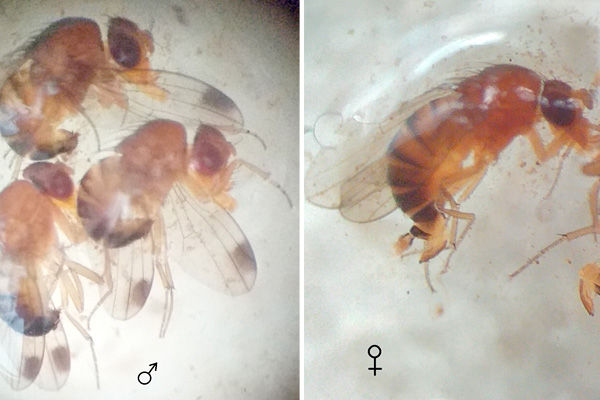
Male and female individuals of D. suzukii
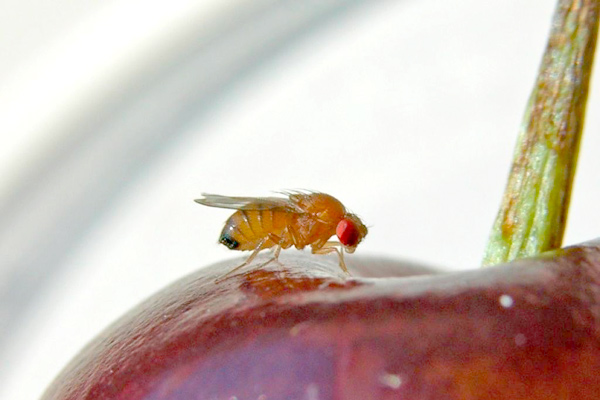
Drosophilids in general are characterized by a high reproductive potential and an extremely rapid developmental cycle. D. suzukii overwinters as an adult insect in places protected from weather conditions. Under suitable conditions it can develop throughout the year. It is active at temperatures above 10°C (EPPO, 2010). Female drosophilids are small flies (2 to 3.5 mm), yellowish or brown in colour with dark bands on the abdomen and prominent red eyes. They have a large, saw-like ovipositor with which they easily pierce the skin of the fruits when laying eggs. Males have a dark spot at the end of each wing, from which the name spotted-wing drosophila is derived. The eggs are semi-transparent, milky white and shiny; before hatching they become more transparent and the larva inside them becomes more clearly visible. The larvae are white and cylindrical, reaching 3.5 mm in length. The pupa is brownish and reaches the adult stage in 4 to 14 days. Pupation takes place in or outside the fruits. The adults reach sexual maturity 1–2 days after emergence, and their life span is about 300 days. The females lay their eggs on healthy, ripening fruits, and the hatched larvae feed on the fleshy part of the fruits. Within a few days they become deformed, soften and become unsuitable for sale. The entire development of the larvae takes place inside the fruit. The duration of the individual developmental stages varies depending on environmental conditions, with temperature being the most important factor.
Monitoring
The monitoring programme of the Bulgarian Food Safety Agency (BFSA) for surveillance of D. suzukii started in 2012 with the aim of clarifying the status of the pest in Bulgaria. Monitoring was carried out by the plant protection departments in the following regions of the country: Blagoevgrad, Burgas, Veliko Tarnovo, Vidin, Vratsa, Varna, Dobrich, Kardzhali, Kyustendil, Pazardzhik, Plovdiv, Pernik, Ruse, Silistra, Sliven, Sofia City, Stara Zagora and Haskovo. Visual inspections of the fruits were carried out and traps for adult flies were placed at risk locations such as wholesale fruit and vegetable markets, trading platforms, warehouses, markets, enterprises, fruit repacking facilities and border crossing points. In addition, observations were made in fruit-bearing permanent crops – cherries, peaches, plums, strawberries, raspberries, blackberries, vineyards and wild and ornamental hosts. Later, in 2015, based on all observations and studies carried out in Bulgaria, the National Programme for Phytosanitary Control and Management of Drosophila suzukii Matsumura was established, which provides detailed information on the species.
For monitoring of D. suzukii various ready-made traps are used: universal fruit fly traps of the Tephri-trap type with the three-component attractant Biolure and an insecticide, Jackson-type traps with the attractant trimedlure, and Riga-type traps with a food bait or homemade traps with food bait made from apple vinegar, white or red wine. Also investigated were mixtures of brown sugar, alcohol, vinegar and water, ripe bananas, strawberry puree, apple cider or baker’s yeast, sugar and water. Among all tested baits, apple vinegar was found to be the cheapest and easiest attractant to use. The placing and reading of the different traps should be carried out in the period May–November. Results from numerous monitoring studies in many countries show high variability in the effectiveness of the baits depending on the geographical region and the crop surveyed. This largely hinders the development of a unified monitoring approach, which leads to the need for future research at regional level. The objective is to develop baits with increased sensitivity in specific regions that reflect the actual population density of D. suzukii.
In the Kyustendil region, the monitoring programme for surveillance of the spotted-wing drosophila began to be implemented in 2012 by the Regional Directorate for Food Safety (RDFS). For the first time in the Kyustendil region, the spotted-wing drosophila was detected in September 2014 in a plum orchard. Single adults of D. suzukii were also recorded in 2015 in “Riga cup trap” type traps in two apple and one pear orchard. Studies carried out in recent years have shown an increase in the population density of D. suzukii from 2 individuals in 2014 to 2813 individuals in 2018. The highest number of adults was captured in raspberry and plum plantations and a significantly lower number in cherries. Population build-up of the pest begins at the end of summer and reaches its peak in September. The trend in recent years for the density of D. suzukii to increase at the end of summer, in September and October, was altered in 2023. The high density as early as the end of June and the beginning of July led to significant damage to cherries in the Kyustendil region. This requires serious attention from cherry and plum producers in the future for the timely implementation of measures against this pest.
Control
For successful control of Drosophila suzukii, it is necessary for all farmers to apply a combination of preventive, agronomic, physical, biological and chemical methods.
Fruits that remain in the orchards serve as a food source and allow the pest to complete its development.
When Drosophila suzukii is detected, it is necessary to:
- collect infested fruits, remove them from the orchard and destroy them by burying them in the soil.
- place infested fruits in intact, well-tied polyethylene bags and leave them for 1 week exposed to sunlight.
- not use damaged fruits for composting or fermentation.
- destroy all wild and ornamental host plants (blackberries, mahaleb cherry, guelder rose, lilac, honeysuckle, dogwood, etc.) in and around the orchards.
- biological control – among the natural enemies and potential biocontrol agents of D. suzukii reported in the literature and included in the List of biocontrol agents that may be applied in the Republic of Bulgaria, approved in 2015 by the Minister of Agriculture and Food and the Minister of Environment and Water, are:
Anthocoris nemoralis (Hemiptera: Antochoridae)
Orius laevigatus (Hemiptera: Antochoridae)
Orius majusculus (Hemiptera: Antochoridae)
Dalotia coriaria (= Atheta coriaria) (Coleoptera: Staphylinidae)
Hypoaspis miles (Acari: Laelapidae).
- chemical control – the wide range of host plants requires a specific approach to chemical control for each particular crop. There are a number of registered products approved for the respective crop and included in the List of authorised insecticides published on the BFSA website. However, their frequent application, due to the large number of generations and the treatments carried out during the fruit ripening stage, leads to an increased risk of pesticide residues in fruits, the development of resistant populations, and the destruction of pollinating insects and other beneficial species. Chemical control is mainly targeted at adults, since the larvae develop inside the fruits and are difficult to reach with plant protection products.
For cherries, the products registered in 2024 for control of D. suzukii are: Affirm 095 SG – 200 g/da, Affirm Opti – 200 g/da, Mospilan 25 SG – 25 g/da, Delegate 250 WG – 30 g/da, Karate Zeon 5 CS – 15 ml/da, Mavrik F/Evure 2 F – 25 ml/da, Lamdex Extra – 60–100 g/da, Deca EC/Desha EC/Dena EC/Poleci/Decis/ Deltin – 30–50 ml/da, Sineis 480 SC – 20 ml/da, Nim Azal T/S – 300 ml/da, Flipper – 1–2 l/da. The last three products are approved for organic production.