

![MultipartFile resource [file_data]](/assets/img/articles/заглавна-малина-1.jpg)
Abstract
Pests are one of the main limiting factors in raspberry production. In 2023–2024, a survey was carried out in Southern Bulgaria to determine the species composition of the harmful entomofauna. A description has been made of the main raspberry pests, as well as of the methods for limiting their harmful activity.
Raspberry (Rubus idaeus L.) is an economically important crop in much of Northern Europe, as well as in the United States and Canada.
In 2021, global raspberry production reached 886,538 tons, and in 2022 it increased to 947,852 tons. The largest raspberry producers in the world are Russia, Mexico, Serbia, Poland and the USA (DOMOZETOVA, 2012).
Raspberry fruits have valuable medicinal and organoleptic qualities. They are rich in vitamins (C and Mg), fibre and antioxidants. They are consumed mainly fresh, but are also widely used in the food industry for the production of jams, syrups, etc. In medicine, their consumption is recommended as a preventive measure against cardiovascular and oncological diseases.
Raspberries are attacked by a number of pests that damage leaves, buds, fruits, stems and roots. At high population density they can severely compromise yield (Funt, 2013).
Common raspberry beetle (Byturus tomentosus)
The pest damages mainly raspberry, but can also be found on blackberry, apple and cherry.
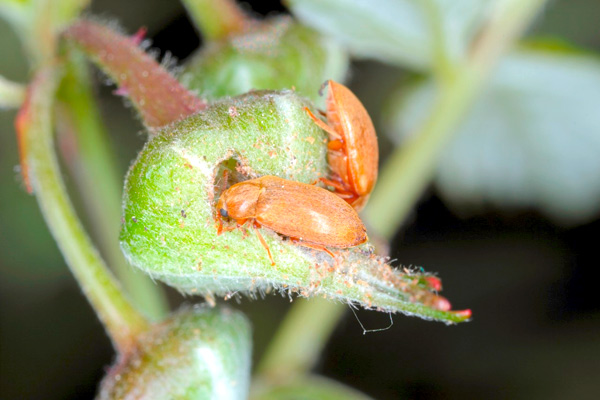
Common raspberry beetle (Byturus tomentosus)
The species develops one generation per year and overwinters as an adult in the soil. In spring the beetles leave their overwintering sites and begin to feed on raspberry flower buds. They bore into the flower buds and consume their interior. The damaged buds most often dry up. During flowering the beetles gnaw the stamens and the pistil, and fruits do not develop from the damaged flowers. The females lay their eggs at the base of the flower buds, in the flowers or on the green fruits. The larvae feed on the interior of the fruits. Attacked fruits are small, deformed and with impaired taste qualities. After completing their development, the larvae move into the soil, where they pupate.
Tillage destroys a large proportion of the pupae and adult insects. Chemical control is directed against the adults before the beginning of egg laying and must start at the “bud formation” stage. Contact insecticides from all groups can be used, and the pre-harvest intervals must be strictly observed.
Raspberry gall midge (Lasioptera rubi)
The pest is distributed throughout the country, but its population density is higher in raspberry-producing regions.
The species develops one generation per year and overwinters as a mature larva in a puparium at the damage sites.
Early in spring the larvae pupate, and the adults appear in May and June, during the mass flowering of raspberry. The females lay their eggs at the base of the buds on young shoots. The larvae bore into the stem and feed on its interior.
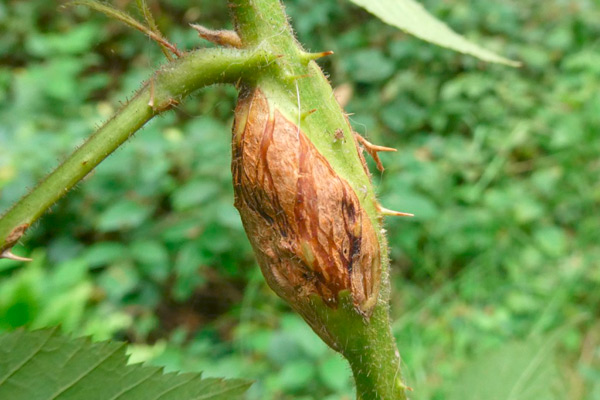
Damage caused by raspberry gall midge (Lasioptera rubi)
During feeding they secrete saliva containing growth regulators that induce hypertrophy of the tissues. Tumours or galls are formed at the damage sites. As a result of the damage, the normal flow of water and nutrients is disrupted. Attacked plants lag in their development and most often dry up.
Raspberry agrilus (Agrilus rubicola)
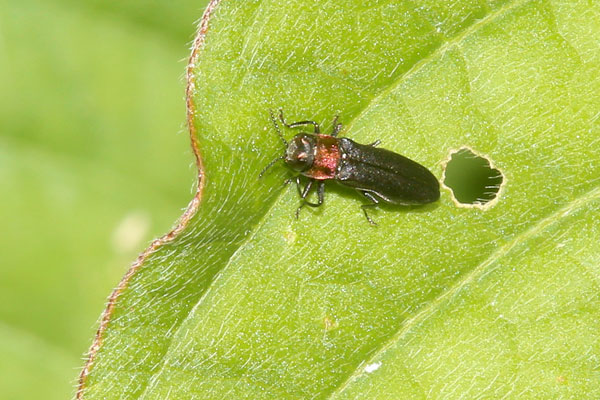
Raspberry agrilus (Agrilus rubicola)
The species is widely distributed. It attacks raspberry, blackberry and oil-bearing rose.
The pest develops one generation per year and overwinters as a fully grown larva at the damage sites. In spring the larvae pupate, and the adults appear at the beginning of June. The beetles feed on raspberry leaves in order to reach sexual maturity, but this damage has no economic significance. The females lay their eggs on the bark of young shoots.
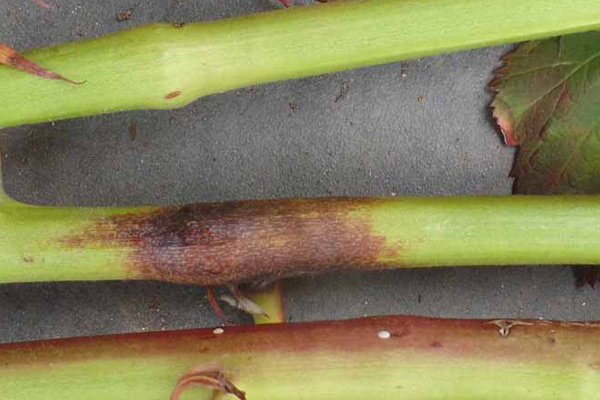
Damage caused by agrilus
The larvae bore and penetrate under the bark, where they make spiral galleries. As they grow, the larvae penetrate into the pith of the stem and make deep vertical galleries. At the damage sites the stem enlarges and swellings are formed. The bark at the damage site cracks. Damaged plants develop poorly and most often dry up.
For successful control, all attacked plants must be cut out and destroyed. During the vegetation period, treatments may be carried out against the adults before egg laying. Contact insecticides from all groups are used.
Southern green stink bug (Nezara viridula)
The species is distributed throughout the country and in some years occurs at high population density. The pest is polyphagous and attacks vegetable, leguminous, berry and other crops.
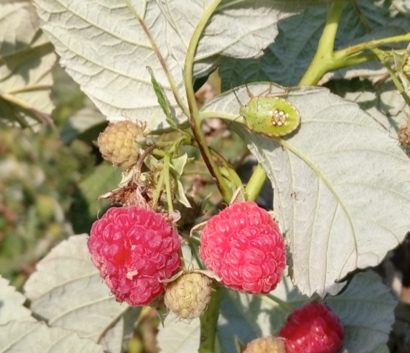
5th instar nymph and damage
It develops 2 generations per year and overwinters as an adult under plant residues, in cracks in trees, in old buildings and structures, etc. The adults leave their overwintering sites early in spring. After copulation, the females lay their eggs on the underside of the leaves of the host plant. Damage to plants is caused both by the nymphs and by the adults. They suck sap from all parts of the host plants, but prefer buds and fruits. On attacked fruits small spots are observed; the fruits grow unevenly, become deformed and drop. The injured plant tissue is an entry point for phytopathogens that lead to fruit rot. Adults of the first generation appear in July, and of the second at the end of August and the beginning of September. They feed intensively and then move to overwintering sites.
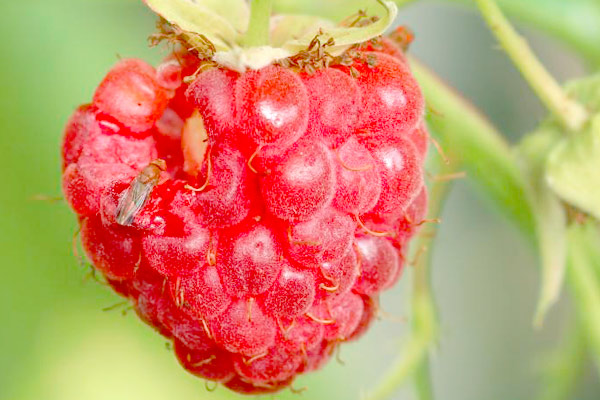
Spotted-wing drosophila (Drosophila suzukii)
The pest is polyphagous and damages a large number of cultivated plants, but prefers ripe fruits with thin skin. It causes the greatest damage to cherries, peaches, nectarines, apricots, plums, raspberries, blackberries, strawberries, blueberries and grapes.
Spotted-wing drosophila can develop up to 15 generations per year and overwinters as an adult in places that protect it from adverse climatic conditions. In spring the adults leave their overwintering sites. With their ovipositor the females insert a single egg under the skin of the fruit, and several eggs may be laid in one fruit. Embryonic development takes 3 days. The larvae feed on the interior of the fruit, which becomes deformed and mushy. Damaged fruits are unfit for consumption and have no commercial value. Depending on the temperature, the duration of larval development is from 4 to 9 days.
Control is carried out against the adults before egg laying. All contact insecticides are suitable, and treatments must be coordinated with the pre-harvest intervals and fruit picking.
Raspberry cane midge (Resseliella theobaldi)
It is distributed throughout the country. It attacks raspberry.
The pest develops 3–4 generations per year and overwinters as a larva in the soil. In spring the larvae pupate, and the adults appear in April and May. They are active during the day, in warm and sunny weather. The females lay eggs singly or in groups on one-year-old and two-year-old shoots. The young larvae feed on the cambial layer.
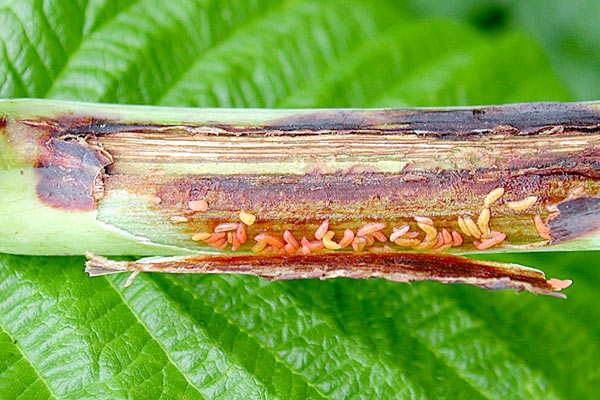
At the damage site, brown discoloration and a slight depression are observed. The damage is usually located in the lower part of the plants and is easily visible against the green background. Under heavy infestation the plants turn yellow and dry up.
Attacked plants are cut out and destroyed. Chemical control is directed against the adults before egg laying, using contact insecticides.
Literature
- Basnet, S., Maxey, L. M., Laub, C. A., Kuhar, T. P., & Pfeiffer, D. G. (2014). Stink bugs (Hemiptera: Pentatomidae) in primocane-bearing raspberries in southwestern Virginia. Journal of entomological science, 49(3), 304-312.
- DOMOZETOVA, D. D. (2012). State and perspectives of raspberry production in Bulgaria. AgroLife Scientific Journal, 1.
- Funt, R. C. (2013). Pest and disease management. Raspberries; Crop Production Science in Horticulture Series; CABI: Oxfordshire, UK, 133-155.
- Kharizanov, A., Kharizanova, V. (2018). Agricultural entomology