

![MultipartFile resource [file_data]](/assets/img/articles/заглавна-мелотрия-1.jpg)
To cope with the challenges posed by climate change and to ensure food supplies, smallholder farmers and producers must adopt sustainable and adaptive practices. One such practice is to expand the diversity of crops by including new varieties that are tolerant to high temperatures and drought. There are numerous crops that can be grown in Bulgaria and combine resilience with culinary appeal. Some will be hardy outdoors, others may be tender and need protection, but it is time to broaden our horizons. One such crop is the African cucumber, also known as melothria and mini watermelon.
Gardeners and food producers are directly exposed to the complex impact that climate change has on their day-to-day work. Rising temperatures, changing precipitation patterns and the increasing frequency of extreme weather events pose significant challenges to food production. Smallholder farmers and producers, who are the backbone of local food systems, are particularly vulnerable. Among the vast diversity of ornamental and vegetable seeds that have appeared on the market in recent years, the demand for exotic species is becoming increasingly widespread. Some of them are indeed suitable for the conditions in the country and provide good yields. Others are merely being tested, and still others are considered something exotic. One such unusual proposal is the plant melothria (Melothria scabra), also known as mini watermelon, African cucumber, but in fact this plant is an entirely new crop for us and is not related to any of the plants it resembles.
Why might Bulgarian farmers turn to melothria?
One of the main reasons why melothria is of interest to farmers in Bulgaria is that they are seeking alternative crops to the traditional species grown for consumption. Although the cultivation of economically important species from the Cucurbitaceae family is well known in our country, increasing biodiversity in agricultural ecosystems is not a primary focus area in these conventional production systems. Adding melothria to traditional production systems can increase biodiversity in more than one way. First, it can increase the diversity of crops produced on agricultural plots, but it can also provide habitat for beneficial insects, microorganisms and vertebrate animals.
The more erratic the climate becomes, the more agronomists and farmers will have to explore alternative crops that may prove more suitable for the changing environment.
The threat of climate change makes it difficult to grow traditional crops in the familiar ways used so far. The 21st century will be a time of challenge for people if we continue our current agricultural practices.
By introducing this relative of our cucumber to interested consumers, the market opens up for farmers and provides an opportunity for diversification in agronomic fields. With the growing challenges in the agricultural sector in our country and the potential risk that a given crop may fail to bear fruit in a particular season, diversification in the range of products on the market can be a good opportunity for both farmers and consumers. Unfortunately, although melothria is suitable for cultivation in our country, it is still unknown to Bulgarian farmers and is grown only by amateur gardeners. This is where institutions such as the National Agricultural Advisory Service and the sectoral institutes within the Agricultural Academy need to be more active in promoting this and similar alternative crops.
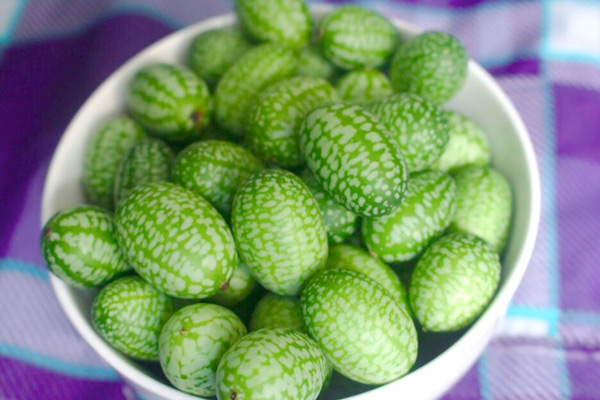
Photo 1: Fruits of Melothria scabra. Source

Climate change is the most significant set of challenges faced by farmers and food producers in Bulgaria.
Some of the current climate-related challenges are unstable weather patterns, water scarcity, pest and disease pressure and, last but not least, soil health.
Unpredictable weather patterns can lead to crop failure, loss of productivity and increased susceptibility to diseases. Home growers and small-scale farmers need to adapt by selecting resilient crop varieties and using protective measures such as row covers and greenhouses.
On the other hand, changing precipitation patterns and increased evaporation due to higher temperatures place pressure on water resources. Rainwater harvesting, efficient irrigation techniques and drought-tolerant crops are essential for mitigating these challenges.
Another negative factor associated with rising temperatures is that they can create favourable conditions for pests and diseases. Integrated pest management (IPM) techniques, mixed cropping and the use of beneficial insects can help minimise the need for chemical interventions.
Last but not least, climate change affects soil structure and composition. Regular soil testing, as well as crop rotation and cover crops, are crucial for maintaining soil fertility.
What is melothria or mini watermelon?
It is no coincidence that the plant is often called mini watermelon. Its small fruits, which are no more than 3 cm long and 2 cm wide, have a very similar colour: dark green stripes run over a light green background. If you pick the fruit and show it separately from the plant, it is indeed a mini watermelon. And melothria grows in the form of a long creeping vine, very similar to that of the watermelon.
However, if you taste the fruit, it resembles cucumber. In longitudinal section it has two halves similar to cucumber halves. And the smell is very similar. Only the white seeds resemble watermelon seeds in shape. Because of this similarity, the plant has many popular names: “Mexican miniature watermelon”, “mouse melon”, “Mexican sour gherkin”, “African cucumber”, “hummingbird cucumber”, as well as “cucamelon”, “pepin” and “mouse melon”.
Despite the fact that Melothria scabra is neither a watermelon nor a cucumber, it still has something in common with these crops – it belongs to the Cucurbitaceae family. Melothria has its own genus – Melothria, which includes about 166 species, most of which are not edible.
Melothria scabra originates from Central America. There it grows as a fairly aggressive weed. Spreading along the ground and climbing supports, the vine is capable of suppressing other crops. Thanks to the warm climate there, it is a perennial plant and reproduces not only by seed but also by tubers.
The leaves of the plant are hairy, triangular, three-lobed, with pointed segment ends. The plant produces both male and female flowers. At the same time, they are easy to distinguish: the former are arranged singly and bloom earlier, the latter are grouped in several and bloom later. The flowers are funnel-shaped and yellow in colour. The stems develop rapidly, reaching more than 3 m during the season. Quite large tubers, weighing up to 400 g, similar to sweet potatoes, are formed on the roots of the plant. Thus, the yield per plant is up to 6 kg of “cucumbers” and about 6 kg of tubers.
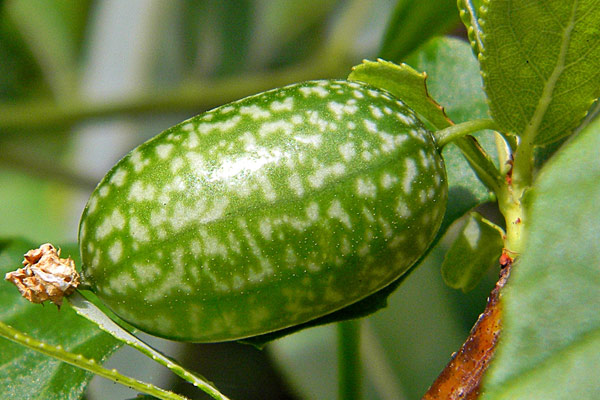
Photo 2: Melothria scabra. Source

What are its benefits and uses?
Melothria was introduced into Europe quite recently – in 1987. Due to its size, taste characteristics and the fact that the fruits taste like cucumber, they can be used for preparing salads, pickles, as a garnish for various dishes and in “rolls”, as well as in various healthy dietary meals.
The skin gives acidity to the fruits and the older the fruit, the more sour it becomes. However, due to their size, the “mini cucumbers” are not peeled, but should be harvested before the seeds are formed. For canning it is also better to use “young cucumbers”, as the thick skin of mature melothria spoils the taste. The tubers of the crop lose their nutritional value over time and are therefore usually consumed immediately after harvest.
Including melothria in the diet has a tonic, anti-inflammatory and immunostimulating effect.
The fruits of melothria contain a lot of fibre and are rich in proteins, fats and carbohydrates, but they also contain minerals such as magnesium, iron, potassium, calcium, phosphorus and sodium. In addition, African cucumbers contain vitamins B9 and C. At the same time, the caloric content of one fruit is very low, only 15 kcal, which helps maintain a healthy body weight by inducing a feeling of satiety and supporting weight loss.
Regular consumption of its fruits has a positive effect on the cardiovascular system (restores blood pressure), removes excess bile from the body and reduces cholesterol levels.
However, people with increased stomach acidity, gastric ulcer or gastritis should be cautious when consuming melothria and should either completely avoid or at least limit the intake of fresh fruits.
In addition to being used as food, melothria can also be used as an ornamental plant – planted in hanging pots, near a pergola or a fence. Its leaves do not turn yellow, thus retaining their ornamental properties until frost.
What conditions are required for growing melothria?
The crop is undemanding, likes the sun, but also tolerates partial shading. Like all cucurbit crops, it prefers well-structured and manured soils. It requires regular watering and maintenance.
Under our conditions the plant can be grown exclusively from seed, as the tubers are difficult to preserve until spring. Sowing can be carried out directly in the garden bed (in warm climates) or in pots to obtain seedlings. In the latter case, sowing is done at the beginning of April. In the former, depending on local conditions, the soil should have warmed to 10 °C. When planted outdoors, the plant should be watered regularly and abundantly, preferably with warm water at the root, avoiding wetting the leaves. (See more details on its sowing at the very bottom)
Among diseases under our conditions, melothria is most often susceptible to powdery mildew, but it has a fairly high immunity to other diseases. For this reason, several preventive treatments against it can be carried out during the season.
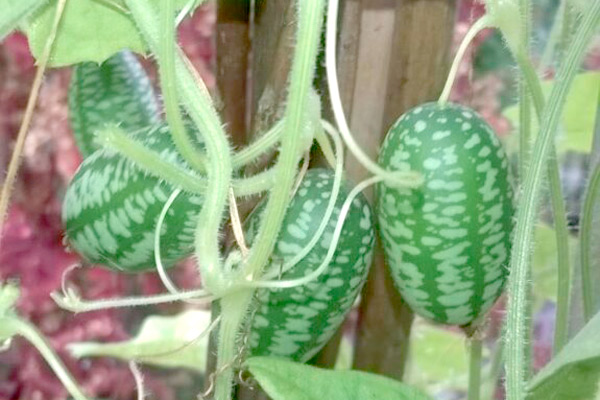
Photo 3: Melothria scabra plant in fruiting. Source: the author
Climate change poses a serious threat to food security not only in Bulgaria but also worldwide. In our country, due to climatic characteristics, smallholder farmers and home producers can adapt and develop various organic and sustainable practices. By diversifying crops, maximising available resources and adopting resilient varieties, including melothria, we can build a healthier and more resilient food system for the future. These new crops, atypical for our country, not only increase food security but also contribute to a more sustainable and environmentally friendly agricultural landscape. This is one of the ways to address the challenges of climate change and ensure a sustainable food supply for future generations.
How is melothria seedling sown outdoors?
When choosing a place in the garden, it is advisable to select one where the supports will not cause shading and interfere with neighbouring crops. The best predecessors in the previous few seasons can be legumes, potatoes, garlic, early cabbage, maize, cauliflower, parsley and onions, while it is not recommended that pumpkins have been grown there. It is recommended that subsequent sowing at the original site should not be earlier than two years later.
When sowing in a container, the small melothria seeds can either be slightly pressed into the soil or sprinkled with a small layer of sieved soil and lightly compacted (for better adhesion to the substrate). Water (moisten the soil surface with a spray) and place in a warm place at a temperature of about 24 °C.
After about 10 days, seedlings will appear. Once the seedlings have formed 2–3 true leaves, you can start ventilating them to harden the plants or move the pots to a cooler place with an air temperature of 18–21 °C.
When the risk of frost has passed, the plants can be transplanted into open ground. The distance between them should be at least 50 cm. It is also advisable to provide support immediately. It is better not to leave melothria on the ground, as the plant must be well ventilated.
When sowing directly in the permanent place, it is important not to rush and to wait for stable soil warmth. In the garden, seed germination will take a little longer, sometimes up to 2–3 weeks. Moreover, the warmer it is, the faster this will happen.
Melothria fruits begin to appear a few weeks after pollination, as with all cucurbit crops, and they can overripen. Therefore, they should be harvested regularly, preventing the skin from hardening. Seeds are collected from overripe fruits.