

![MultipartFile resource [file_data]](/assets/img/articles/заглавна-лозарство-1.jpg)
Summary
The article focuses on the sustainable management of grapevine plantations and effective methods for the control of grapevine moths (Lobesia botrana) and (Eupocilia ambiguella), which are among the most economically significant pests of grapevine. These pests can cause serious damage to vineyards, particularly by injuring generative organs such as inflorescences and grape clusters, which negatively affects both the quality and quantity of the yield. Sustainable viticulture aims to reduce the negative impact on the environment by using integrated and biological plant protection methods and minimizing the use of synthetic pesticides. The article also examines various methods for controlling grapevine moths, such as the use of pheromone traps and dispensers, parasites of the genus Trichogramma and others, microorganisms such as Bacillus thuringensis and certain agrotechnical practices such as removing old bark from vines, which can reduce the population of overwintering pupae. In the long term, the application of integrated and biological control can lead to increased profitability of agricultural holdings, as well as to the conservation of natural resources for future generations.
Sustainable viticulture and methods for controlling grapevine moths
Abstract: The article focuses on the sustainable management of grape vineyards and effective methods for the control of grapevine moths (Lobesia botrana) and (Eupocilia ambiguella), which are among the most economically important pests of grapevines. These pests can cause serious damages to vineyards, especially by damaging generative organs such as inflorescences and clusters, which negatively affects the quality and quantity of the harvest. Sustainable viticulture aims to reduce the negative impact on the environment by using integrated and biological methods of plant protection, and minimizing the use of synthetic pesticides. The article also discusses different methods for the control of grapevine moths, such as the use of pheromone traps and dispensers, parasites of the genus Trichogramma and others, microorganisms such as Bacillus thuringensis and some agrotechnical measures such as the removal of old bark from vines, which can reduce the population of overwintering pupae. In the long term, the implementation of integrated and biological control can lead to increased profitability of agricultural holdings, as well as the preservation of natural resources for future generations.
Wine and grape production is one of the oldest sectors of agriculture, which requires careful balancing of factors for successful management. One of the main challenges for producers is the control of diseases and pests that can cause serious damage to vines and threaten the yield and the quality of the grapes and wine produced. This article examines the economically important grapevine pests and how integrated and biological methods can be used for their control.
Some of the most common grapevine pests, which in certain years can cause significant economic damage, are: grape phylloxera (Phylloxera vastatrix), grapevine moths (Lobesia botrana/Eupoecilia ambiguella), vine leafroller moth (Theresimima ampellophaga), vine looper (Peribatodes rhomboidaria), leafrollers (Sparganothis pilleriana), vine soft scale (Pulvinaria vitis) and other scale insects, vine weevils (Otiorhynchus turca/O.sulcatus), grape leafhopper (Empoasca vitis), other leafhoppers, thrips (Drepanothrips reuteri), grape tree cricket (Oecanthus pellucens), vine beetle (Lethrus apterus), vine flea beetle (Adoxus obscurus), spider mites (Tethranychoidea), eriophyid mites (Eriophydae) and others.
These phytophagous insects are part of the agricultural entomofauna – as pests of grapevine. The main host plants of these species are representatives of the grape family (Vitaceae). Through their feeding they most often destroy those plant organs that have the greatest economic significance, thereby deteriorating the quantity and quality of the yields. Damage to different parts of the plant also disrupts normal physiological processes, which further negatively affects the yield. In terms of the damage caused by the different species described above, they can be classified as follows:
- Pests that cause changes in the physiological processes of the plant, as a result of which it weakens and its productivity decreases. These include all leaf-chewing insects, which by destroying the leaf surface affect assimilation and photosynthesis, causing the plant to weaken and/or die.
- Pests that damage the generative organs of plants (inflorescences and grapes) and render them unfit for processing or consumption. They usually do not affect the physiological processes of the plant. Such pests include grapevine moths, vine leafroller moth, grey vine looper, etc.
A clear distinction cannot be made between species that damage only generative organs and those that cause damage leading to negative changes in the plant’s physiological processes, because in many cases species from one category also fall into the other and vice versa. We can also distinguish pests that are vectors of plant diseases. The most numerous representatives of this group are insects with piercing-sucking mouthparts, which are among the main vectors and disseminators of viral and phytoplasma diseases. These include various species of aphids, leafhoppers, etc.
For an agricultural holding, the more important question is how to remain competitive and sustainable. Globally, there is increasing focus on sustainable agriculture. In viticulture, such a type of agriculture is a practice that aims to preserve ecological sustainability, improve product quality, and maintain a balance between meeting the needs of the population and preserving natural resources for future generations. This requires the use of methods and practices that minimize adverse effects on the environment, such as optimizing the use of water and energy, maintaining natural entomofauna and biodiversity, reducing pesticide use, and applying biological and integrated plant protection to control diseases and pests.
Plant pests develop unevenly. Depending on meteorological, climatic, anthropogenic and other environmental factors, which often cannot be predicted, they may be at a low population level or reach an outbreak that leads to negative consequences and huge losses. Plant protection is one of the key activities within the system of measures to increase the efficiency of agricultural production. Therefore, good plant protection practices, such as integrated pest management (IPM) and biological plant protection (BPP), represent the best combination of agrotechnical, biological and chemical measures against insect pests, diseases, weeds and other harmful organisms of cultivated plants. This system takes into account all relevant management approaches and methods available in the respective environment, assessing their economic feasibility. However, IPM is not built on absolute and rigid criteria. It is a flexible system that combines local resources and scientific research, technologies, knowledge and practical experience.
Historically, the first integrated pest management (IPM) programme was developed in Canada as early as 1946 by Pickett and his collaborators. In Bulgaria, the first IPM trials began in 1967 against apple pests. Later, systems were developed and applied for grapevine, peach, plum, tobacco, greenhouse vegetables and others. IPM has been applied to many different crops in this country with varying success, but due to its specific features it is most effectively implemented in perennial crops such as vineyards.
Nevertheless, unfortunately, many farms today apply synthetic insecticides indiscriminately. As a result, serious negative consequences arise and accumulate following one-sided and uncontrolled use, such as their accumulation in soil, groundwater, water bodies and living organisms. The emergence of resistant pest populations, disruption of natural agro- and biocenoses and the massive reduction of the regulatory capacity of beneficial species (predators and parasites), as well as the appearance of new quarantine and economically significant pests, have reached alarming proportions in recent years. There is an increasing potential risk to human health from new and unforeseen, including genetic, diseases.
With the accumulation of the above-mentioned negative consequences, Europe and Bulgaria strive for the continuous improvement of chemical plant protection products. According to Directive 2009/128 establishing a framework for Community action to achieve the sustainable use of pesticides, products of plant origin may be marketed only if integrated or biological plant protection has been used; new alternative ways of controlling economically important pests may also be used instead of and/or in parallel with traditional methods.
In this context, pest control is preferably carried out using approaches and means that not only preserve but also positively affect the activity of beneficial species.
For the application of IPM against pests in viticulture, it is necessary to implement certain measures and take into account various factors, the most important of which are:
- The availability of well-trained specialists to implement IPM. The use of forecasting models and other relevant software in order to more accurately predict the occurrence and spread of harmful species.
- Knowledge of the economic injury levels of economically important pests.
- Identification of the key pests and thorough study of their development, as well as the possibilities for forecasting their occurrence and harmful activity.
- Determination of their zoophages, acarophages and disease agents and study of their regulatory capacity, as well as the selection of precise methods for assessing the population density of pests and their natural enemies.
- Study of modifying factors and their influence on the individual stages of economically important pests and the use of appropriate (selective) insecticides to control them, as well as good knowledge of the effects of the product used on harmful and beneficial species, and the possibilities for combined application of different control methods, such as the biological method.
The term biological control was used for the first time by Smith in 1919 in a narrow sense – regulation of pest insect populations by their natural enemies (Harizanov et al., 2010).
Biological plant protection fully fits into the current EU strategies for environmental protection (the Green Deal), reducing pesticide pollution and preserving biodiversity. The biological method of pest control represents the antagonistic relationships between species existing in nature and consists in carrying out certain activities to destroy or reduce the numbers of some harmful species through the use of their natural enemies and/or agents causing certain diseases in them.
In nature, a mass occurrence of certain pests is very often followed by their natural decline – natural regulation. This is a process of maintaining fluctuating average densities of wild organisms within certain upper and lower limits over a given period of time under the influence of abiotic and/or biotic environmental factors. Abiotic factors are called modifying, and biotic – regulating (Harizanov A., 1986).
Natural regulation plays an important role in pest control strategies. By understanding its nature and regulatory capacity, we can limit the use of chemical insecticides to a minimum.
For the application of BPP against harmful insects in viticulture, mainly entomophagous insects (predators and parasites) and microorganisms pathogenic to insects (fungi, bacteria and viruses) are used, among others.
Of the pests described above, the most important for grapevine are the European grapevine moth (Lobesia botrana) and the grape berry moth (Eupocecilia ambiguella).
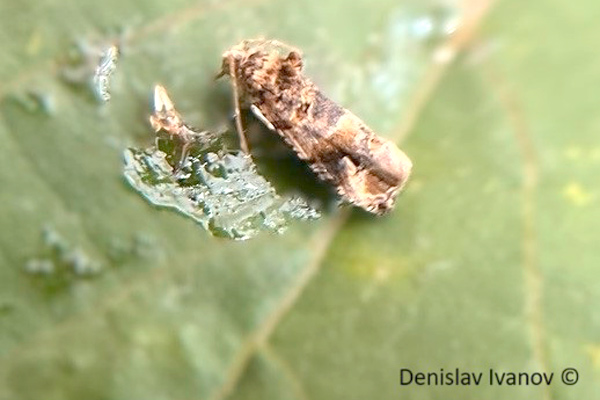
European grapevine moth (Lobesia botrana)
In Bulgaria, the European grapevine moth predominates and is widespread throughout the country.
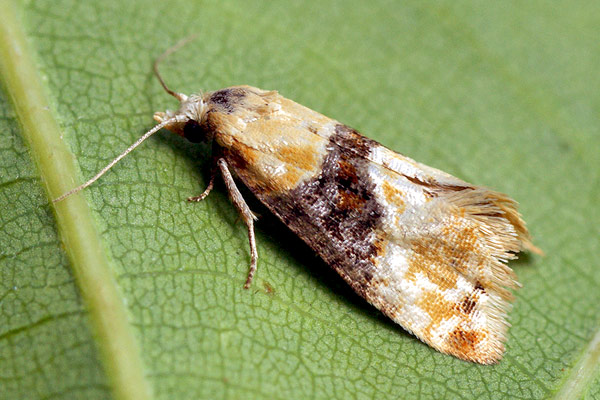
Grape berry moth (Eupocecilia ambiguella)
The grape berry moth, on the other hand, is found mainly in vineyards in the eastern part of the country, especially along the Black Sea coast, where it often predominates over the European grapevine moth.
As a grapevine pest, it occurs only in areas where the average daily relative air humidity in May–July exceeds 70% (Nedyalkov, 1978; cited in Ivanov, S., Harizanov A. et al. 1980).
The European grapevine moth (Lobesia botrana) develops 3 generations per year and overwinters as a pupa under old cracked bark, rarely in the soil. The grape berry moth (Eupocecilia ambiguella) develops 2 generations per year and overwinters as a pupa under the bark. The damaging stage of both species is the larvae of all instars, and the economically significant damage they cause is mainly to the generative organs, which they bind with silken threads, a reliable indicator of their presence and harmful activity in vineyards.
The natural regulators of both moth species are: certain species of predatory ladybirds, lacewing larvae, predatory bugs, predatory mites, spiders, parasites and parasitoids of eggs, larvae and pupae. Some agrotechnical practices that act as control methods are the removal and destruction of old and cracked bark on vines during winter, which reduces the density of overwintering pupae. In the second half of March, the number and viability of overwintering pupae can be determined for each vineyard. If there are 0.3–0.4 viable pupae per vine on average, there is a risk to the crop during the year (Andreev, 2012).
The placement of pheromone traps at the end of March and beginning of April is a good plant protection practice for determining the dynamics of moth flight, the duration of generation development for each vineyard, as well as for the placement of pheromone dispensers for the disorientation of male individuals, e.g. (RAK 1+2 by BASF), which are combined for the simultaneous control of both moth species, as well as other similar products.
During the growing season, monitoring of inflorescences is necessary to determine the onset of oviposition and egg density, as well as to establish larval density, which can be easily detected by the loose webs. Monitoring continues for subsequent generations, and the economic injury levels depend on the generation and the variety of the vineyard and are established by Order No RD 11-536 of the Bulgarian Food Safety Agency (BFSA, 2022).
According to this order, for the first generation the economic injury level is 4–6 eggs or larvae per 100 inflorescences for table grape varieties and 6–8 for wine varieties. For the second generation it is 6–7 eggs or larvae per 100 young clusters and grape clusters for table varieties and 10–12 for wine varieties. For the third generation it is 7–8 eggs or larvae per 100 grape clusters for table varieties and 10–12 for wine varieties.
Parasitoids of the genus Trichogramma can be used against the egg stage of both moth species – released three times against each generation, while preparations based on Bacillus thuringensis can be used against larvae; registered products include Dipel, Rapax and others, as well as bioproducts such as Sineis 480 (spinosad) and others. In parallel with the Eco-schemes for restoring soil potential, there are registered and approved multicomponent microbial products based on (Bacillus thuringensis, Metharizium anisopliae, Bouveria bassiana). The use of such products should be adapted to temperature and air humidity. At temperatures above 30°C the microorganisms contained in the product enter a dormant state. Foliar treatment with this product will be most effective at lower temperatures and high atmospheric humidity.
For sustainable control of grapevine moths, it is advisable to take into account certain key biological characteristics. According to some authors, when the temperature drops below 12o C, part of the overwintering pupae die. First-instar larvae are sensitive to intense rainfall and many of them perish. Direct sunlight for 1–3 hours and temperatures above 32oC has a sterilizing effect on the eggs of both grapevine moth species, and at relative air humidity below 50% the number of hatched eggs is negligible. At temperatures above 32–34o C, the adults live only a few days and females lay more sterile eggs.
Based on the methods and good plant protection practices described above, professional farmers must decide when and whether the use of plant protection products and/or measures is necessary. The decision-making factors are the already mentioned economic injury levels of grapevine pests, as well as the environmental conditions in individual micro-regions and the climatic conditions.
Sustainable methods (biological, agrotechnical, mechanical, non-chemical, etc.) are preferable to the use of chemical products that provide a satisfactory level of pest control. If chemical products are nevertheless used, they should be as selective as possible and have no adverse effects on human health, non-target organisms (beneficial species), the environment and water bodies.
The conscious use of the practices described above would help reduce the development of pest populations resistant to chemical products, as well as preserve biodiversity. In the long term, the application of sustainable practices in plant protection will increase the productivity and profitability of agricultural holdings. Modern agricultural policies and stricter control over pesticide use, as well as educating producers about the benefits of sustainable agriculture, could contribute to achieving these goals. Only through joint efforts can we ensure a better future for the generations after us, as well as for our planet.
References:
1. Andreev, R. (2022) Agricultural entomology for everyone. Computer reference book. Agricultural University – Plovdiv.
2. BFSA (2022). https://bfsa.egov.bg/wps/portal/bfsa-web/home/orders/orders.quality.control.of.fresh.fruits.and.vegetables/zapoved-ikonomicheska-vrednost
3. Biological means for plant protection – Collection of articles – Zemizdat/Kolos
4. Malinov V. (1996) Protection of grapevine
5. Nakov B., Angelova R. et al. (2007) Forecasting and signalling of diseases and pests of cultivated plants. Plovdiv.
6. Pelov V. (1972) Biological control of plant pests. Zemizdat.
7. Harizanov A. (1986) “Biological control against plant pests” Zemizdat.
8. Harizanov A., Harizanova V., Stoeva A. (1994) “Protection of grapevine from diseases and pests” Zemizdat.
9. Harizanov A., Harizanova V., Stoeva A. (2010) Biological plant protection. Dionis