

![MultipartFile resource [file_data]](/assets/img/articles/напояване-лозе-1.jpg)
The need for irrigation in grapevine cultivation in Bulgaria is determined by the quantitative and temporal discrepancy between the water requirements of the plants and its availability in the soil.
Water deficit suppresses vine growth, and grape ripening may be delayed or impeded. Vegetative growth is affected to a greater extent than yield. On the other hand, an excess of water stimulates unnecessary vegetative growth, which leads to dense foliage, high water content of the berries, compact bunches as a result of increased berry size, poor sunlight exposure of the clusters due to shading, and the development of diseases.
When addressing the issue of ensuring an optimal water regime in vineyards, it should be borne in mind that, unlike many fruit crops, the vegetative growth of vines precedes flowering and fruit growth, and the degree of overlap between these phenophases varies among different cultivars.
The irrigation regime of vineyards depends on the vigour of vine growth and on their developmental stages during the growing season, the so-called phenophases. Plants begin to consume water at budburst, and their water requirements continuously increase with the development of leaves and shoots. By mid-June the vines are already fully developed and water consumption reaches its maximum in the second half of June, July and August.
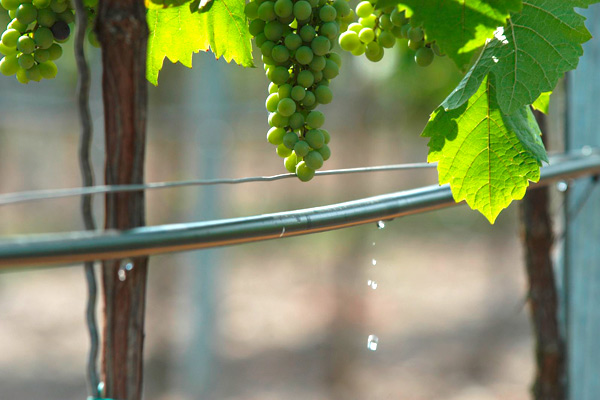
According to the changing water requirements of vines during the growing season, the irrigation regime is usually organised into four main stages.
The first stage covers the period from budburst to the end of flowering. Due to the insufficient development of the vines during this period, the water consumption of the vineyard is low. Quite often, the soil water reserve and precipitation are sufficient to meet the needs of the plants. Water deficit, however, may lead to uneven budburst, weak shoot growth and fewer flowers. Water deficit during flowering is associated with low vitality of pollen and pistil and, consequently, with poorer berry set, which can reduce yield by up to 50%; the size of the set berries is also adversely affected. Suppressed growth as a result of possible drought during this stage may be reflected in an insufficient leaf area and, accordingly, an insufficient capacity for synthesis of photoassimilates necessary for the growth and nutrition of the fruits during the subsequent phenophases. The yield in the following year may also be adversely affected, insofar as inflorescence initiation in nodes 1–4 starts approximately two weeks before full bloom and continues for about two weeks. It is considered that water deficit at this time reduces rather the number of inflorescences per shoot than the number of flowers in one inflorescence, which develop later.
The second stage begins after flowering and continues until the onset of fruit ripening. The beginning of the stage coincides with the first phase of berry development. This is the period of cell division in the berries and their subsequent initial enlargement, during which meeting the water requirements is of paramount importance for the quantity and quality of the yield. During this phase the berries are highly sensitive to water stress, as a result of which they remain small in the event of water deficit. This reduction in berry size cannot be compensated for by optimising the water regime during the subsequent phenophases, and yield losses may reach 40%. The end of the stage coincides with the second phase of berry development, during which their growth is noticeably slowed and their size is not significantly affected by water deficit. Shoot growth, however, continues, and any water stress would have a limiting effect in this respect.
The third stage continues from the onset of fruit ripening until harvest. As a rule, vines are not as sensitive to water stress during this period. Growth has almost ceased and can hardly be influenced by a lower water status of the plants. Drought at the beginning of the period, however, may cause defoliation of the lower leaves and exposure of the bunches, followed by sunburn on the berries. Any water deficit at this time does not significantly affect berry size and, accordingly, the quantity and quality of the yield, even though this stage coincides with the third phase of berry development, when they resume their rapid growth, reach maximum size and ripen. High levels of water stress, however, cause drying of shoot tips, and a subsequent higher irrigation rate or heavier rainfall may stimulate the growth of lateral shoots. The growth of lateral shoots at this time diverts photoassimilates, hinders fruit development and delays ripening.
The fourth stage begins after harvest and ends with leaf fall. During this period the water consumption of the vineyard gradually decreases. The irrigation regime should maintain the physiological processes in the plants without inducing secondary growth. Mild to moderate water stress suppresses the vigorous growth of some cultivars and promotes shoot maturation. More severe water deficit may suppress root growth, resulting in reduced uptake of mineral nutrients from the soil and potential micronutrient deficiency in the following spring. This may be reflected in premature or delayed budburst, slowed growth and even dieback of young shoots. At the end of October and the beginning of November, when low temperatures prevent secondary growth, irrigation rates may be increased in order to restore the soil water reserve in the active root zone.