

![MultipartFile resource [file_data]](/assets/img/articles/домат-миниращ-молец-заглавна-1.jpg)
The tomato leafminer Tuta absoluta (Meyrick) (Lepidoptera:Gelechiidae) is an extremely dangerous and problematic pest. In recent years, due to ongoing climate change, it has successfully overwintered and damage caused by it can be observed as early as the seedling stage. It attacks not only tomatoes, but also eggplant, potatoes, beans, pepper and other species, including ornamental and wild plants from the family Solanaceae. The losses it causes can reach up to 100%.
It is considered that the tomato leafminer T. absoluta originates from South America and was initially described in Peru. At the beginning of the 1980s it was recorded as a pest of agricultural crops in Argentina, Bolivia, Brazil, Chile, Colombia, Ecuador, Paraguay, Peru, Uruguay and Venezuela.
The first report of its introduction into Europe is from the province of Castellón de la Plana (eastern Spain) at the end of 2006. Since then, outbreaks have been detected in Spain, Portugal, France, Germany, Morocco, Algeria, Egypt, Cyprus, Greece, Turkey, Macedonia, Romania, Italy, Switzerland and others. In the summer of 2009 T. absoluta was also identified in Bulgaria. The moth can travel kilometres, flying or carried by the wind, easily survives harsh conditions and reproduces rapidly in new habitats. Trade in agricultural products has also played a major role in its spread. It can significantly reduce tomato yields and is considered a serious threat to their production.
The life cycle of T. absoluta passes through four developmental stages: egg, larva, pupa and adult, and depending on the temperature, its duration varies from 29 to 38 days. It develops many generations per year, the number of which depends on environmental factors. A characteristic feature of the species is that in the presence of accessible food the larvae (caterpillars) do not enter a state of diapause, which determines its high reproductive potential. The tomato leafminer overwinters as egg, pupa or adult insect in the soil, in damaged plant parts or in other shelters (e.g. packaging). The damage to the plants is caused by the caterpillar.
Plants can be attacked at any stage of their development. The most clearly distinguishable signs of the presence of the moth are the mines on the leaves. They are broad and relatively large, with the caterpillars and black granular excrements visible through the epidermis. Under severe infestation the leaves dry out due to the coalescing mines, which form large lesions, and the plants become defoliated.
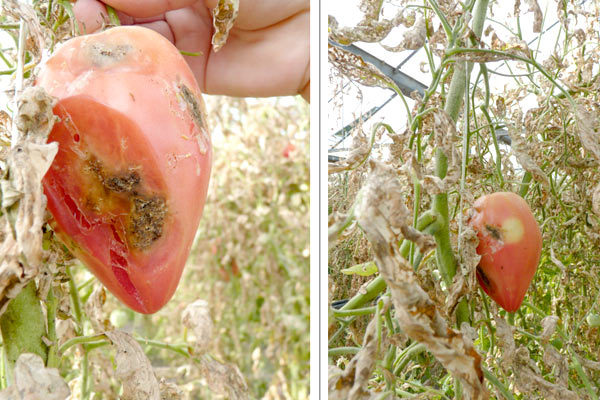
Although less frequently, the larvae develop in the stems or in the fruits. Mining of the stem causes deformation of the plant, and the attacked fruits rot as a result of secondary phytopathogenic infections. The produce is of reduced quality, often unfit for consumption. As an additional problem, it should be noted that the pest feeds mainly on the growing parts of the plant, thereby disrupting or completely stopping its development.
The damage caused by the tomato leafminer on the leaves differs from that of leafmining flies (Liriomyza spp.). The mines are diffuse and broad, whereas those of leafmining flies are serpentine and narrow.
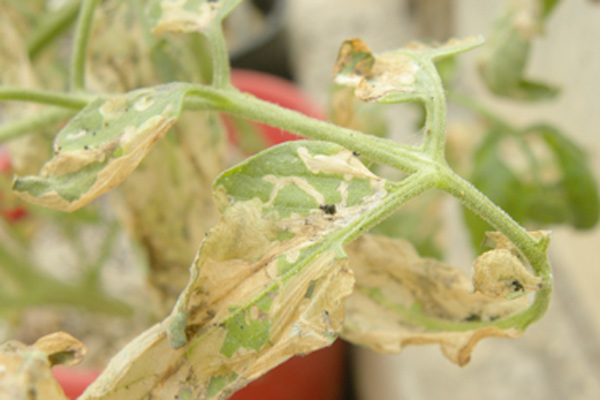
Damage caused by the tomato leafminer
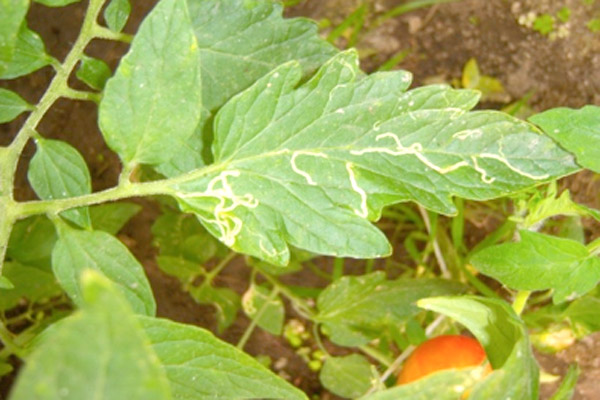
Damage caused by leafmining flies
The damage to the leaves is identical to that of the potato tuber moth (Phthorimaea operculella Zeller), which has limited distribution in our country. At first glance, the adults and larvae of the two species are very similar, but there are several essential differences between them, which can be detected by observation under a hand lens or binocular microscope.
Differences in the external morphology of adults:
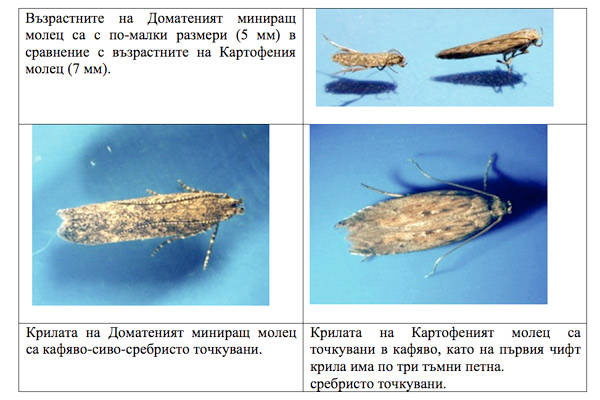
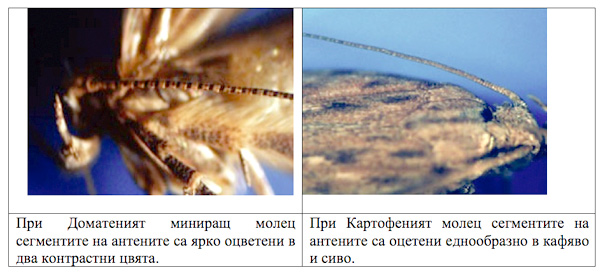
Male moths of the potato tuber moth have tufts of long grey hairs on both sides of the penultimate abdominal segment.
Differences in the external morphology of larvae:
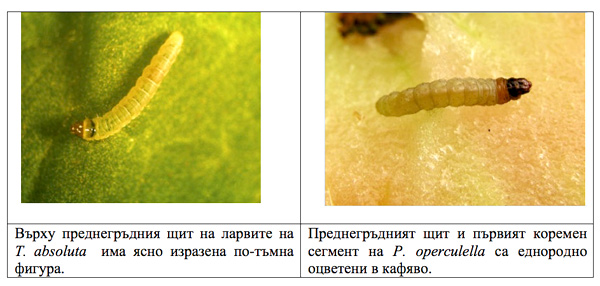
Accurate identification of the species is carried out by specialists after preparation of microscopic slides of the genitalia of male individuals.
At present, the control of the tomato leafminer is a difficult task for several reasons:
- the concealed way of life of the caterpillars within the mines;
- the high reproductive potential;
- the multivoltine development;
- the manifestation of resistance to a large part of the insecticides used.
Until recently (2005), the main method of control in South America was chemical, whereby in order to protect their crops, growers carried out more than 20 treatments per season, as a result of which the pest developed resistance to a number of insecticides. Currently, in Europe, in addition to chemical means, biological control agents are also being tested.
General sanitary measures and good agricultural practices include:
- use of healthy planting material;
- installation of fine insect-proof nets on the vents and doors in greenhouses;
- use of black sticky traps;
- upon detection of the first mines, the infected leaves should be removed from the plant;
- in the production areas and at least 20 m outside the greenhouses, weeds must be regularly removed;
- cleaning of transport vehicles;
- cleaning of the fields from plant residues after harvest;
- rotation of host crops (tomato, eggplant, pepper, potato) with crops not attacked by the pest.
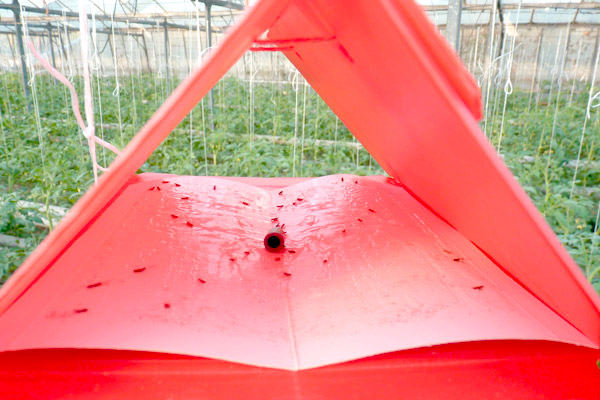
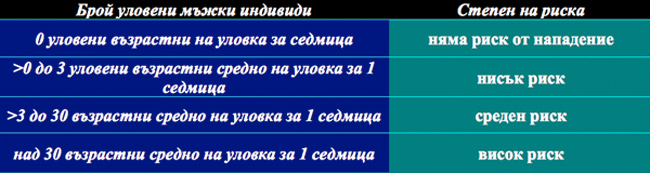
In practice, pheromone traps are being used more and more frequently. Various types have been developed, which can be used for monitoring or for mass trapping of male individuals. For monitoring, sex pheromone traps of the “delta” type (triangular) with a sticky bottom are usually used. They serve to detect the presence of the pest, as well as to determine the level of risk of infestation depending on the number of moths caught. Assessment is carried out according to the following table:
Risk assessment of T. absoluta based on the catch in pheromone traps at a rate of
2 traps per 10 decares
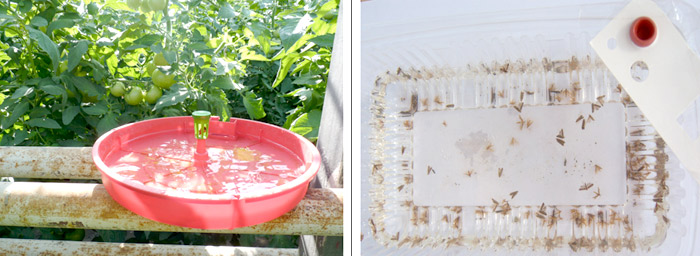
For mass trapping of male individuals, sticky and water-based pheromone traps have been developed. Their number is determined according to the risk of infestation: at low risk – 2 traps per decare; at medium risk – 2–4 traps per decare; at high risk – 5–6 traps per decare. In greenhouse areas, 1–2 traps are also placed outside the greenhouse, near the door.
After the establishment of the tomato leafminer in the Mediterranean basin, a range of local natural enemies was reported, whose suitability for biological control is currently being evaluated. Recent reports on different species of parasitoids attacking T. absoluta show that local species in Europe may also be effective. The egg parasitoid Trichogramma achaeae successfully parasitises the eggs, and experiments show that it can be extremely effective, especially when used in combination with predatory bugs from the family Miridae. Within the first year after the establishment of T. absoluta in Europe, the presence of a large number of arthropod predators was reported. It has been found that the predatory bugs Macrolophus pygmaeus and Nesidiocoris tenuis actively attack the eggs and larvae of the moth, preferring young larvae. In addition to the various species of predatory bugs, the predatory mites Amblyseius swirskii and Amblyseius cucumeris are also considered promising predators of T. absoluta eggs, particularly on eggplants, which are an alternative food host of the tomato leafminer.
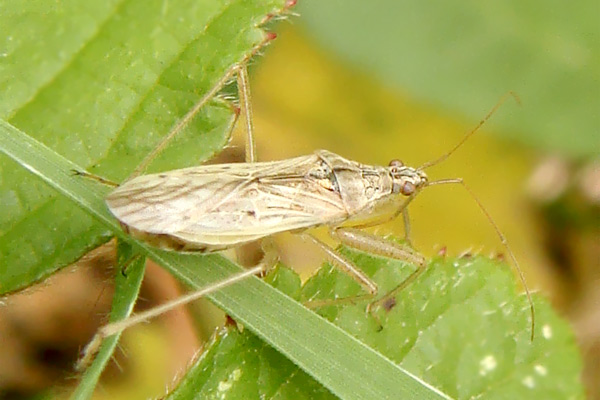
Nabis pseudoferus
Currently, several bioagents used for the control of the tomato leafminer are available on the market. In Bulgaria the following are registered: Trichogramma achaeae – against eggs; Macrolophus pygmaeus, Nesidiocoris tenuis, Nabis pseudoferus – against eggs and all larval stages. The use of bioagents for control must start at the beginning of the vegetation period, when the risk from the pest is low, in order to achieve successful control.
In the Mediterranean region, promising results have been obtained from testing the bacterium Bacillus thuringiensis (Bt) under laboratory, greenhouse and field conditions. All commercial formulations reduce the damage caused by the pest by up to 90%. Under greenhouse conditions, weekly application of a low dose of the preparations leads to control of the pest throughout the entire vegetation period.
Control of the tomato leafminer should begin while the population density is still low and the different generations have not overlapped. The use of insecticides with different modes of action is of essential importance in order to prevent the development of resistance in the pest population. Control is directed against all stages of the pest, and with properly selected means and approaches, it is necessary to determine in advance which is the predominant stage in the population.
Chemical control is still the main method for managing T. absoluta. Economic injury level for the pest during the vegetation period – caterpillars: 10% of the leaves with mines; 4% of the fruits with damage.
Authorised plant protection products: Azatin EC 100–150 ml/da; Altacor 35 WG 8–12 g/da; Ampligo 150 SC 40 ml/da; Benevia 40–60 ml/da; Beltirul 50–100 g/da; Verimark™ 200 SC 37.5–50 ml/da; Voliam Targo 063 SC 80 ml/da; Delmur 50 ml/da; Dipel DF 75–100 g/da; Exalt 200–240 ml/da; Coragen 20 SC/Voliam/Shenzi 14–20 ml/da; Minecto Alpha 125 ml/da (Water l/da 25–100 l/da); Minecto Alpha 100 ml/da (Water l/da 1000–2000 l/da); Neemik Ten 390 ml/da; NeemAzal T/S 300 ml/da; Rapax 100–200 ml/da; Sineis 480 SC 10–25 ml/da.
Combining different means and approaches, depending on the specific phytosanitary situation, the phenological stage of the plants, the degree of infestation by the tomato leafminer and the harvesting period, makes it possible to minimise the risk of yield losses in tomato cultivation.