

![MultipartFile resource [file_data]](/assets/img/articles/заглавна-чавдаров-1.jpg)
In this material, I want to draw your special attention to certain measures that will guarantee you the production of quality and stable yields of tomatoes, cucumbers, and peppers.
For all crops, success in the fight against diseases can only be achieved if a comprehensive system of organizational, agrotechnical, genetic, biological, chemical, and other measures is applied, with the help of which we limit the population density of disease-causing agents below their damage threshold. For vegetable crops, the basis of this system should be prophylaxis, i.e., all plant protection measures should be aimed at preventive treatment, with the goal of preventing the establishment of fungal, bacterial, and viral phytopathogens.
First, I will start with the selection of the correct variety. For cultivation, a variety is chosen that, along with high yield and quality, also possesses genes for resistance to certain economically important diseases. Many varieties of vegetable crops, both domestic and foreign, are widespread in our country, which possess genes for resistance to fungal and viral diseases. Resistance breeding in tomatoes, cucumbers, and peppers, conducted in our country and abroad, has a complex focus – both on soil-borne and airborne phytopathogens. There have been significant achievements in this area, especially for tomatoes and cucumbers, related to the level of resistance to viral phytopathogens. Extremely resistant tomato genotypes are available on the market, suitable for both greenhouse and field production.
Another important direction is crop rotation, or the so-called crop rotation. An extremely important measure related to the accumulation of a large amount of inoculum (infection), especially from soil-borne phytopathogens causing typical root rot and tracheomycosis in host plants. When growing tomatoes and peppers in the same place, a large amount of plant residues accumulate in the soil, which are a necessary substrate for the development of soil fungi from the genera Verticillium sp., Fusarium sp., Phytophthora sp., and others. Very often, in seedless cultivation of tomatoes, the soil fungus Pyrenochaeta lycopersici tomato, which causes corky root rot, also accumulates, and in some years, it significantly reduces the yield and quality of the produced crop. In greenhouse production, the possibilities for crop rotation are limited, and therefore, it is necessary to disinfect the soil every 3-4 years. In practice, greenhouse producers can use solarization and the application of biological products as a method for controlling important disease-causing agents in major vegetable crops. Nowadays, a large part of chemical products for soil disinfection are prohibited, which, of course, has its positive and negative sides. In field production, there is an opportunity to rotate vegetable crops with others. They should be returned to the same place after 4-5 years. For tomatoes, for example, it has been proven that the soil completely self-purifies from various bacterial phytopathogens if this period is observed.
Spatial isolation is of great importance for open-field tomato and pepper crops, which should be grown far from greenhouse complexes. In such facilities, if a high density of vectors is allowed, they develop year-round and quickly migrate to the field, and in autumn, they return to the greenhouses. These vectors include tobacco thrips, various types of aphids, and whiteflies, which are the main carriers of various types of viral phytopathogens.
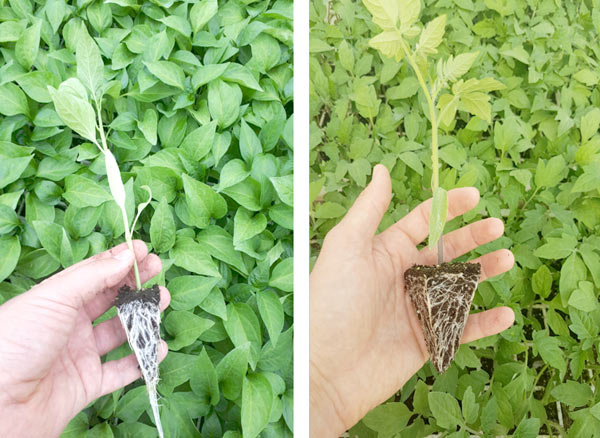
The production of healthy and quality seedlings is an extremely difficult and responsible undertaking for obtaining quality produce. Quality seedlings are obtained by observing the following measures: using sterile substrates for sowing seeds, using new trays, sowing clean and disinfected seeds, maintaining optimal thermal and water regimes, fertilizing young plants, preventive plant protection measures, in accordance with the development stage of the crop and environmental conditions. In our country, greenhouse complexes that produce quality seedlings of major vegetable crops are already functioning.
An important condition is also the treatment of plants with fungicidal solutions, which begin to be applied 5-6 days after transplanting the seedlings to their permanent location. With this measure, we can successfully control the development and spread of bacterial diseases on the aerial parts of vegetable plants, as well as various fungal diseases causing localized spots on leaves, stems, and fruits.
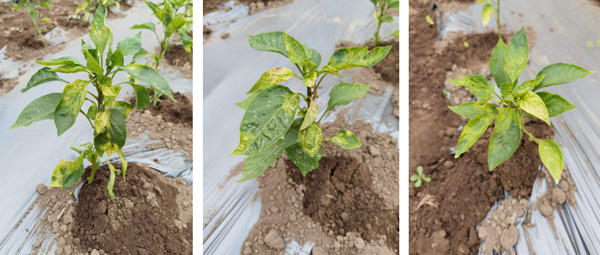
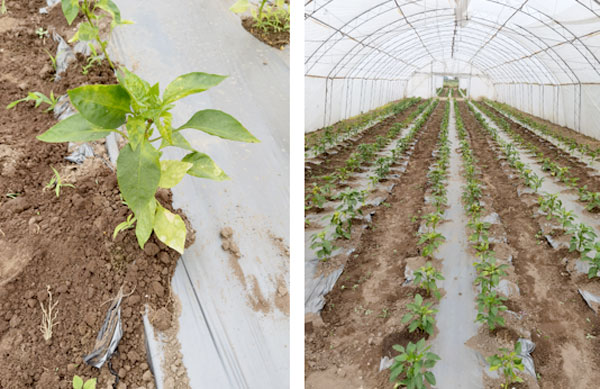
As someone who has been involved in plant protection for over 20 years, I want to share with you how an incorrect assessment in choosing the right pepper variety led to a 100.0% loss for a person who has been involved in vegetable production for over 30 years. The greenhouses I visited in Plovdiv region were located on an area of 4 decares, planted with peppers. Upon inspection, I found that more than 80.0% of all plants were infected with the causative agent of tomato spotted wilt - Tomato spotted wilt virus. It turned out that no regular preventive plant protection measures were taken against the vector (tobacco thrips), and about 30 days after transplanting, we observed the following damage picture (photos 1, 2, 3, 4, 5).
I wish all vegetable producers in the country high yields and high purchase prices for their produce. And most importantly DO NOT FORGET to inspect your crops daily, and if in doubt, consult your agronomists for accurate advice and an adequate solution.