

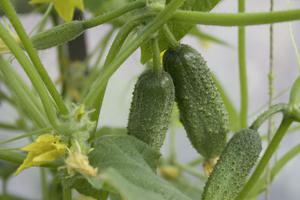
Greenhouse Production
The cultivated crops are in the phase of mass fruiting. In unheated greenhouses, the first harvests are beginning, while in heated ones, mass harvests are being conducted – 2-3 times per week. It is necessary to carefully select Plant Protection Products (PPPs) – with a shorter pre-harvest interval. Pre-harvest intervals must be strictly observed.Due to rising external temperatures and the intensity of solar radiation, shading should be applied where it has not yet been done. For this purpose, a lime solution or ready-made mixtures available in agricultural pharmacies are used. To maintain air humidity in the facilities, the pathways should be watered several times a day. The crops should be inspected daily or at least twice a week for disease and pest infestation. Colored sticky traps, which are placed at plant level from the time of planting, can be used as sources of information. During the growing season, they follow the growth of the plants. Leaves, stems, and fruits with disease spots, aphid colonies, egg clusters, larvae, mines, etc., are collected, removed from the greenhouse, and destroyed.
The diseases described for seedlings can be observed on plants in greenhouses:
For tomatoes, these are: early blight (alternaria), powdery mildew, gray mold (botrytis), downy mildew. In case of infestation, the crops are treated with the PPPs indicated for seedlings. Seeds of tomato varieties resistant to downy mildew are available on the market. If spots are nevertheless detected, the plants are sprayed with 0.1% Topsin M.
For cucumbers: The main diseases that can harm cucumbers are powdery mildew and downy mildew. Many cucumber varieties grown in greenhouses are resistant to powdery mildew. For susceptible varieties, after symptom appearance, treatment is carried out with the fungicides recommended for seedlings. Ensuring heating during the early morning hours limits downy mildew infestation. Upon appearance, spray every 7-10 days with 0.3% Cursait M DF, 0.25% Cursait R DF, 0.3% Aliet Flash, 0.04% Equation Pro, 0.15% Verita WG, 0.2% Previcur Energy, 0.075% Quadris, 0.075% Amistar, 0.25% Galben 8 M 65, 0.25% Mancozeb 80 WP. There are already cucumber varieties resistant to this disease.
Among pests, greenhouse whitefly, aphids, thrips, tomato leafminer, caterpillars, and mites cause damage. Against greenhouse whitefly, aphids, thrips, mites, and tomato leafminer, spraying is done with the products indicated for seedlings. Against caterpillars, plants are treated with 0.05% Decis 2.5 EC, 0.025% Supersect Mega, 0.04% Nexide, 0.03% Vaztak Nov 100 EC, 0.08% Confidor Energy, 0.1% Dipel 2X, 150 g/decare Affirm.
For control of root-knot nematodes and sucking pests (greenhouse whitefly, aphids, and thrips), 1 l/decare Vidate 10 L can be applied through the drip irrigation system with the nutrient solution – 2 weeks after transplanting and if necessary another 1-2 times at 15-20 day intervals. Only against sucking pests, Actara 25 WG can be applied in the same way – for plants up to 6 weeks old, 2 times at 14-day intervals at 40 g/decare, and for plants older than that, the treatment is a single application at 80 g/decare.
Field Production
The transplanting of mid-early tomatoes, peppers, eggplants, and cucumbers is upcoming. Before transplanting, Venish 300 g/decare is broadcast in the furrows against wireworms.In the field, early sown cabbage, onion, garlic, potatoes, peas, broad beans, and beans are in a phase of intensive growth and development. Upon appearance of mildew on cabbage and peas, treatments are carried out with suitable PPPs - 0.25% Ridomil Gold, 0.3% Cursait M DF, 0.15% Verita WG. Early transplanted tomatoes are monitored for infestation by early blight and mildew, and during intense rains – also for bacterial diseases. Against the first two, treatment is with PPPs indicated for seedlings and greenhouse production, and against bacterial spot diseases, copper-containing products are applied – 0.3% Champion, Cursait, Funguran.
Upon detection of aphid infestation on broad beans and peas, the PPPs indicated for seedlings are applied. In areas with more than 5 wireworm larvae per sq.m., it is recommended to apply granular insecticides before transplanting of non-transplanted tomatoes – 4 kg/decare Mocap 10 G.
The fight against leafminer flies on bulb crops and cabbage root fly – on cabbage and radishes – continues. The fight against the mentioned flies is directed against the adult forms. Effective are 70 ml/decare n.Nurelle D, 30 ml/decare Vaztak Nov 100 EC. Two treatments are carried out at an interval of 7 to 10 days with one of the mentioned insecticides. Upon detection of damage by pea weevils and gall midge on pea crops, spraying is done with 150 ml Dursban 4E, 25 ml Sumi Alpha 5 EC, 70 ml Nurelle D per decare. The same are also effective against the pea moth. The first spraying is during flowering, so measures must be taken to protect bees.
Leafy vegetables lettuce and spinach, as well as onion and garlic for greens and radishes, which are offered for fresh consumption, should be treated only as a last resort, strictly observing the pre-harvest intervals. When spraying onion and cabbage crops, a sticker is added to the pesticide solutions.
All requirements for the application, storage, and transport of pesticides must be observed. A crop treatment log must be kept, in accordance with the requirements of the Bulgarian Food Safety Agency.