

![MultipartFile resource [file_data]](/assets/img/articles/фъстъци-заглавна-1.jpg)
Bulgarian agriculture, and agricultural science in particular, operates and develops in a highly competitive environment within the European Economic Community. This requires our country to utilize all its resources - natural endowments, climatic conditions, experience, financial and scientific resources to develop modern agriculture with high-quality production.
For European consumers, it is important to receive high-quality, environmentally friendly, and healthy food. Peanuts, as well as food products prepared from them, are distinguished by high biological and nutritional value and bring high added value.
As a result of climate change, the northern boundary for possible cultivation of the crop is shifting, and peanuts of our varieties are now grown not only in Italy, Portugal, Greece, and France but also in Austria. The main advantage that our varieties offer over American, Chinese, and Argentine peanut varieties is their short vegetation period – perfectly suited for the European climate.
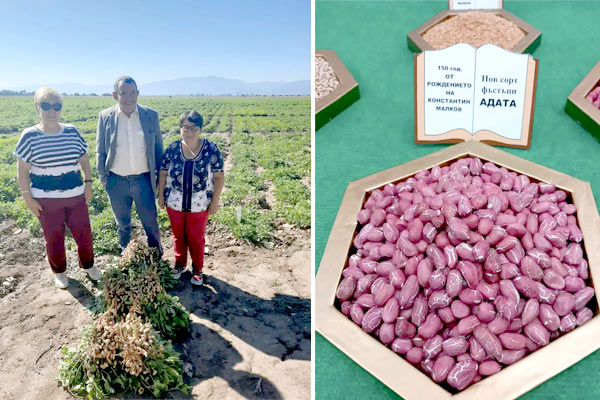
Assoc. Prof. Stanislav Stamatov presents one of the newest peanut varieties created at IPGR- Sadovo. The peanut variety „Adata“ stands out with large kernels, high yields, and a characteristic cracking, a particularly distinctive feature of Bulgarian peanut varieties, which sets them apart from the range produced globally.
Our country is a European leader in peanut breeding, and it must continue to uphold this position. Modern Bulgarian varieties are intensive crops and as such are excellent precursors for all field crops. Peanut production in Bulgaria increases its cultivated areas annually thanks to the high price of the produce and the fact that peanuts are included in the list of protein crops.
Bulgaria, as the largest producer of peanuts in Europe, will need to ensure production that satisfies its own needs and to conquer specific niches in the European peanut market. This goal can only be achieved by introducing new high-yielding varieties with good taste qualities into production and applying standard technology, ensuring the competitiveness of Bulgarian produce.
Such a position for our country will define the goals and objectives of the updated scientific and work program for research on peanut breeding and technology.
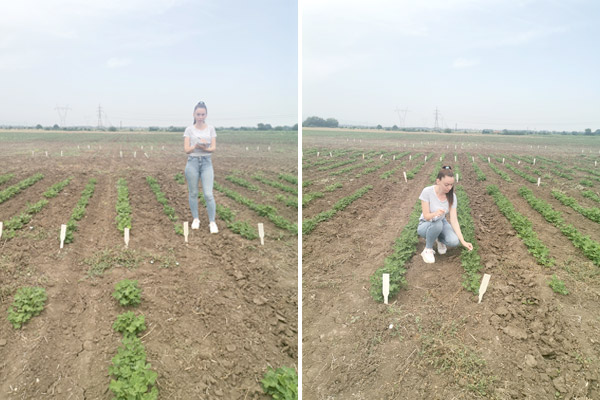
From a scientific point of view, work on this crop in our country, and in Europe, is only carried out at IPGR-Sadovo. The topic of the young scientist Vanya Karamfilova's dissertation at the institute is „Identification and Evaluation of Peanuts (Arachis hypogaea L.) from the National Collection based on Important Morpho-Biological Traits“. The main goal in the doctoral student's work is to assess taxonomic affiliation and compare variability between ecotypes of diverse origin and peanut varieties based on morphological and agronomical characteristics, as well as to establish criteria for identifying suitable sources of germplasm for *ex situ* conservation and breeding.
The implementation of the dissertation will go through the following stages:
1. Study of the morpho-biological traits of peanut ecotypes and varieties.
2. Study of the agronomical characteristics of peanut ecotypes and varieties.
3. Taxonomic identification of some peanut samples according to their affiliation with the variety types Valencia, Virginia, and Spanish.
The study includes samples by type as follows: 10 samples from North America, 10 samples from South America, 10 samples from Africa, 10 samples from Asia, and 51 samples from Bulgaria.
As a result of the study, lines serving as sources of variation for important morpho-biological traits can be selected, and those suitable for new varieties can be proposed.
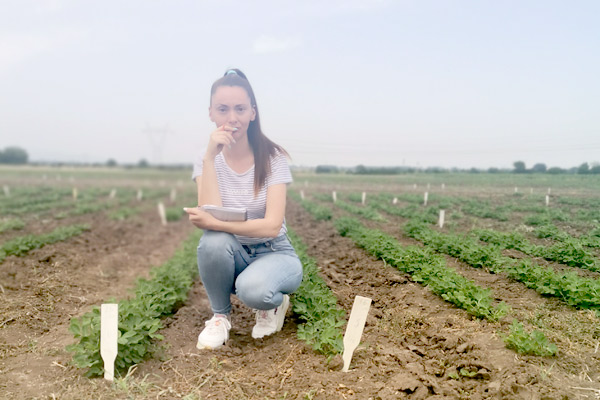
PROFILE
In February 2024, after successfully passing a competition, Ivanka Karamfilova was enrolled as a full-time doctoral student at IPGR-Sadovo, part of the Agricultural Academy. The topic of the dissertation, on which the young scientist is working, is „Identification and Evaluation of Peanuts (Arachis hypogaea L.) from the National Collection based on Important Morpho-Biological Traits“.
Doctoral student Ivanka Karamfilova graduated with honors with a bachelor's and master's degree from the Agricultural University of Plovdiv, specializing in “Crop Production“. Two years later, she graduated from the same university with a master's degree in "Breeding and Seed Production". During her studies, she actively participated in the activities of the Student Council at the Agricultural University of Plovdiv.
She first became acquainted with the work and activities of the Institute in Sadovo when, in 2014, she was invited for a one-month internship, during which she gained valuable knowledge in cultivating various plant species.
In the period 2013-2015, Ivanka Karamfilova participated in scientific lectures, seminars, research, and experiments on the topic „Increasing Yield and Quality of Agricultural Crops“, which contributed to enhancing her professional competence.
She is a co-author of the scientific article "Inventory of fam. Hyacinthaceae Batsch ex Borkh subfam. Hyacinthoideae in the Herbarium of AU-Plovdiv (SOA)", published in Scientific Papers of the Agricultural University – Plovdiv, vol. LIX, book 1, 2015.
Before embarking on a scientific career, I. Karamfilova gained more than six years of experience as an agronomist at a company for raspberry production and processing. There, she was involved in the maintenance and growth control of raspberry plantations, cultivation of planting material, and coordination of field workers' activities. She conducted surveys for the appearance of plant diseases and pests, as well as for their proper control.
For her, agriculture is a passion and a responsibility. Every day she enjoys the opportunity to work with various plant species and to collaborate with agricultural producers to increase their yield and product quality. She believes that innovation and knowledge are the successful formula for the development and preservation of agricultural science for future generations. Therefore, she continues to learn and acquire new knowledge to apply in her practical work for better and sustainable agriculture.