

![MultipartFile resource [file_data]](/assets/img/articles/пипер-струпясване-заглавна-1.jpg)
Abstract
An economically important disease of pepper in Bulgaria is bacterial spot caused by Xanthomonas euvesicatoria and Xanthomonas vesicatoria. Bacteria are isolated from leaves with symptoms characteristic of bacterial spot on diagnostic nutrient media. The pathogenic properties of the obtained strains were verified by injecting tobacco. Identification of the pathogens was performed based on physiological, biochemical, and genetic methods. The pathotype and races were determined by vacuum infiltration. Small, irregular, water-soaked, necrotic spots surrounded by a chlorotic halo, typical of X. euvesicatoria, form on pepper leaves. X. vesicatoria forms large, solitary brown, water-soaked lesions that can cover the entire leaf surface. A necrotic ring forms at the base of the petiole, and leaves fall off. Necrotic spots encompass the fruit stalk in a ring. Spots on green fruits are water-soaked, solitary or traces, sunken. Scabs of different colors form on red fruits. It is found that Xanthomonas euvesicatoria is more frequently isolated from pepper. Pathotype analysis reveals differences in the dominant pathogen populations on pepper. In the studied population of strains belonging to the species Xanthomonas vesicatoria and Xanthomonas euvesicatoria, the pepper-tomato (PT) pathotype dominates, which is equally dangerous for both pepper and tomato, explaining the severe damage to both crops in Bulgaria. It is found that the pepper pathotype predominates in Xanthomonas euvesicatoria.
The disease was first reported in our country by Karov (1965). X. euvesicatoria is a highly specialized causal agent of bacterial spot on pepper in Bulgaria. The species X. vesicatoria is the main causal agent of bacterial spot on tomatoes, also causing disease on pepper. It has been established that X. euvesicatoria is in closer interaction with pepper than with tomato and is specialized to the genome of the genus Capsicum.
Bacteria are isolated from leaves with symptoms characteristic of bacterial spot on diagnostic nutrient media. The pathogenic properties of the obtained strains were verified by injecting tobacco. Identification of the pathogens was performed based on physiological, biochemical, and genetic methods. The pathotype and races were determined by vacuum infiltration.
Small, irregular, water-soaked, necrotic spots surrounded by a chlorotic halo, typical of X. euvesicatoria, form on the leaves. X. vesicatoria forms large, solitary brown, water-soaked lesions that can cover the entire leaf surface (Figure 1 and Figure 2). A necrotic ring forms at the base of the petiole, and leaves fall off. Necrotic spots encompass the fruit stalk in a ring. Spots on green fruits are water-soaked, sunken, solitary or traces. Scabs of different colors form on ripe fruits.
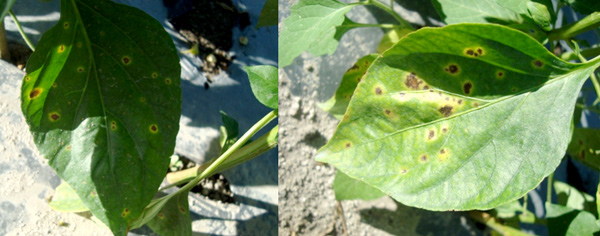
Symptomatic manifestations caused by X. euvesicatoria and X. vesicatoria
It is found that Xanthomonas euvesicatoria is more frequently isolated from pepper. Pathotype analysis reveals differences in the dominant pathogen populations on pepper. In the studied population of strains belonging to the species Xanthomonas vesicatoria and Xanthomonas euvesicatoria, the pepper-tomato (PT) pathotype dominates, which is equally dangerous for both pepper and tomato, explaining the severe damage to both crops in Bulgaria. It is found that the pepper (P) pathotype predominates in Xanthomonas euvesicatoria. Isolates belonging to X. euvesicatoria are classified as P and PT pathotype. The races determined in P are P6 and P4. Races P4T2 and P2T2 were identified in PT. The dominant race in PT is P4 in combination with T2. In the pepper pathotype P of X. vesicatoria, races P0, P2, and P3 were differentiated. The predominant races in PT of X. vesicatoria are P1T2 and P9T2.

Symptoms of bacterial spot on pepper leaves
Bacterial spot on pepper is more frequently recorded if the crop is near tomatoes or in crop rotations where the two crops alternate. The simultaneous cultivation of pepper and tomato in certain areas may lead to an exchange between the tomato and pepper populations.
A study by Vasileva and Bogatzevska (2022) found that the Shipka, Kambi, and Kapiya varietals are resistant to X. euvesicatoria P4T2t (isolated from tomato) and slightly susceptible to X. euvesicatoria P4T2p (isolated from pepper) and X. vesicatoria P2, P3T2p, P1T2t. Shipka is resistant to X. vesicatoria P1T2t, and Calabre to X. euvesicatoria P3. The varieties Shipka and Ivaylovska Kapiya are slightly susceptible to X. euvesicatoria P3, while Bulgarian Ratund is susceptible. The Bulgarian Ratund variety, when artificially inoculated with the causal agents of bacterial spot, reacts with severe defoliation. The content of alkaloids and capsaicin in the tissues of the Calabre variety limits the penetration and multiplication of X. euvesicatoria (P3, P4T2 p, t) in the leaves.
The relationship of the varieties Pazardzhishka Kapiya and Pirin, which are characterized by complex resistance to both pathogens (X. euvesicatoria and X. vesicatoria), was studied. Unilateral resistance to X. euvesicatoria P is shown by the variety Fitostop, and to X. vesicatoria PT – by the varieties Zlaten Medal 7, Dzhulyunska Shipka 1021, and Chorbadzhiyski. High resistance to both bacteria is shown by the variety Zlaten Medal 7.
A study conducted by Vancheva et al. (2016) on 23 pepper varieties (17 from Bulgaria, 5 from Serbia, and 1 from Italy) found variations in the degree of attack after artificial inoculation with X. euvesicatoria P and X. vesicatoria PT. It was established that all conical-type pepper varieties are susceptible to X. euvesicatoria P. A moderately susceptible reaction was reported for Hebar and Ekstaza, a susceptible reaction for Yasen F1 and Delfina, and a highly susceptible reaction for Sivriya 600. Among Kapiya type, particularly susceptible to both pathogen strains are Kapiya UV-Vertus, Sofiyska Kapiya, and Familiya. Quadrato D "Asti Giallo (var.dolma) from Italy is moderately susceptible to pathotypes P and PT of both bacterial species. Bulgarian varieties of this type are susceptible to both bacteria. Small-fruited peppers (microcarpum) are susceptible to X. euvesicatoria. All red grinding pepper varieties are susceptible to X. euvesicatoria. Variety IZK Kalin is moderately susceptible, and variety IZK Rubin is susceptible.
The breeding of varieties with complex resistance is more appropriate to apply the established resistance clusters to both bacteria together. All this will support future approaches in developing resistance programs for pepper varieties to the Bulgarian pathogen population.
The control of bacterioses in pepper and tomato is most often carried out by applying chemical substances. There are numerous data in the literature that representatives of the genus Xanthomonas have different sensitivities to chemical elements, with some of them being resistant. It is found that with increasing concentration of copper cations, the sensitivity of the bacteria also increases. X. vesicatoria and X. euvesicatoria are susceptible to copper sulfate, copper oxychloride, and copper hydroxide.
The great diversity among the pathotype and races of the pathogens causing this disease makes them a threat to pepper production worldwide, including in Bulgaria, where the disease has become a major problem. The European Union (EU), through various regulations, strategies, laws, etc., imposes increasingly stringent restrictions on the use of pesticides due to their harmful effects on the environment, food production, and human health. This justifies the conduct of even more in-depth breeding activities to create pepper lines and varieties resistant to attack by these pathogens.
References
- Bogatzevska N and Pandeva R, 2009. Reaction of Bulgarian pepper (Capsicum annuum L.) accessions to Xanthomonas euvesicatoria and X. vesicatoria. Genetics and Breeding, 38, 43-48.
- Bogatzevska N and Pandeva R, 2009. Reaction of Bulgarian pepper (Capsicum annuum L.) accessions to Xanthomonas euvesicatoria and X. vesicatoria. Genetics and Breeding, 38, 43-48.
- Bogatzevska N, Pandeva R and Stoimenova E, 2006. Sources of resistance to Xanthomonas vesicatoria (PT) and Phytophthora capsici in accessions from genus Capsicum. In: Proceeding from Scientific Conference with international participation, Stara Zagora, 1, 222-227 (Bulgarian).
- Bogatzevska N, Stoimenova E and Mitrev S, 2007. Bacterial and virus diseases spread in Bulgaria and Macedonia on field pepper. Plant Protection, 18, 17-21.
- Bogatzevska N, Vancheva T, Vasileva K, Kizheva Y, Moncheva P, 2021. An overview of the diversity of pathogens causing bacterial spot on tomato and pepper in Bulgaria. Bulgarian Journal of Agricultural Science, 27 (1) 137-146.
- Bogatzevska N., T. Vancheva, K. Vasileva, Y. Kizheva, P. Moncheva. 2021. An overview of the diversity of pathogens causing bacterial spot on tomato and pepper in Bulgaria. Bulgarian Journal of Agricultural Science 27 (1), 137-146.
- Bogatzevska, N., Stoimenova, E., Mitrev, S. (2007). Bacterial and virus diseases spread in Bulgaria and Macedonia on field pepper. Plant Protection 18:17-21.
- Ignjatov M, Gašic´ K, Ivanovic´,M, Ševic´ M, Obradovic´ A, Miloševic´ M, 2010. Characterisation of Xanthomonas euvesicatoria strains pathogens of pepper in Serbia. Pesticidi i Fitomedicina, 25 (2): 139–149. (Serbian)
- Ignjatov, M., Gašic´, K., Ivanovic´, M., Ševic´, M., Obradovic´, A. and Miloševic´, M. (2010). Characterisation of Xanthomonas euvesicatoria strains pathogens of pepper in Serbia. Pesticidi i Fitomedicina, 25 (2): 139–149. (Serbian)
- Karov S, 1965. Xanthomonas vesicatoria (Doidge) Dowson on pepper in our country. Scientific works, HAI 14, 245-250 (Bulgarian).
- Scortichini M. (1995) Le malattie batteriche delle colture agrarie e delle specie forestali. Edagricole- Edizioni Agricole, Bologna.
- Vancheva T, Stoyanova M, Tasheva-Terzieva E, Bogatzevska N and Moncheva P, 2018. Molecular methods for diversity assessment among xanthomonads of Bulgarian and Macedonian pepper. Brazilian Journal of Microbiology, 49S, 246-259.
- Vancheva T, 2015. Phythopathogenic bacteria from genus Xanthomonas in Capsicum annuum. Thesis for PhD (Bulgarian).
- Vancheva, T. (2015). Phytopathogenic xanthomonads of pepper plants (Capsicum annuum). Ph.D. Thesis. Sofia University “St. Kliment Ohridski”, Sofia, Bulgaria,262.
- Vancheva, T., Stoyanova, M., Tatyozova, M., Bogatsevska, N. & Moncheva, P. (2014). Sub-species diversity of Xanthomonas euvesicatoria Bulgarian and Macedonian strains from pepper. Biotechnology and Biotechnological Equipment, 28 (4), 592- 601.
- Vasileva K, Bogatzevska N, 2019. Races of bacterial spot pathogen infecting genus Capsicum in Bulgaria. Agricultural Science and Technology, 11, 2: 113-117.
- Vasileva K, Bogatzevska N, 2021. Statistical analysis of resistance variability of pepper accessions to Xanthomonas euvesicatoria and X. vesicatoria. Agricultural Science and Technology. In print
- Vasileva, K., & Bogatzevska, N. (2019). Races of bacterial spot pathogen infecting genus Capsicum in Bulgaria. Agricultural Science and Technology, 11(2), 113–117.
- Vasileva, K., & Bogatzevska, N. (2022). Resistance of pepper types to Xanthomonas euvesicatoria and Xanthomonas vesicatoria – impact of the species, races and hosts specialization. Agricultural Science and Technology, 14(2), 44–53. https://doi.org/10.15547/ast.2022.02.018