

![MultipartFile resource [file_data]](/assets/img/articles/томба-вирус-заглавна-1.jpg)
Abstract
Tomato brown rugose fruit virus (ToBRFV) is one of the most dangerous tomato pathogens. In recent years, its global spread has been steadily increasing due to its contact mode of transmission. The reporting of the virus in Bulgaria also alerts farmers to more stringent application of phytosanitary measures during agrotechnical activities in tomato cultivation. Various methods of disinfecting seeds, equipment, clothing, and surfaces are necessary for crop prevention and obtaining quality produce.
Since the tomato brown rugose fruit virus, ToBRFV, was first reported in Jordan in 2015, its „popularity“ has rapidly grown due to the damage it began to cause in tomato production worldwide. The spread of the virus has taken on wide dimensions, similar to COVID-19 in humans. Currently, the virus has been reported in almost all countries in Europe, mainly in Middle Eastern countries in Asia, in some parts of India and China, in North (USA, Canada, and Mexico) and South (Argentina) America. For reference, on the Balkan Peninsula, official reports of the virus's presence have been made by Greece, Albania, Turkey, and Bulgaria.
Like any infectious disease, the situation in our country is dynamic and subject to change. Since 2021, when the virus was first reported in a tomato greenhouse covering 500 sq. m. in Mezdra municipality, another report followed on the website of the European and Mediterranean Plant Protection Organization (EPPO). According to information provided by the Bulgarian Food Safety Agency, EPPO reports that outbreaks of the rugose virus were found in two production plantations in Smolyan and one in Pazardzhik regions in June 2022, with the status „in the process of eradication“. These data indicate that producers must be particularly careful, both during agrotechnical activities for growing tomatoes and during accompanying activities related to the transport of seedlings, finished products, and the movement of personnel involved in these activities. Panic is not needed, but rather a sober application of a system of measures to prevent the spread of the virus.
Before we mention some measures, it is necessary to recall some aspects of the biology of the rugose virus. It is a member of the tobamovirus group, similar to the well-known tobacco and tomato mosaic viruses. In shape, virions are rod-like, about 300 nm long and 15 nm in diameter. This implies that they are only visible with an electron microscope. As an obligate parasite, the virus exhibits the properties of a living organism, reproducing only in a living cell. Characteristic of this group of viruses is that plant infection occurs through mechanical contact. This usually happens during suckering, tying, winding, and other activities that require touching the plants. Thus, when a diseased plant is touched (with hands, clothes, equipment), the trichomes on tomato leaves easily „break“, and cell sap, which can be transferred to healthy plants, leaks out. The virus can also be absorbed through the roots via infected plant residues in the soil and through water in which it has fallen. The virus is also seed-borne. It is usually localized on the surface of the seed and very rarely under the seed coat. Transmission from the seed to the new plant is in the range of 0.08–2.8%, but this is enough for the infection to spread to the remaining plants in the crop, as well as to other areas. Bumblebees (Bombus terrestris) are often used for pollination in greenhouse tomato cultivation and act as a vector for mechanical transmission of the virus when collecting pollen.
Besides tomatoes, natural hosts of the rugose virus include pepper, eggplant, and weeds such as black nightshade (Solanum nigrum). Under laboratory conditions, Madagascar periwinkle (Catharanthus roseus), lamb's quarters, jimsonweed, gomphrena, various types of tobacco, and petunia can be infected.
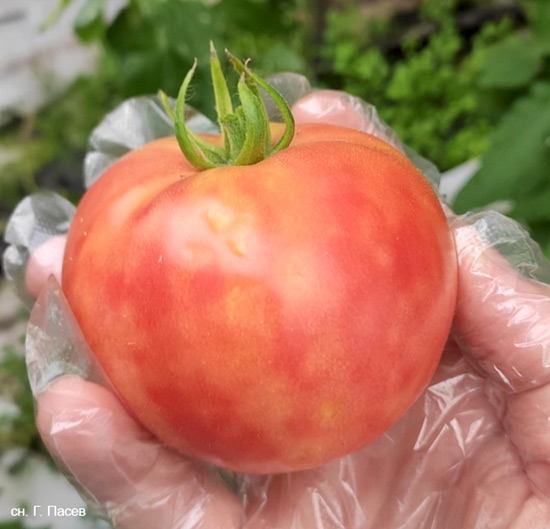
Tomato Brown Rugose Fruit Virus, ToBRFV
Symptoms in tomatoes affect the foliage, potentially causing mosaic mottling of varying intensity or deformations such as blistering, vein enations, or severe dissection of the leaf blade resembling a fern leaf. On fruits, the most common occurrences are uneven coloring in the form of yellowish spots of varying intensity and size, brownish rough patches on the skin, and deformations. Similar symptoms are observed in peppers.
It is important to note that similar symptoms on leaves and fruits can also be caused by tobacco and tomato mosaic viruses and pepper mild mottle virus, which are also found in our country. Identification of the rugose virus should not be based solely on symptoms, as they also depend on possible mixed infections or other factors such as phytotoxicity.
Besides single infections, mixed infections with tomato spotted wilt virus and pepino mosaic virus are also possible. As a result of this damage, yields can decrease by approximately 15–55%, regardless of whether the cultivated variety is resistant to tobacco and tomato mosaic. The ability of the rugose virus to overcome the widely used resistance gene (Tm22) to tobamoviruses makes it dangerous for production.
Strategy for combating the rugose virus
Combating the virus is complex and multi-layered. Approaches such as restricting access to production areas to authorized personnel only, using disposable gloves, limiting personnel movement from packaging facilities back into production areas, and effective disinfection of tools and equipment must be applied.
Routine activities such as using bees for pollination are difficult to control to reduce the risk of contamination with rugose virus. Also, the „accidental“ introduction of potentially infected fruits (tomatoes, peppers) into production areas or staff dining areas could also pose a potential threat. Therefore, frequent diagnostic tests are recommended to reduce the risk.
Seed Treatment
One of the mandatory elements in seed production is the prophylactic treatment of seeds, as the virus in most cases is localized on the surface of the seed. Various chemical preparations for seed treatment have been tested. Scientific studies suggest several recipes for seed treatment: heating seeds at 70°C for 96 h; 75°C for 48 h or 80°C for 24 h, as well as treating them with a 2.5% sodium hypochlorite solution for 15 min. Other authors indicate that treatment with 2% hydrochloric acid for 30 min or 10% trisodium phosphate provides 100% disinfection. On the other hand, our observations show that treatment with 20% hydrochloric acid for 30 min provides complete decontamination, unlike trisodium phosphate.
Surface Treatment
Another aspect of disinfection is related to the tools used in production areas. Scientific studies show that the virus is inactivated by more than 90% after treatment with 10% Clorox® (contains sodium hypochlorite), 2% Virocid (contains glutaraldehyde), 3% Virkon (contains calcium peroxymonosulfate), or a 5% bleach solution.
Clothing Disinfection
Preparations such as Fadex H+, Menno Hortisept Clean Plus, Menno Florades, specifically developed for fabric disinfection, are available on the market and provide more than 99.9% protection. Washing clothes with ordinary detergent does not kill the virus. In this case, the virus retains its infectivity in the water.
Footwear Disinfection
Treatment with preparations such as sodium hypochlorite, Virkon S, Menno Florades, and skimmed milk show more than 90% effectiveness against the virus when treating plant sap.
photos by Assoc. Prof. Dr. G. Pasev
References
1. Salem, N., Jewehan, A., Miguel A. Aranda, M.A., Fox, A. 2023. Tomato Brown Rugose Fruit Virus Pandemic. Annu. Rev. Phytopathol. 61:137–64 https://doi.org/10.1146/annurev-phyto-021622-120703
2. EPPO Global Database https://gd.eppo.int/taxon/TOBRFV/distribution/BG
3. Samarah, N., Sulaiman, A., Salem, N., Turina, M. 2021. Disinfection treatments eliminated tomato brown rugose fruit virus in tomato seeds. Eur J Plant Pathol 159, 153–162. https://doi.org/10.1007/s10658-020-02151-1