

![MultipartFile resource [file_data]](/assets/img/articles/житна-пиявица-3.jpg)
The Cereal Leaf Beetle (Oulema melanopa L.) has one generation per year and overwinters as an adult insect under fallen leaves on the outskirts of forests, forest shelterbelts, shrubs, and in the soil. In spring, the beetles appear on wild cereal grasses at air temperatures of 18-20°C and soil temperatures of 9-10°C. Later, they move to wheat and concentrate in localized outbreaks.
In recent years, the common cereal leaf beetle has established itself as a persistent pest in the regions of Vidin, Montana, Shumen, St. Zagora, Yambol, Plovdiv, and Pazardzhik, while the blue cereal leaf beetle – in Dobrudzha, on wheat and triticale. However, a significant reduction in their numbers has been observed in cereal crops. They are preferential pests, mainly on oats, but should not be underestimated primarily due to their density and fecundity. Under favorable agro-climatic conditions, it is not excluded that they might present a surprise with localized mass outbreaks and require chemical intervention with suitable organophosphorus insecticides.
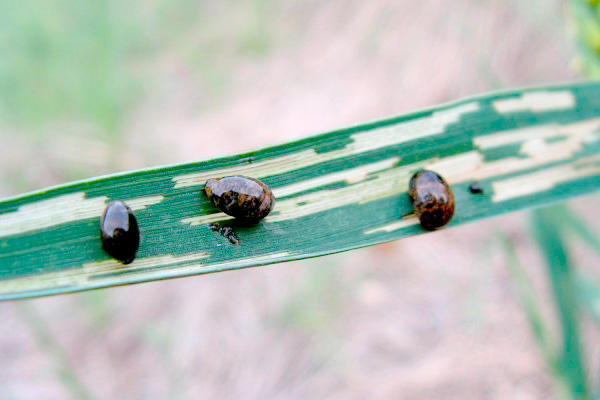
Photo© FLICKR Larva of cereal leaf beetle (Oulema melanopa L.) on a barley leaf
The harmful activity of adults and larvae lasts about two months. The reduction in wheat yields depends on the degree of damage inflicted on the leaves. In winter wheat, when 12 to 25% of the leaf surface is destroyed, yields are reduced by 14%, and at a density of one larva per plant - by 10 kg per decare. Therefore, it is advisable to conduct chemical control at this moment.
Control
Pyrethroid and neonicotinoid insecticides can also be successfully applied, such as Inazuma – 15 g/decare, Karate Zeon – 15 ml/decare, Mospilan 20 SP – 15 g/decare, Sumi Alpha 5 EC, Sumicidin 5 EC, Oasis 5 EC – 25 ml/decare, Mavrik 2F, Lamdex Extra – 42-56 g/decare.
It is desirable that chemical control against cereal leaf beetles be conducted in an environmentally friendly manner, primarily against the beetles, immediately after migration before egg-laying, when a density of 8-10 individuals per 1 sq.m is established. Infested crops should be edge-treated, spraying should be applied in strips, and only in case of uniform infestation of the entire crop should the whole area be treated.
Chemical control against cereal leaf beetle larvae is usually carried out with a significant delay, after substantial damage has been inflicted – destruction of a large part of the leaf blade down to a 'parchment leaf', in which cases the yield decreases by over 50%.