

![MultipartFile resource [file_data]](/assets/img/articles/домати-заглавна-1.jpg)
![MultipartFile resource [file_data]](/assets/img/articles/phytoseiulus-persimilis-28.jpg)
Abstract
The main diseases and pests of tomatoes are described, the damage they cause, and the favorable conditions for their development. The fight against them is indicated, including agrotechnical, physical, and chemical methods. The chemical PPPs – fungicides and insecticides – authorized for use are listed. Plant protection measures guaranteeing successful cultivation of the crop and its protection from diseases and pests are enumerated – from site selection to harvest and clearing of plant residues. More important of these are: proper selection of cultivation areas; selection of suitable varieties, if possible, disease-resistant; use of only certified, disinfected seeds; suitable, if possible, sterile substrates for seedling production; production of healthy, hardened seedlings; optimal planting times and density; monitoring of diseases and pests; adequate methods and means of control; optimal water and nutrient regime.
Tomatoes are affected by over 200 known diseases during cultivation or after harvest. They are a preferred crop for many pests. Tomatoes are a limiting factor for production and lead to significant economic losses. The occurrence of diseases is often associated with impacts caused by climate change. These are mainly related to an increase in CO2, concentration, temperature, and relative and soil humidity. Increased temperatures can lead to an increase in the population of whiteflies and thrips, vectors of viral diseases in tomatoes (bronzing, jaundice, etc.). Combining increased temperature with low atmospheric humidity creates favorable conditions for the multiplication of spider mites and powdery mildew attacks. Increased humidity leads to an increased frequency of plant diseases requiring moisture. Under such conditions, tomato production can truly be threatened by late blight (Phytophthora infestans), gray mold (Botrytis cinerea), early blight (Alternaria solani), leaf mold (Fulvia fulva), etc. The development of the listed diseases is favored by the presence of rain, high air and soil humidity, because the virulence of pathogens that infect the aerial parts is significantly enhanced by these conditions. Intensive technologies and often monoculture cultivation lead to the accumulation of pathogenic microorganisms and an increased risk of pest attacks.
VIRAL AND MYCOPLASMA DISEASES
Tomato Mosaic (TоMV)

It is caused by specific races of TMV. This is the most widespread viral disease of tomatoes, especially for early varieties and those grown in cultivation facilities. After the introduction of resistant varieties into production, its economic importance sharply decreased, and mosaic-diseased plants are rarely found. The virus is one of the most stable and persists for a long time in various forms. Symptoms are most easily found on the top leaves. They are mottled with mosaic patterns, often deformed, slightly curled. As they age, these symptoms are masked and disappear, but new mottling appears on subsequent leaves. In case of severe attack, the deformation of the top leaves is more pronounced, sometimes even becoming filamentous. Diseased plants form flower buds, bloom, but do not set fruit. In addition to the mosaic form, internal darkening of fruits and a streak form are also observed. In the latter, black necrotic streaks are observed on the leaves, petioles, and stems, and the plants look like they have been scorched. It is caused by a necrotic strain of the virus. It persists until the next growing season in plant residues in the soil. Low temperatures, low light, and high nitrogen content in the soil are favorable prerequisites for the development of the disease. Temperatures above 300С, intense sunlight, and high levels of phosphorus and potassium limit its development.
Control
Cultivation of resistant varieties; use of healthy seed and planting material; seed disinfection with 20% hydrochloric acid for 30 min or with 3% perhydrol for 25 min; thermal treatment of seeds of susceptible varieties; uprooting and destroying the first diseased plants outside the crop.
Cucumber Mosaic (CMV)

It is caused by Cucumber Mosaic Virus. A widespread disease. It occurs wherever tomatoes are grown. It has a large and diverse host range – over 800 cultivated and wild species. It damages field-grown tomatoes because the vectors – aphids – appear later. The leaves are mottled with mosaic patterns. Sometimes they are severely deformed, elongated, or greatly reduced, filamentous. Plants are stunted in their growth, flowers abort, or bloom but do not set fruit. Formed fruits are small, with impaired taste. The main source of infection are 82 species of aphids, which transmit the virus from diseased to healthy plants. The virus is not transmitted through tomato seeds, but it persists in the seeds of 19 weed species, which can serve as a source of infection. It is not transmitted by contact or through the soil, and does not persist in plant residues. During vegetation, it persists on weed hosts. They serve as a source of infection and contribute to its spread to cultivated hosts. Mass infections occur in May and June, when the density of vectors – aphids – is highest.
Control
Systematic control of aphids; production of healthy, aphid-free seedlings; clearing crops of weed hosts.
Bronzing (Tomato spotted wilt virus)
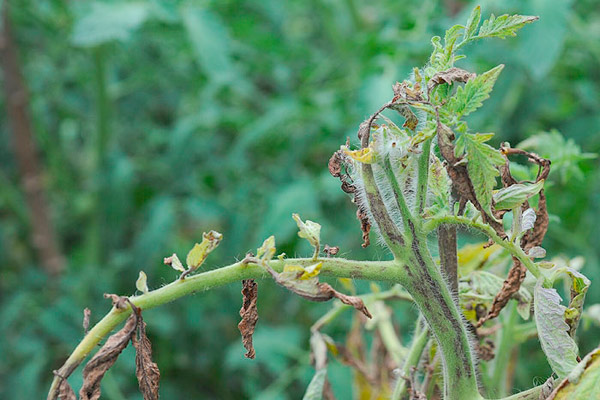
A widespread disease. Hosts include over 170 plant species, including many herbaceous ones, belonging to 35 plant families. Significant differences in virus manifestations are observed. The first symptoms appear on the top leaves, as small rings and spots that affect only the upper surface. Later, the spots merge and severely mottle the leaves. Affected leaves have a bronzed hue. Necrotic streaks appear on the stems. Fruit damage is observed during ripening, when large orange, concentric rings with a diameter of up to 2 cm appear on them. They do not penetrate the flesh, but such fruits have no market appearance and are unfit for consumption. It is not transmitted by seeds or sap from diseased plants. It does not persist in the soil. It is spread by thrips that have sucked sap from diseased plants. The virus overwinters in the roots of weed vegetation, on houseplants, as well as in overwintered viruliferous thrips. It is transmitted by both adult insects and larvae.
Control
Cultivation of resistant varieties; regular weeding; systematic control of vectors; spraying of weed strips bordering cultivated tomatoes; removal of the first diseased plants.
Stolbur (Phytoplasma)
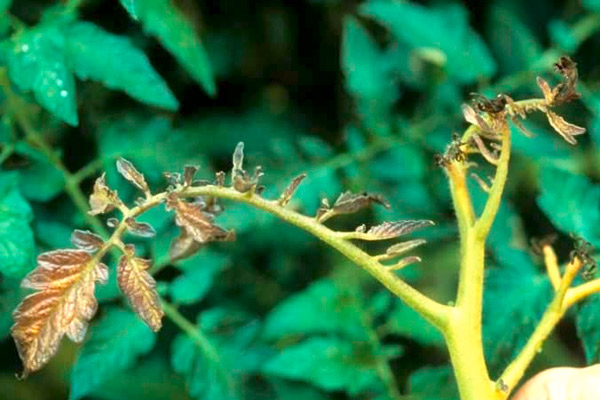
It is caused by mycoplasma. In tomatoes, the top leaves fade, deform, and turn anthocyanin-colored. Later, they are reduced and their size reaches 1-2 cm in diameter. The flowers of such plants are large, with strongly developed sepals and reduced petals. Most often, they do not form fruits, and those formed earlier are lighter, harder, tasteless, and have no market value. The pathogen is transmitted by the leafhopper Hyalesthes obsoletus. It overwinters as a larva in the roots of bindweed and other perennial weeds. Adults appear in June, suck sap from infected weeds, and transmit the infection to cultivated plants. The incubation period is about a month.
Control
No resistant varieties have been developed. Control is directed against the vector - the leafhopper.
BACTERIAL DISEASES
Bacterial Wilt (Clavibacter michiganense subsp. michiganensis)

The first symptoms appear on plants obtained from infected seeds, or transplanted into infected soil. Later infection is associated with the suckering of plants, which is one way of its spread. The first signs are expressed in wilting and subsequent drying of leaf blades located on one side of the petiole, which curves arch-like towards the dried blades. Longitudinal cracks appear on the petioles, formed by destroyed conductive vessels. When a leaf with signs of the disease is broken off, it is seen that the conductive system is destroyed, necrotic. The pathogen can also penetrate fruits through the fruit stems, causing darkening of the conductive vessels in them. The bacterium persists in the soil in plant residues. It dies after their mineralization. The introduction of a three-year crop rotation including non-susceptible crops is sufficient to clear the soil.
Control
Cultivation of resistant varieties; sowing healthy, disinfected seeds; sowing seeds in sterile, disinfected soil; the first diseased plants and neighboring healthy ones are uprooted and destroyed outside the greenhouse; the affected areas are watered with a 2% solution of copper sulfate; during suckering, wounds should not be touched; disinfection of inventory by soaking in a 2-3% solution of copper sulfate.
Pith Necrosis (Pseudomonas corrugatа)
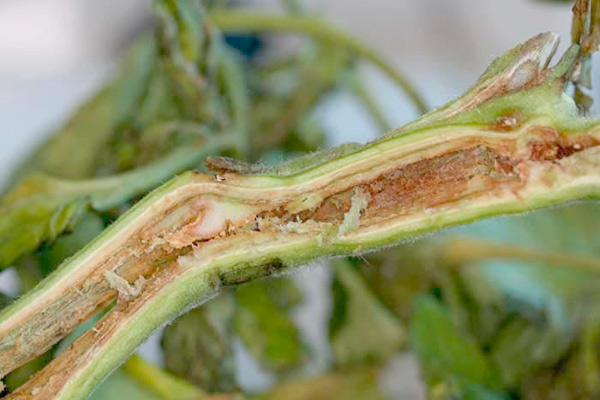
Diseased plants are chlorotic, especially the areas between the veins. Later, these areas become necrotic. In places where suckers have been removed, dark brown spots measuring 1-2 cm are observed. The conductive vessels and the pith of the stem turn black. The petioles also have affected pith. Dark necrotic streaks appear on their upper surface. The pathogen moves acropetally and infects subsequent leaves; it does not attack the host's root system. It attacks tomatoes in unheated greenhouses. Large differences between day and night temperatures, high air humidity are a prerequisite for the appearance of the disease. Most often, the pathogen penetrates through wounds caused by suckering. The development of the disease is stimulated by one-sided intensive nitrogen fertilization.
Control
A complex of agrotechnical measures limits the appearance and development of the pathogen: introduction of at least a two-year crop rotation; balanced fertilization; optimal irrigation rates; regular ventilation of cultivation facilities; upon appearance the first diseased and neighboring healthy plants are uprooted and destroyed outside the crop. The remaining plants are sprayed with copper-containing PPPs. The goal is to limit the spread of the disease.
Bacterial Spot (Xanthomonas vesicatoriа X. gardneri and Pseudomonas syringae pv. tomato)

They attack all parts of tomato plants. Small black spots with a chlorotic halo appear on the leaves, stems, petioles, and flower stalks. In case of severe attack, the leaf scorches and dies. When flower stalks are attacked, the flowers drop off. On fruits, the spots are initially watery, and later turn black, slightly raised, resembling scabs (bacterial spot). The fruits have no market appearance, and the pathogen can reach the seeds and infect them superficially. Bacteria persist in the seed coat, in plant residues, and in the soil. They develop asymptomatically on the leaves of other hosts, but in tomato crops, it causes serious losses in yield and product quality.
Control
Introduction of at least a two-year crop rotation; balanced fertilization; optimal irrigation rates; regular ventilation of cultivation facilities; upon appearance the first diseased and neighboring healthy plants are uprooted and destroyed outside the crop. The remaining plants are sprayed with copper-containing PPPs. The goal is to limit the spread of the disease. Other registered PPPs are: Aerwan SC 250 ml/da; Coprantol Duo 250 g/da; Kuproksat FL/Tribase Flowable 0.3%; Serenada ASO SC 400-800 ml/da; Taegro 18.5-37.0 g/da; Funguran ON 50 WP 0.3%.
FUNGAL DISEASES
Soil Pathogens
Root Rot
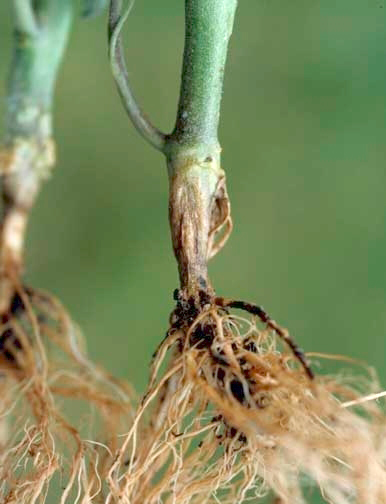
It attacks all vegetable crops grown in cultivation facilities. It is caused by several fungi: Rhizoctonia, Alternaria, Sclerotinia, Phytophthora and Pythium. These are typical soil pathogens. They are transmitted with seedlings, with infected soil, with tillage, irrigation water, etc. The degree of attack is influenced by environmental factors – temperature, humidity, amount of infection, presence of mechanical damage to plants caused by pests and agrotechnical measures, deficiency or excess of nutrients. Seedlings are most susceptible, but it is also observed in already transplanted plants. Watery or dark necrotic sunken spots appear on their stems, in the area of the root collar. Most often, the disease develops in patches. Seedlings grown in cool, poorly drained, waterlogged substrates are particularly sensitive. Such plants, once planted in a permanent location, often die. The variety of causative pathogens, differences in their habitat, their requirements for environmental factors, and their different sensitivity to soil fumigants seriously complicate the control of the root rot complex.
Control
Chemical disinfection with Basamid Granulat or Nemasol; physical disinfection by steaming or solarization with subsequent application of biopreparations containing the antagonistic fungus Trichoderma. Treatment with PPPs: The first diseased plants and healthy ones around them are removed. The spots are watered with a solution of copper sulfate or ammonium nitrate – 3.0%. The remaining plants are treated with registered fungicides - Beltanol 400 g/da, Rival 5 ml/m2; Proplant 722 SL 0.1%; application of biopreparations Trichodermin or Fusaclin.
Corky Root (Pyrenochaeta lycopersici)
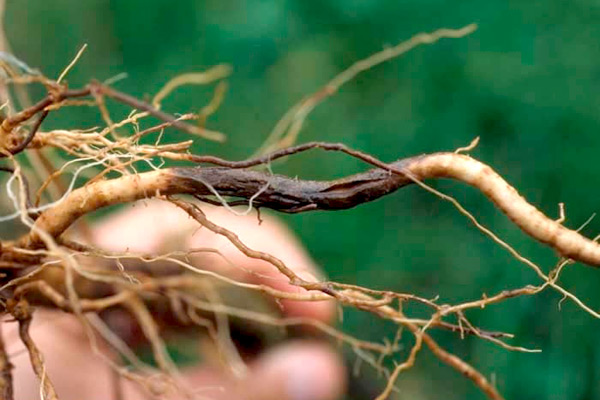
A highly damaging disease with great economic importance for tomatoes. Hosts also include other cultivated species from the Solanaceae family – peppers, eggplants, and some weed species. Cucumbers are asymptomatic carriers of the pathogen, which makes it practically impossible to introduce effective crop rotation in cultivation facilities. The temperature range in which the pathogen develops is 8 – 32оС, with an optimal temperature of – 26оС. The fungus persists in plant residues and in the soil for 3-4 years. It reaches a depth of up to 50 cm. It causes greater damage in cold, unstructured, heavy soils. Losses caused by this disease can reach 40–70%. The pathogen damages the root system of tomatoes. The first symptoms observed on the above-ground parts of the plants are stunted growth, dwarfing, chlorotic lightening, and netted mottling of the top leaves. These symptoms appear significantly later, when the root system is already affected. Dark, corky areas are observed on its branches, alternating with light, healthy ones. The spots grow and cover almost the entire roots. The number of sucking rootlets is greatly reduced. Diseased plants wilt in sunny weather, due to increased transpiration and reduced root surface, and restore their turgor at night. By the end of the growing season, some of them may even dry out. Fruits obtained from such plants are fewer in number and smaller.
Control
Prevention to limit the disease; production of healthy seedlings in a sterile substrate; if the pathogen is established in the soil, its spread should be limited by water flow; fertilization with ammonium sulfate during vegetation, controlling pH continuously; frequent irrigations with reduced irrigation rates, to maintain continuous soil moisture; in infected soils, ridging should not be done, as plant roots are broken and this additionally increases the water deficit; soil disinfection in cultivation facilities with Lysol 60 l/da or Basamid Granulat 50-70 kg/da; soil solarization in suitable atmospheric conditions with subsequent application of biopreparations based on *Trichoderma*.
Verticillium Wilt (Verticillium dahliae, V. albo-atrum)

The causative agent of Verticillium wilt is a soil pathogen, with over 300 hosts. In tomatoes, it is more significant for those grown in cultivation facilities. Favorable conditions for its development are high organic matter content in the soil, monoculture cultivation, and the inability to introduce crop rotation with non-host plants. With the accumulation of a significant amount of inoculum in the soil, the pathogen is able to compromise the harvest. It attacks plants of all ages. The first symptoms appear on the lowest leaves. The leaf blades yellow and later wilt and dry out. After that, the disease moves upwards to higher levels. Early infected plants do not yield, and in later infected ones, the leaves wilt. The causative agent of Verticillium wilt is a typical soil-dwelling microscopic fungus. The pathogen penetrates the host through the roots and develops in the conductive system, destroying and clogging it. In this way, sap movement in the plant is disrupted. Simultaneously, it releases toxins that disrupt the normal course of biochemical and physiological processes. In tomatoes, damage is more severe at lower temperatures. The fungus overwinters as mycelium in intermediate hosts and in plant residues. The pathogen spreads through infected seedlings, with tillage, and with irrigation water. New tomato varieties are resistant to Verticillium wilt.
Control
It is mainly based on prevention and includes: cultivation of resistant varieties; disinfection of cultivation facilities with Basamid Granulat, Lysol, solarization, and subsequent application of bioproducts based on Trichoderma spp.; production of healthy seedlings.
Fusarium Wilt (Fusarium oxysporum f.sp. lycopersici (FOL)

It attacks all vegetable crops grown in greenhouses. The pathogen develops in the conductive vessels, blocking the movement of water to the leaves and can cause their death. It infects plants at all stages of their development. The first symptoms are yellowing of the lowest leaves. Plants are stunted in their growth. Yellowing can begin from one side of the plant. The leaves turn brown and dry out. Gradually, wilting moves upwards and covers higher levels. The entire plant wilts and dies. Discoloration of the conductive system is an important diagnostic sign. A cross-section of the stem shows darkening of the conductive vessels. The varieties grown in greenhouses are resistant to the disease. Favorable conditions for the development of the pathogen are high temperatures (28оС), high soil moisture, acidic soil reaction, abundant fertilization with ammonium nitrate. The pathogen persists in the soil for many years, even in the absence of a host. The accumulation of infection is favored by high air and soil humidity and temperature. The fungus penetrates directly through the roots and root hairs, even if they have no wounds. It persists in the soil as chlamydospores and in infected plant residues. Resting spores can maintain their viability on structures and on seeds for up to one year.
Control
Introduction of a 4-6 year crop rotation; cultivation of resistant varieties. Most varieties grown in cultivation facilities are resistant to Fusarium wilt, race 1, which is widespread in our country; production of healthy seedlings; keeping crops free of weeds; fumigation; solarization. Treatment with Serenada ASO SC 1000 ml/da.
Fusarium Root and Stem Rot (Fusarium oxysporum f.sp. radicis-lycopersici (FORL) is a necrotrophic pathogen. It causes rotting of the root collar and roots of tomatoes. It has great economic importance and causes serious losses in greenhouse, field, and hydroponic cultivation. The optimal soil temperature for pathogen development is 18°C. Infection causes wilting and drying of plants and impairs fruit quality. The infection first penetrates through the secondary roots, but then reaches the conductive vessels of the plants. Infected plants slowly wilt, stunt, and yellow. Eventually, the entire plant turns brown and dies. Stems often have brown vascular streaks. Other symptoms include delayed growth and wilting on sunny days, especially if plants are laden with fruit. Although it is a parasite of the root and collar, the fungus causes browning of the vessels up to 30 cm above the collar. Brown longitudinal necrotic lesions form on the stem, from which drops of resin are exuded. Roots turn brown and rot. Various methods for controlling this pathogen have been tested, but the use of resistant varieties is the most acceptable system.
Control
Introduction of a 4-6 year crop rotation; cultivation of resistant varieties; production of healthy seedlings; keeping crops free of weeds; fumigation; solarization.
DISEASES OF ABOVE-GROUND PLANT PARTS
Gray Mold (Botrytis cinerea)
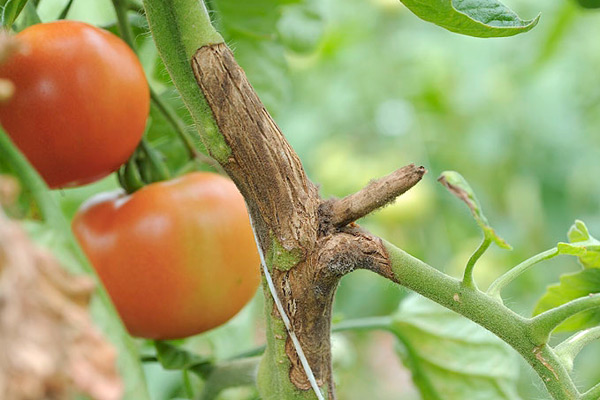
The disease attacks plants in all phases of their development. In cultivation facilities, infections most often occur through wounds sustained during plant suckering. When conditions are favorable for pathogen development, it is able to defoliate entire plants if adequate measures are not taken. The most dangerous is the attack on the stems. Damage is difficult to notice until it is too late. They encircle the stem like a ring, interrupt sap flow, and the part above them dies. Optimal temperature for development - 22-25оС. In young plants, it most often damages the base of the stem, where a dry brown spot appears, initially affecting only the bark. Later, the pathogen penetrates inwards and can interrupt sap flow, resulting in the death of the plant. The spots are covered with abundant grayish-brown mycelium and sporulation of the fungus. Plant parts located above the affected area wilt and dry out. In the presence of high air humidity (90%) and temperature (13-180С), the pathogen also affects the leaf mass. Light brown elongated spots appear on the petioles and leaf blade tips. The vegetative part above them dies. The spots are also covered with sporulation of the fungus. Development on fruits most often starts from the stem cavity, where the tissues lighten and soften. Later, they are covered with abundant sporulation.
Control
Cultivation of resistant varieties; maintaining optimal air humidity in greenhouses; regular ventilation; clearing plant residues and weeds; suckering should be done in sunny weather and after the dew has lifted; no parts of the suckers should be left; affected parts (leaves, fruits) are collected in bags and destroyed outside; if necessary, treatments with PPPs. Registered PPPs: Avalon 200 ml/da; Botrybel 0.4-1.5 l/da; Geox WG 50 g/da; Difcor 250 SC 50 ml/da; Erune 40 SC 200 ml/da; Julieta 250 g/da; Captan 80 WG 150-190 g/da; Laitane 200 ml/da; Polyversum 10-30 g/da; Pretil 200 ml/da; Prolectus 50 WG 80-120 g/da; Serenada Aso SC 400-800 ml/da; Signum 100-150 g/da; Skomrid Aerosol 3 g/da; Switch 62.5 WG 100 g/da; Fontelis SC 240 ml/da; Fungisey 300 ml/da.
Late Blight (Phytophthora infestans)
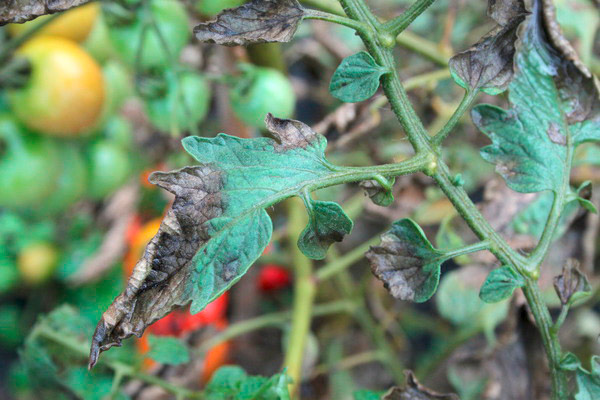
A universally widespread disease of tomatoes. It is found all over the world where favorable conditions exist. The fungus develops year-round. Conditions are especially good in plastic-covered facilities, where abundant dew forms. Therefore, it is dangerous to grow seedlings in such facilities. In glass greenhouses, with heating at night, its significance is limited. The incubation period, depending on conditions, is 3-10 days. The fungus develops under a specific combination of meteorological conditions – „critical periods”, which are: quiet precipitation for two or more days; relative air humidity during the period above 75%; cloud cover above 8 octas; average daily temperature – around 160С (min 10-120C; max 18-250C). The retention of water droplets for more than 4 hours on the plant surface is also a prerequisite for new infections. It attacks all aerial parts of the plants. Large watery spots appear on the leaves, which usually begin from the tip or periphery of the leaf. They quickly grow and then dry out. The lower surface of the spots is covered with a loose whitish coating – the sporulation of the fungus. In severe attacks, the entire leaf mass can die. Spots on the petioles and fruit stalks are dry, dark brown. Spots on the stem are also large and watery and cover it entirely. These are particularly dangerous for tomatoes grown in cultivation facilities, as entire plants can soon dry out. On the fruits, the spots are brown, rough, with a radial structure. They quickly increase in diameter. In high air humidity, a loose whitish sporulation appears on them. When transported, such fruits can also infect neighboring healthy ones. It usually attacks green fruits. With favorable conditions and inadequate control, losses from this disease can reach 60-70%. Cyclicity in the development of late blight has been established. The duration of one cycle is about 10 years.
Control
Production of healthy seedlings. This will be ensured if dew formation on the plants is prevented; regular ventilation of cultivation facilities; optimal temperature-humidity regime; preventive treatments with PPPs; treatment with PPPs in the presence of critical periods. Registered PPPs: Proxanil/Axidor 250 ml/da; Lieto 40-45 g/da; Azaka 80 ml/da; Acticluster 250-350 ml/da; Polyram DF 0.2%; Quantum Rock 250 g/da; Zoxis 250 SC 70-80 ml/da; Karyal Star 60 ml/da; Tribase Flowable/Kuproksat FL 0.3%; Pergardo Med 27 WG 500 g/da; Corseight 60 WG 20-30 g/da; Difaz 100 ml/da; Vitene Triplo R 400-450 g/da; Presidium One 83-100 ml/da; Taser 250 SC 80-100 ml/da; Champion WP 0.15%; Orondis Ultra 40 ml/da; Funguran ON 50 WP 0.15%.
Phytophthora Rot (Phytophthora nicotianae var. parasitica)
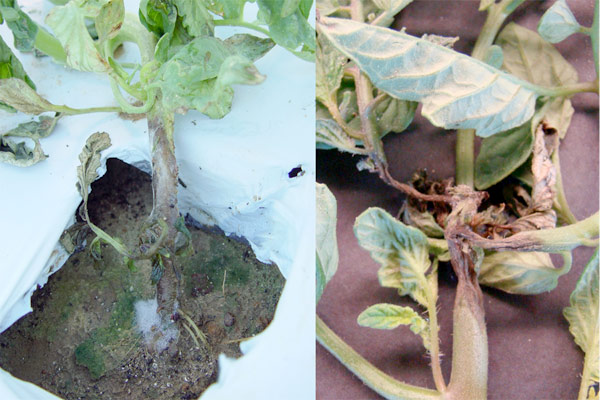
It occurs in tomatoes grown in cultivation facilities and outdoors. It is especially dangerous when grown under soilless conditions – hydroponics. It attacks plants in all stages of their development. In seedlings, it causes „damping-off”, in transplanted plants, the fungus attacks the base of the stem. Rot on fruits is called „buckeye rot” and appears upon contact with the infected soil surface. Diseased fruits easily fall off upon touch. From the lower cluster, the infection can spread upwards if adequate treatments are not carried out. When growing tomatoes by the hydroponic method, the fungus attacks the root system. All rootlets located outside the rockwool block rot and break off. If the system is of a closed type, they are carried into the reservoir, infecting the nutrient solution located there. The pathogen has many hosts. It persists with plant residues in the surface soil layer for 1-2 years. High soil moisture is favorable for its development. It dies at low temperatures in winter. It is also sensitive to high temperatures.
Control
Disinfection of soil in greenhouses; growing seedlings in a sterile substrate; spraying the soil surface with copper-containing PPPs (0.15% Champion, Koside, Funguran) before the first cluster lays on it; maintaining optimal soil moisture around the plants where the first cluster lays; PPPs applied against late blight are also effective against Phytophthora rot.
Early Blight (Alternaria porri f. solani)
This is the most widespread and common disease of tomatoes grown in cultivation facilities and outdoors. On the oldest leaves, and later on the entire plant, small watery spots appear, which grow up to 5-7 mm in diameter. Later they dry out, turn dark brown, to black, with a concentric structure, merge, and the leaf scorches. Spots on the stem, petioles, and flower stalks are similar, with the characteristic concentric structure. Spots on fruits begin from the stem cavity and also have a concentric structure. Spots on flower stalks are particularly important for yield reduction, as they can cause flowers to drop. In high relative air humidity, the affected areas are covered with a black coating from the sporulation of the fungus. The optimal temperature for development is 26-28оС. The pathogen persists as mycelium in plant residues in the soil for more than one year. When fruits are infected, it also infects the seeds. The infection persists mainly superficially until the next growing season. High relative air humidity in cultivation facilities is a prerequisite for abundant sporulation. The pathogen prefers old leaves that have completed their growth. Plants are most susceptible during the period of intensive fruiting. Ripe fruits are resistant, while green ones are susceptible to the disease.
Control
Seed disinfection; seedling production in a sterile or disinfected substrate; maintaining optimal temperature-humidity regime in cultivation facilities; regular ventilation of facilities; treatment with PPPs upon appearance or in favorable conditions. Registered PPPs: Azaka 80 ml/da; Vitene Triplo R 400-450 g/da; Dagonis 100 ml/da; Difaz 100 ml/da; Difcor 250 SC 50 ml/da; Zoxis 250 SC 70-80 ml/da; Casino Royal 150 g/da; Karyal Star 60 ml/da; Captan 80 WG 150-190 g/da; Copforce Extra 200 g/da; Ortiva Top SC 100 ml/da; Polyram DF 0.2%; Prev-Gold 200-600 ml/da; Serifel 50 g/da; Sinstar 70-80 ml/da; Scor 0.05%; Taegro 18.5-37.0 g/da; Taser 250 SC 80-100 ml/da; Cideli Top 100 ml/da.
Leaf Mold (Fulvia fulva)
In our country, it is mainly widespread in tomatoes grown in cultivation facilities. Its economic importance is greater for plastic-covered greenhouses. Large, pale, irregularly shaped, and indistinctly delimited spots appear on the upper side of the leaves. Later they turn yellow. In high air humidity, their lower surface is covered with a light coating of fungal sporulation, which later darkens and becomes velvety brown. This is the most typical diagnostic sign of the disease. In the presence of favorable conditions for fungal development, the crop can be defoliated, which severely reduces yield. The fungus develops at an optimal temperature of - 20-25оС. Below 10оС, the infectious process is not possible. Spores germinate at high air humidity – above 95%. It persists as mycelium and spores in plant residues in the soil. Conidiospores can survive on structures and facilities and superficially on seeds until the next growing season. They are carried by air currents. It attacks only tomatoes. 6 physiological races have been identified. Resistant varieties have already been developed.
Control
Treatment of plants at the end of the growing season with formalin to destroy spores adhering to plants, soil surface, and structures; cultivation of resistant varieties; maintaining an optimal temperature-humidity regime; regular ventilation of facilities; treatment with PPPs upon disease appearance; when treating with PPPs, spray the lower surface of the leaves where the fungal sporulation is located. Registered PPPs: Zoxis 250 SC 70-80 ml/da; Signum 100-150 g/da; Sinstar 70-80 ml/da; Scor 250 SC 0.05%; Cideli Top 100 ml/da.
Powdery Mildew (Leveillula taurica and Oidium neolycopersici)
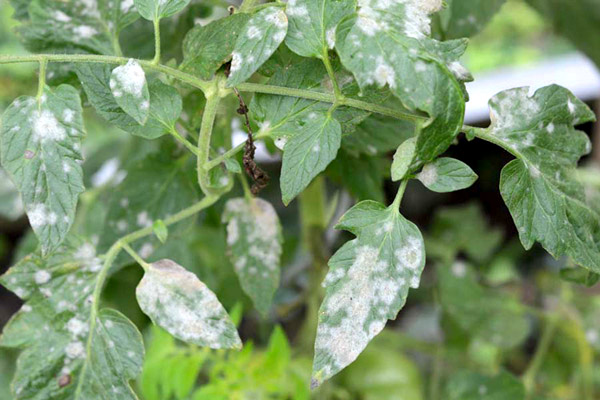
Common powdery mildew is rarely found in cultivation facilities. It is typical for regions characterized by low air humidity. Whitish to yellow spots of irregular shape form on the leaves. On the underside, they are covered with a loose white coating of fungal sporulation. In severe attacks, the spots merge and the leaf scorches. The fungus attacks only the leaves of the plants. Optimal conditions for its development are temperatures above 250С and humidity below 60%. In recent years, a new species has been identified that attacks only greenhouse tomatoes, and its requirements for environmental conditions are different. It develops on the upper surface of the leaves and all aerial parts of the plants, with the exception of fruits. It has great economic importance for tomatoes grown in cultivation facilities, but its importance for field production is continuously increasing. Conidia form at 20оС and relative humidity of 70-85%. The mycelium of L. taurica develops predominantly in the mesophyll of the leaves and is found on their underside, while O. neolycopersici develops predominantly on the upper side and does not penetrate the mesophyll.
Control
Cultivation of resistant varieties; increasing air humidity against L. taurica; treatment with PPPs upon appearance. Registered PPPs: Ortiva Top SC 100 ml/da; Kosavet DF 500 g/da; Domark 10 EC 40-50 ml/da; Diagonal 250 g/da; Sivar 80-100 ml/da; Carbicur 300 g/da; Zoxis 250 SC 70-80 ml/da; Taser 250 SC 70-80 ml/da; Legado 80-100 ml/da; Custodia 50-100 ml/da; Taegro 18.5-37.0 g/da; Fitosev 200 ml/da; Vivando 30 ml/da; Sinstar 70-80 ml/da; Cideli Top 100 ml/da; Dagonis 60 ml/da; Azaka 80 ml/da; Sonata SC 500-1000 ml/da; Trezin/Trunfo 100 ml/da; Flosul 200 ml/da; Topaz 100 EC 35-50 ml/da; Prev-Gold 160-600 ml/da; Scor 250 EC 0.05%.
PESTS
European Mole Cricket (Gryllotalpa gryllotalpa L.)
A typical polyphagous pest. In spring, it is often observed in tomato crops immediately after transplanting. It has one generation per year. It overwinters as a larva, nymph, or adult insect in the soil. It causes damage as early as February in seedling greenhouses, especially severely where it is introduced with soil-fertilizer mixtures and manure. It prefers loose, moist, humus-rich soils. In the field, adults appear towards the end of May. The mole cricket makes underground tunnels, undermines, and lifts plants. Larvae, as well as adults, feed on the underground parts of plants, gnawing on the root system and stem near the soil surface, eating young sprouts. Damaged plants dry out.
Control
Application of granular PPPs before sowing and planting. Registered PPPs: Belem 0.8 MG/Colombo 0.8 MG 1.2 kg/da; Force 1.5 G 500 g/da.
Aphids
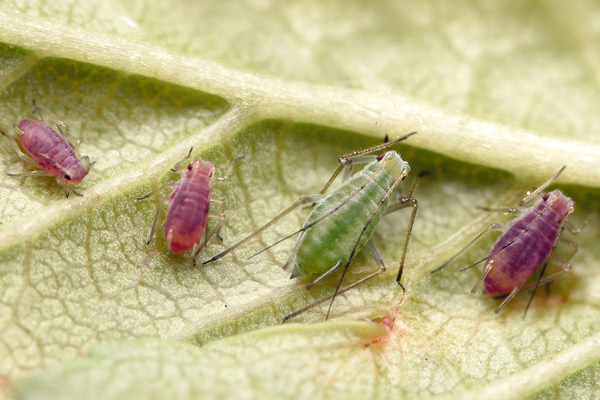
Tomato Aphid (Macrosiphum euphorbiae Thomas)
The tomato aphid (Macrosiphum euphorbiae Thomas), peach aphid (Myzus persicae Sulz.), and pepper aphid (Aphis nasturtii Kalt.) are mainly found. They cause damage by sucking sap from the leaves. They prefer young and tender plant tissues. They concentrate on the tips of the stem and branches, on leaf and flower buds. Affected plants are stunted in their growth and development. Aphids excrete a sticky secretion called “honeydew”, on which black saprophytic fungi develop, contaminating the leaves and produce. They also cause indirect damage as vectors of some viral diseases. Under favorable conditions, aphids develop very quickly and form high-density colonies in a short time. High temperatures, accompanied by low air humidity, have a depressing effect on aphids. These pests develop many generations per year and quickly form resistant forms to applied insecticides, which complicates their control. It is necessary to spray with alternation of insecticides from different chemical groups, as well as to adhere to the indicated concentrations and doses.
Control
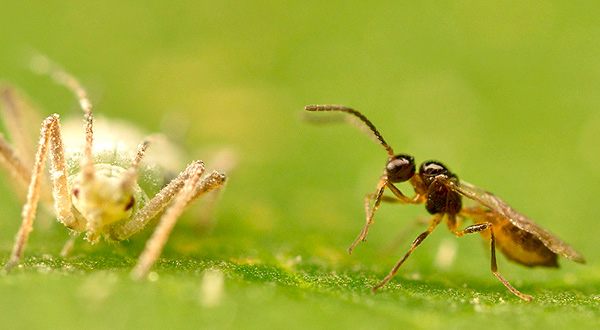
Bioagent Aphidius colemani
The bioagents Aphidius colemani and Aphidoletes aphidimyza can control aphid populations in greenhouses. Authorized aphicides: Azatin EC 100-150 ml/da; Ampligo 150 ZC 20 ml/da; Grial 50 ml/da; Deltagri (Deltafarm) 30-50 ml/da; Deca EC (Desha EC, Dena EC, Deltin, Decision, Poleci) 30 ml/da; Delmur 50 ml/da; Decis 100 EC 7.5-12.5 ml/da; Infis 50 ml/da; Closer 120 SC 20 ml/da; Lamdex Extra 28-60 g/da; Meteor 60-70 ml/100 l. water; Niimik Ten 390 ml/da; Oikos 100-150 ml/da; Sivanto Prime 45 ml/da; Skato 30-50 ml/da; Teppeki (Afinto, Hinode) 10 g/da; Flipper 1-2 l/da.
Greenhouse Whitefly (Trialeurodes vaporariorum Westw.)
A pest that is constantly present in tomato crops from seedling production to harvest. Polyphagous, widespread throughout the country. It has 10-12 generations per year. It mainly causes damage in cultivation facilities, but recently it has also been found in high densities outdoors. All developmental stages of the pest occur on the underside of the leaves. Larvae and nymphs feed by sucking plant sap from the underside of the leaves, petioles, and rarely on the stems. During feeding, the larvae excrete “honeydew”, on which sooty mold fungi develop, contaminating the leaves and reducing the assimilating surface. Plants are stunted in their growth and development. In severe attacks, leaves yellow and drop off, and plants often die.

Whitefly eggs are often arranged in a semicircle or circle
The greenhouse whitefly reproduces very quickly and causes significant damage to plants. Eggs, larvae, and adults are found simultaneously on the leaves, which greatly complicates control. In addition to direct damage, the greenhouse whitefly also acts as a vector for the viral disease of tomatoes Tomato Infectious Chlorosis Virus (TICV).
Control
Placing yellow sticky traps or strips not only for monitoring the appearance and density of whiteflies, but also for control. They are used in greenhouses and seedling departments. The bioagent Encarsia formosa can successfully control the population of greenhouse whiteflies in cultivation facilities. Registered PPPs: Abanto 75 ml/da; Azatin EC 100-150 ml/da; Verimarktm 200 SC 37.5-50.0 ml/da; Deca EC (Desha EC, Dena EC, Poleci, Decision, Deltin) 30 ml/da; Expedient 10 EC 50-80 ml/da; Closer 120 SC 20-40 ml/da; Krisant EC 75 ml/da; Limocid 400 ml/da; Mospilan 20 SP 20 g/da; Mulligan 25-95 ml/da; Minecto Alpha 125 ml/da; Meteor 60-70 ml/100 l. water; Naturalis 75-100 ml/da; Natur Breaker 75 ml/da; Niimik Ten 390 ml/da; Oikos 100-150 ml/da; Piregard 75 ml/da; Prev-Gold 160-600 ml/da; Requiem Prime 500-1000 ml/da; Sivanto Prime 56 ml/da; Flipper 1-2 l/da; Harpoon 50-112.5 ml/da.
Thrips
In recent years, an increase in thrips population density has been observed. This is largely related to climate change, successful overwintering, early appearance, and high reproductive potential of these pests.
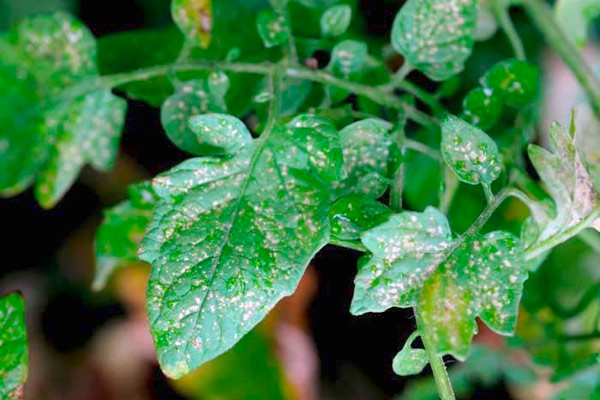
California Thrips (Frankliniella occidentalis Perg.)
In tomatoes, the tobacco thrips (Thrips tabaci Lindeman) is mainly found, with less frequent attacks from the California thrips (Frankliniella occidentalis Perg.) (during seedling production). Thrips develop 8-10 generations per year. They overwinter as adults and last-instar nymphs in plant residues, and in greenhouses, they develop year-round. Adults and larvae cause damage by sucking sap from leaves, growing tips, and flower buds. Small, silvery-white spots with black dots appear at the sites of damage. At high densities, the spots enlarge and merge. Leaves dry out. Plants are stunted in their development. The nymph stage of the pest occurs in the soil, eggs are laid within leaf tissue. Thrips transmit the viral disease bronzing in tomatoes (Tomato Spotted Wilt Virus - TSWV).
Control
Using blue sticky traps in greenhouses not only for monitoring but also for control. Early detection of the pest is crucial for the effectiveness of plant protection measures. Thrips in greenhouses can be successfully controlled by the predatory mite Amblyseius swirskii, as well as by the predatory bug Orius spp. The entomopathogenic nematode Steinernema feltiaе can also be used.
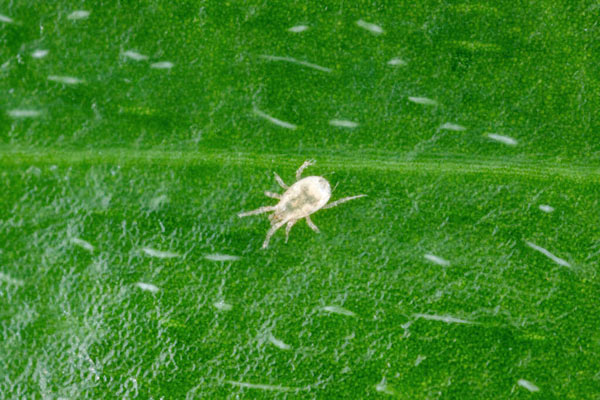
Predatory mite Amblyseius swirskii
Authorized PPPs: Azatin EC 100-150 ml/da; Deca EC (Deltin, Dena EC, Desha EC, Decision, Poleci) 30 ml/da; Dicarzol 10 SP 556 g/da; Exalt 200-240 ml/da; Lamdex Extra 28-60 g/da; Limocid 400 ml/da; Meteor 60-70 ml/da; Minecto Alpha 125 ml/da; Naturalis 100-150 ml/da; Oikos 100-150 ml/da; Requiem Prime 500-1000 ml/da; Syneis 480 SC – 10-37.5 ml/da; Flipper 1-2 l/da.
Leaf Miners
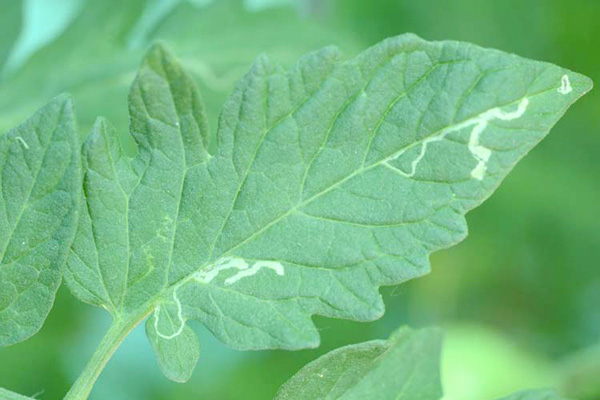
Among the leaf miners, the tomato leaf miner (Liriomyza bryoniae Kalt.) and the South American leaf miner (Liriomyza huidobrensis Blanchard) are often found. They develop 5-6 generations per year. They overwinter as pupae in the soil. Adults, during oviposition, make numerous punctures with their ovipositor, primarily on the upper side of the leaf, and feed on the exuding plant sap. This damage is easily noticeable, as the tissue yellows, dries out, and pinpoint spots form. The hatched larvae burrow into the leaves, feeding by forming long, serpentine lines, without affecting the upper and lower epidermis. The mines expand, intersect, or merge. Only one larva is found in a single mine, but in severe attacks, more than 10 mines can be counted on one leaf. Leaves yellow and dry out.
Control
For the control of leaf miners in greenhouses, the bioagents Dacnusa sibirica and Diglyphus isaea can be used. Authorized PPPs: Verimark tm 200 SC 37.5-50.0 ml/da; Voliam Targo 063 SC 80 ml/da; Syneis 480 SC 25-30 ml/da; Laota 15-100 ml/da; Oikos 100-150 ml/da; Bermectin 50-100 ml/da; Boutic 30-100 ml/da; Apache EV 30-100 ml/da.
Colorado Potato Beetle (Leptinotarsa decemlineata Say.)
This pest is common and well-known in practice. It mainly damages crops from the Solanaceae family (potatoes, eggplants, tomatoes, etc.). Adults and larvae cause damage. They gnaw on leaves and petioles. They destroy the parenchyma, and in severe attacks, also the veins. Plants can be completely defoliated, which leads to a significant reduction in yields.
Control
Regular inspection of crops for early detection of the pest. Treatment with PPPs: Azatin EC 100-150 ml/da; Decis 100 EC 7.5-12.5 ml/da; Deca EC/Desha EC/Dena EC/Deltin/Decision/Poleci 30 ml/da; Niimik Ten 390 ml/da; Altacor 35 WG 8-12 g/da; Lamdex Extra 42-80 g/da; Meteor 60-70 ml/100 l water; Oikos 100-150 ml/da.
Surface Cutworms
Among the surface cutworms, the cotton bollworm and silver Y moth are economically important.
Cotton Bollworm (Helicoverpa armigera Hubn.)
One of the most common pests in tomato cultivation. This crop is preferred by H. armigera. In certain years, damage from this pest can drastically impair product quality. It has three generations per year. It overwinters as a pupa in the soil. Caterpillars skeletonize and partially eat leaves, damage flowers, buds, and fruits. Second-generation caterpillars are the most damaging. They gnaw holes from the stem side, burrow into the fleshy part of the fruit, destroying the pericarp and seeds, thereby contaminating the produce.
Silver Y Moth (Autographa gamma L.)
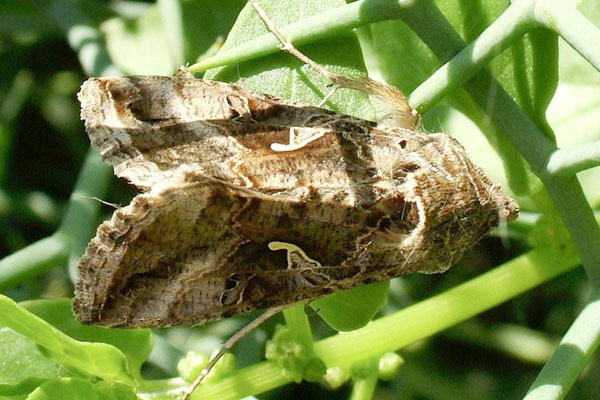
It develops three full generations and an incomplete fourth. It overwinters as caterpillars of various ages and as pupae in the soil. Caterpillars feed on the aerial parts of plants, preferring younger leaves. They gnaw the periphery of the leaves, and in some cases, completely destroy them.
Control
Authorized PPPs: Ampligo 15 ZC 0.04 l/da; Altacor 35 WG 8-12 g/da; Affirm 095 SG 150 g/da; Exalt 200-240 ml/da; Voliam Targo 063 SC 80 ml/da; Verimarktm 200 SC 37.5-50 ml/da; Delmur 50 ml/da; Deltagri (Deltafarm) 30-50 ml/da; Decis 100 EC 7.5-12.5 ml/da; Infis 50 ml/da; Skato 30-50 ml/da; Coragen 20 SC/Voliam 14-20 ml/da; Helicovex 20 ml/da; Dipel DF 100 g/da; Skato 30-50 ml/da; Coragen 20 SC/Voliam/Shenzi 14-20 ml/da; Minecto Alpha 125 ml/da; Rapax 100-200 ml/da; Oikos 150 ml/da; Niimik Ten 390 ml/da.
Subterranean Cutworms (Grey Cutworms)
These include the turnip moth (Agrotis segetum Schiff.), the white-line dart (Euxoa temera Hb.) and the black cutworm (Agrotis ypsilon Rott). Young caterpillars feed by gnawing the underside of leaves, without affecting the upper epidermis. Adult caterpillars hide during the day under the soil surface, under clods of earth, and at night feed on leaves, gnawing holes and later the entire leaf, except for the thickest veins. They almost never emerge from the soil, gnawing stems below its surface. Caterpillars are earthy grey to black, smooth, shiny, with a greasy sheen, and can often be found near plants, curled up in a “curl”.
Control
Authorized PPPs: Belem 0.8 MG/ Colombo 0.8 MG 1.2 kg/da; Ercole GR 1000-1500 g/da; Trica Expert 1000-1500 g/da; Colombo Pro 1.2 kg/da; Lebron 0.5G 1.5-2.0 kg/da; Decis 100 EC 7.5-12.5 ml/da.
Tomato Leaf Miner (Tuta absoluta Meyrick)
This pest has become one of the most common species in tomato cultivation, both in greenhouses and outdoors. The caterpillar causes damage. Depending on the temperature, the development of one generation of T. absoluta lasts from 29 to 38 days, which allows the pest to multiply very quickly. It develops 10-12 generations per year. It overwinters as an egg, pupa, or adult in plant residues, in the soil, or in other shelters. The caterpillar of T. absoluta mines the leaves, stems, and burrows into the fruit, causing significant losses to the tomato harvest in greenhouses and outdoors. In severe attacks, the leaves dry out, completely die, while stem mining causes plant deformation. Fruit damage allows for the development of diseases causing their rot.
Control
Placement of pheromone traps and black sticky traps for early detection of the pest, to reduce density and take adequate control measures.
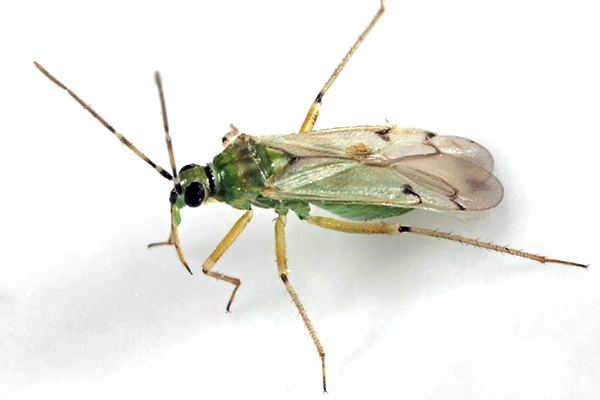
Biological agent Nesidiocoris tenuis
At low densities in greenhouses, one of the biological agents Macrolophus pygmaeus or Nesidiocoris tenuis can be introduced. Upon detection of the first specimens, treatment with PPPs is carried out. Authorized PPPs: Azatin EC 100-150 ml/da; Altacor 35 WG 8-12 g/da; Ampligo 150 ZC 40 ml/da; Beltirul 50-100 g/da; Verimarktm 200 SC 37.5-50 ml/da; Voliam Targo 063 SC 80 ml/da; Delmur 50 ml/da; Dipel DF 75-100 g/da; Exalt 200-240 ml/da; Coragen 20 SC/Voliam/Shenzi 14-20 ml/da; Minecto Alpha 125 ml/da; Niimik Ten 390 ml/da; Nim Azal T/S 300 ml/da; Rapax 100-200 ml/da; Syneis 480 SC 10-25 ml/da.
Wireworms
These are the larvae of beetles from the family Elateridae. Adult beetles do not cause damage; they are known as “click beetles”, but their larvae are economically important pests. A characteristic feature of the larvae is their strongly chitinized, tough, and wire-like body, colored yellow-brown. The life and development of wireworms are associated with the soil. They have a 3 to 5-year developmental cycle. Wireworms are polyphagous. The larvae feed on seeds in the soil, sprouts, root systems, young stems. They bore into the roots or the subterranean part of the stem, enter the plants and feed on the tissues from within. Plants yellow, wilt, and die.
For wireworms, depending on conditions, migration in horizontal and vertical directions is observed. Horizontal migration is associated with the search for food. The accumulation of larvae in the nests and rows of sown seeds or transplanted plants is due to it. Vertical migration can be: seasonal – caused by temperature fluctuations and occurs in autumn and spring; diurnal – associated with changes in temperature and humidity of the surface soil layer; physiological – caused by the search for suitable places for molting and pupation. To determine the density of wireworms in areas designated for tomato cultivation, it is necessary to conduct a preliminary survey using soil excavations and triangular wheat baits in the autumn of the previous year, no later than the end of October. If 5 larvae/m2 are found, there is a risk that the attack will affect the yield.
Control
Before transplanting, the following are applied to the soil: Belem 0.8 MG/ Colombo 0.8 MG 1.2 kg/da; Ercole GR 1000-1500 g/da; Microsed Geo/Sobek Up 1.6 kg/da; Trica Expert 1000-1500 g/da; Naturalis 100-200 ml/da; Colombo Pro 1.2 kg/da; Force 1.5 G 500 g/da; Lebron 0.5G 1.5-2.0 kg/da.
Southern Green Stink Bug (Nezara viridula L.)
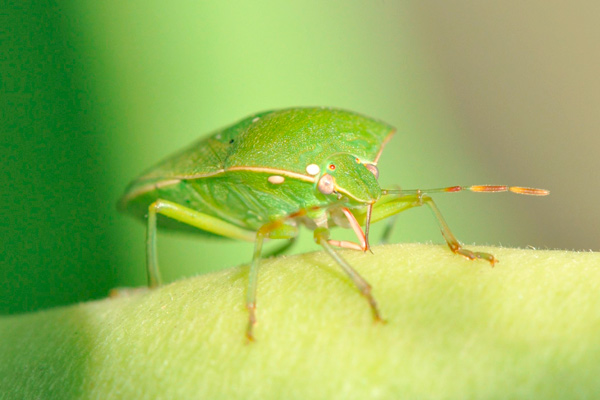
The pest is a polyphagous species. In recent years, its range and population have expanded. It develops three to five generations per year depending on climatic conditions. It overwinters as an adult insect under plant residues, in soil cracks, under tree bark, and in homes. Adult bugs, nymphs, and larvae cause damage. They damage all parts of the plant, but prefer growing fruits, flower buds, and young shoots. When sap is sucked from the fruits, numerous spots form, which are initially whitish, and later turn brown and merge. The fruit tissue under the damaged area has a hard consistency and is unfit for consumption. Young fruits, in case of severe attack, deform, turn white, and often drop off.
Control
To control the pest, „trap crops” can be sown, such as beans in summer or cruciferous crops early in spring and in autumn.
The „trap crops” should be treated with insecticides before the nymphs turn into adults. If necessary, treat with PPPs: Decis 100 EC 4.5-7.5 ml/da.
Leafhopper (Hyalesthes obsoletus Signoret)
It overwinters as a larva in the roots of bindweed. In the second half of June, it migrates and attacks other plants. The multiplication of the leafhopper is cyclical and strongly influenced by meteorological conditions – temperature and moisture for the period. The insect sucks sap from the leaves of affected plants. A small light spot is visible at the puncture site, which often goes unnoticed.
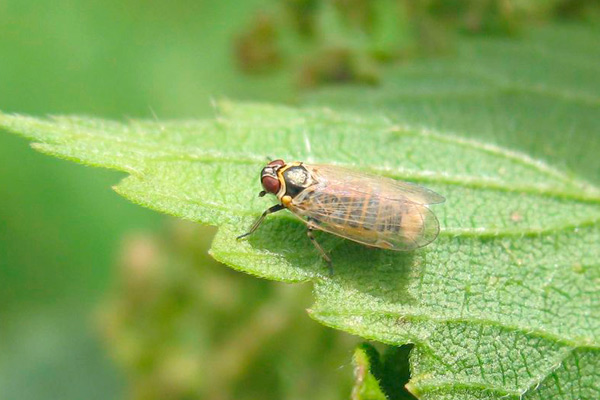
Direct damage has no great economic importance. The transmission of the mycoplasma disease stolbur is dangerous. Once infected, the leafhopper can spread the disease until the end of its life. Symptoms of stolbur