

![MultipartFile resource [file_data]](/assets/img/articles/кпло-заглавна-1.jpg)
The cherry leaf sawfly (Neurotoma nemoralis) occurs in southern Sweden, Denmark, Central Europe, the Baltic states, Italy, Hungary, Romania, the North Caucasus, Turkey, Kazakhstan, the central and southern regions of the European part of the former USSR, and in southwestern Siberia.
The species is widely distributed in our country and damages mainly sweet cherry, mahaleb cherry, peach, apricot, plum, myrobalan plum, quince, almond, etc. Its false caterpillar feeds on the leaves of the attacked trees and in some years, at high population density, it can destroy the branches of entire trees.
The adult insect is a black sawfly with yellow spots and stripes. The abdomen is strongly flattened and the legs are rusty-yellow. The wings are membranous, transparent, with black veins. Its body length reaches 7–8 mm.

Eggs of the cherry leaf sawfly
Immediately after oviposition the egg is light yellow, and later becomes almost white, with a length of 1.6 mm. The false caterpillar is light green to dark green, with yellow stripes on the dorsal side. The body is bare, without hairs, with four small spots on the upper side of the first thoracic segment. It has three pairs of thoracic legs and only one pair of abdominal legs. A darker dorsal line runs longitudinally along the body. The body length is 24 mm.
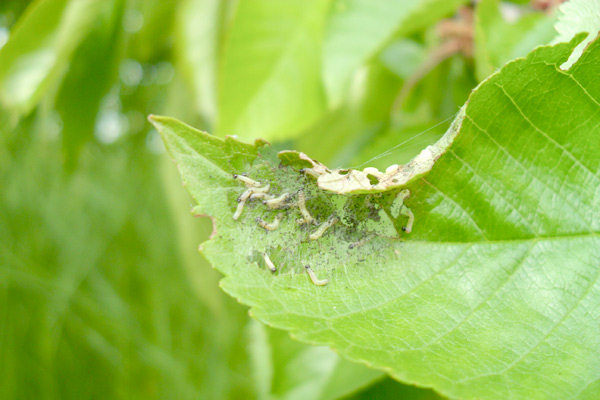
Young false caterpillars of the cherry leaf sawfly
The pest develops one generation per year and overwinters as a false caterpillar in the soil at a depth of 10–40 cm. In early spring, at the beginning of March, the false caterpillars pupate in cocoons, and the sawflies emerge and fly from the end of March to the beginning of April. The adult sawflies are active after sunrise in calm and warm weather. In cool and windy conditions, they hide under the leaves of grasses and shrubs and less frequently on fruit and other trees. After copulation, in warm and sunny weather, they start laying eggs on the underside of the youngest apical leaves in groups of 2 to 26 eggs. One female lays from 40 to 70 eggs. Embryonic development lasts from 9 to 14 days at an average daily temperature of 10.4 to 13.3ºC. After hatching, the larvae skeletonize the leaves, gnawing small holes in the parenchyma. Later they wrap the leaves in webbing and form common nests in which they live and feed on the entangled leaves. After the leaves in one nest are destroyed, they move to another place and make a new nest. The false caterpillars are extremely voracious and can destroy the foliage of entire trees. Their development takes about 24 to 36 days, and after completing their feeding they go into the soil into earthen chambers to overwinter mainly at a depth of 10–20 cm. About 60% of them enter diapause and pupate in the spring of the second year.
Control
For effective control of the cherry leaf sawfly, it is necessary to carry out deep soil cultivation in orchards to destroy the overwintering false caterpillars and to remove wild host plants on which they are able to feed, such as mahaleb cherry, blackthorn, etc.
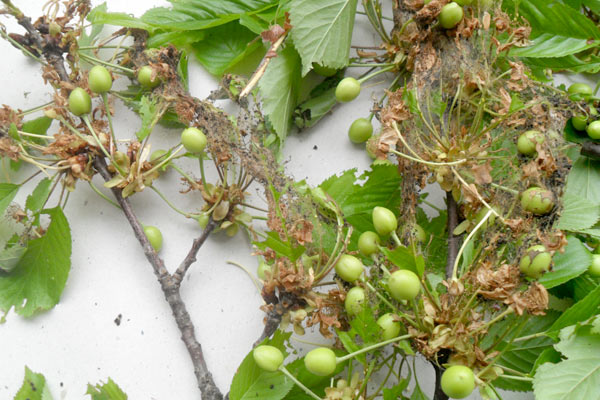
Damage caused by cherry leaf sawfly on sweet cherry
Chemical control must be targeted at the young larvae, immediately after hatching, before they form web nests where they are better protected. The economic injury threshold is 10% shoots infested by larvae during the phenophases fruit set formation / to fruit enlargement. There are no insecticides registered specifically for control of this pest, but at high population density all registered products for control of leaf-feeding caterpillars may be used. Most of them are synthetic pyrethroids.
The false caterpillars of the cherry leaf sawfly are attacked by predatory soil invertebrates, by various species of birds and hymenopterous parasitoids (Limneria crassifemur L. and Holocromus incrassiator Holmgr.). The eggs can serve as food for species of the families Coccinellidae, Chrysopidae and other predators.
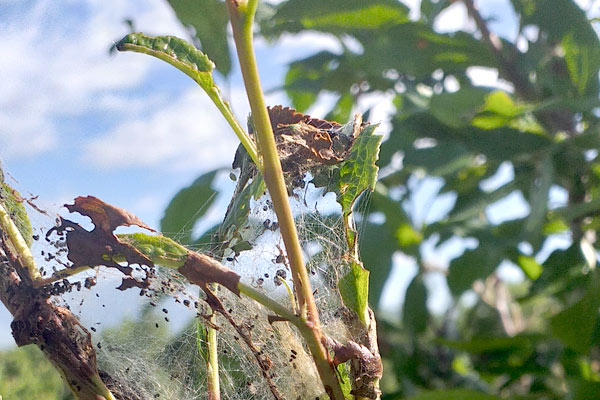
Damage caused by sawfly on plum
In organic plum production, a scientific study conducted in recent years at the Institute of Agriculture – Kyustendil showed that fertilization of plums with organic fertilizers reduces the population density of the cherry leaf sawfly: fertilization with Vita Organic at a rate of 5.0 kg/tree – by 18.3%, treatment according to the Ekofol scheme – by 31.7%, Vita Organic at a rate of 2.5 kg/tree – by 41.5%, and the application of Humustim – by 53.7%.
Photos: Chief Assistant Professor Dr. Vilina Petrova