

![MultipartFile resource [file_data]](/assets/img/articles/заглавна-агротехнически.jpg)
In April, the agrometeorological conditions will be increasingly dynamic. During the first half of the month they will be determined by unstable weather with frequent precipitation, which will improve soil moisture reserves. As a result of below-normal precipitation in March, with the exception of some areas in Western Bulgaria, soil moisture reserves in the 50 cm and 100 cm layer will be unsatisfactory for the beginning of the spring vegetation period.
During the first and the beginning of the second ten-day period of April, the forecast temperatures will be above the monthly norm. During most days in the second half of April, the development of agricultural crops will take place under temperatures and precipitation close to the climatic norms.
During the second half of the second ten-day period, the formation of frost is forecast as a possibility. The forecast minimum temperatures, down to minus 2°C, if they persist for a longer time, will be critical for the blossoms and young fruit set of fruit trees.
During the month, the forecast frequent precipitation and the likelihood of hail will create conditions for an increased infectious background of a number of fungal diseases in fruit trees – blossom blight (early brown rot), scab, shot-hole disease, peach leaf curl and others.
After hail, necessarily after flowering, in order to reduce the risk of secondary infections by pathogens, it is advisable to carry out treatment with copper-containing fungicides at the first opportunity.
In fruit nurseries
Soil tillage is carried out in seed beds, mother plantations and nursery blocks. When the young shoots reach 20–25 cm, the first hilling-up of the apple mother plants is performed.
Uncovering of the grafted walnut rootstocks that were hilled-up in autumn, cutting off the wild part at about 0.5 cm above the grafted bud.
All shoots emerging from the rootstock of the grafted plants planted in the nursery blocks are carefully removed.
Delay in this practice slows down the development of the shoot from the improved (cultivated) bud. Often the competition from the wild shoots is so strong that the bud does not sprout at all.
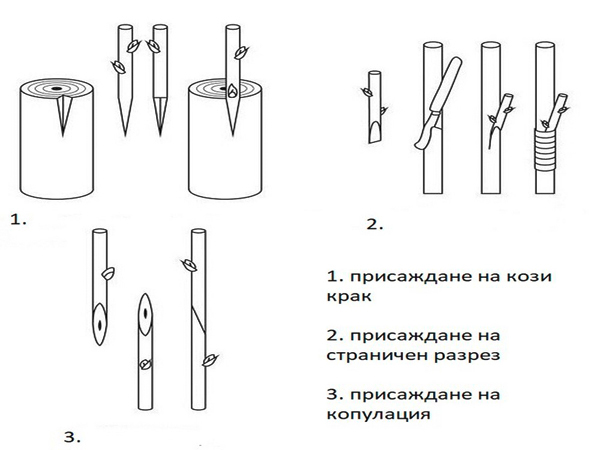
Work on grafting with scions onto rootstocks with failed buds continues.
In fruit orchards
The planting of new fruit orchards is completed.
The work on filling the gaps of dead trees in young fruit orchards is completed.
All newly planted trees must be irrigated with 20–30 dm3 of water in the tree basin around the trunk.
The work on forming the crowns of trees in newly planted and young fruit orchards is completed.
Shoots are removed from the trunks of trees in newly planted orchards. At a height of 50–60 cm above the soil surface, all shoots are removed. Unnecessary shoots in the crowns of young trees are also pinched out.
The shoots in young fruit orchards are pinched back (tipped).
Pruning is carried out to reduce the vigour of strongly growing apple and pear trees.
This is recommended for trees on seedling or vigorous vegetative rootstocks, trained as palmettes.
Top-working by grafting with scions in the crowns of mature trees continues.
Thinning of fruit set is carried out – in apples, some pear varieties and peaches.
In lowland and warmer regions, a second, shallower, soil cultivation is carried out and, if this has not been done in March, nitrogen fertiliser is applied.
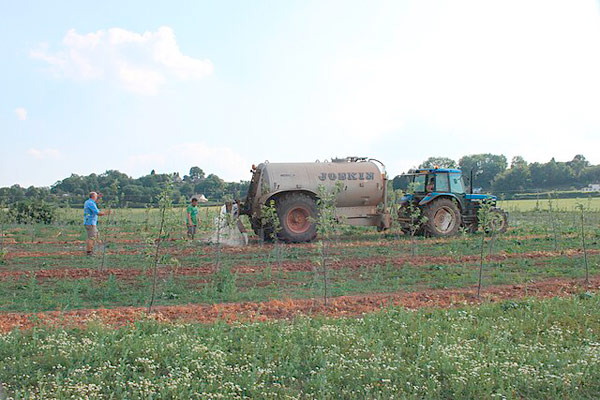
In dry conditions, irrigation is carried out. During flowering and fruit set formation, soil moisture in the orchards should not fall below 70% of field capacity.
Bee colonies are transported from orchards where flowering has finished to orchards with intensive flowering.
In strawberry plantations
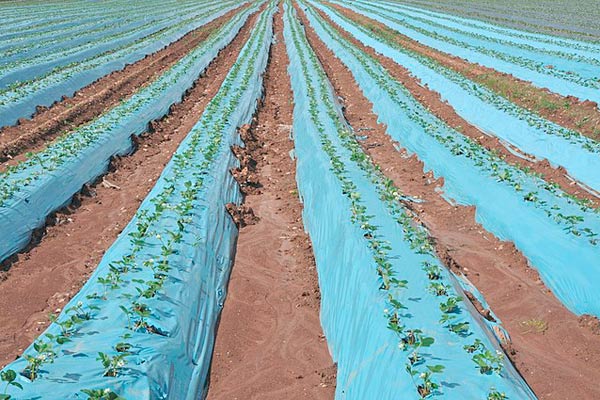
Planting strawberries under polyethylene film
The filling of empty spaces in the areas planted in autumn (mainly in higher regions) is completed.
Planting of virus-free strawberry planting material stored in cold rooms on beds covered with perforated black polyethylene begins.
The plants are planted so that the buds protrude slightly above the surface, without any risk that, when vegetation starts, they will end up under the polyethylene. Before planting, the roots of the seedlings are dipped in a slurry of farmyard manure, soil and water. If the roots have dried out, their tips are trimmed.
New strawberry areas planted on black polyethylene must be irrigated by sprinkler irrigation in order to ensure good establishment.
Old plantations are tilled and, if they were not fertilised in March, fertilisation is carried out beforehand. If necessary, the plantations are irrigated.
Four hundred to five hundred kilograms of straw per decare are transported for mulching the soil under the flower stalks and for protecting the fruit from contamination in plantations established without black polyethylene. Before this, the plantations are irrigated. The soil around the plants is covered with about 10 cm of straw. Mulching is done towards the end of full flowering.
The soil in protected cultivation facilities is tilled and irrigated if necessary.
By mid-April, the last strawberry fruits are harvested from heated greenhouses.
Harvesting of strawberries from solar (unheated) greenhouses and tunnels begins. Later, harvesting in the open field also starts.
Greenhouses and tunnels are regularly ventilated. The required temperature for timely ripening of the fruit is maintained in them.
In warmer sites and in plantations planted earlier, weeds emerging in the holes are weeded out.
Weeding is carried out very carefully so as not to pull out the not yet well-rooted plants.
In raspberry plantations
The filling of empty spaces and the planting of new areas is completed.
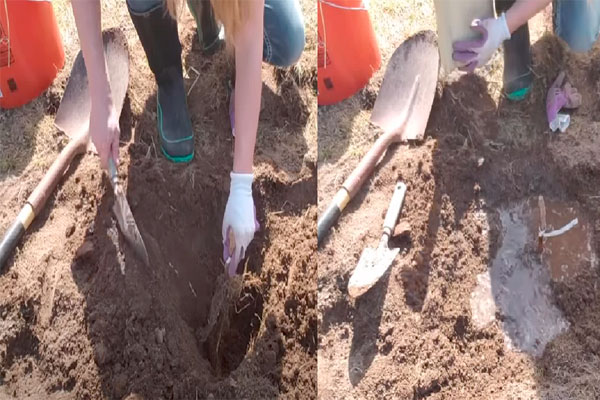
Planting raspberries
Soil tillage is carried out to keep the soil loose and weed-free and to incorporate fertilisers.
Towards the end of the month, top dressing is applied with 10–12 kg of ammonium nitrate or the same amount of another nitrogen fertiliser. In dry conditions, irrigation is carried out.
In blackcurrant plantations
Care is taken of the stool beds – tillage, fertilisation and irrigation are carried out.
New and old plantations are tilled. In dry conditions, irrigation is carried out.
In plantations with other crops
Planting of non-standard bay laurel plants in the nursery for further development is carried out.
Spring budding of Caucasian persimmon with Japanese persimmon (kaki) is carried out after the start of sap flow.
At the end of the month, pricking out of lemon seedlings in the open field is carried out at 15–20 cm in the row and 1 m between rows.
Depending on the need, hoeing and irrigation of rooted cuttings of fig, pomegranate and sea buckthorn are carried out.
According to the needs of the open-field plot where rooting of cuttings of fig, pomegranate and sea buckthorn has been carried out, hoeing and irrigation are performed.
Planting of Japanese persimmon (kaki), sea buckthorn, pomegranate and fig in permanent sites continues.
Bay laurel trees are freed from their winter wrappings and winter protection.
At the end of the month, rooted plants of actinidia and bay laurel saplings from the previous year are planted in permanent sites. Irrigation of the newly planted plants is carried out.
Pricked-out actinidia seedlings are planted in an open-field nursery.
New sowing of bay laurel seeds is carried out in the open field.
Budding of pistachio rootstocks begins.