

The Dobrudzha Agricultural Institute is the only sunflower breeding center in Bulgaria. Since its establishment in 1951 to date, more than 50 varieties and hybrids of this crop have been bred here. More than 15 jointly developed hybrids with our European partners have been registered outside our country. Initially, sunflower breeding was carried out only by the method of individual family selection, with the aim of creating varietal populations. As a result, the first large-seeded variety Stadion was obtained, characterized by high protein content, low oil content and suitability for direct consumption. After it, another large-seeded variety, Favorit, was developed in the same way, which is currently widely grown in Bulgaria and abroad.
Since 1963, breeding and improvement work has begun by the method of interline hybridization for the development of hybrids. As auxiliary methods for obtaining initial material, distant hybridization, experimental mutagenesis and biotechnology methods have been used. One of the first tasks in breeding was to increase oil content and reduce hull content. Shortly afterwards, with the strong spread of broomrape, breeding for resistance to this parasite also began.
During the period 1970-2000, breeding work by the heterosis method expanded continuously. Significant results were obtained both in the field of breeding self-pollinated lines and in the development of hybrids. This became possible thanks to the discovery of the first source of CMS in sunflower by Leclercq in 1969 and the identification of effective fertility restorers by Kinman in 1970.
For the first time, Bulgarian hybrids began to be tested in 1973. In 1979, the first Bulgarian hybrid Start was approved and zoned for the entire country. It is downy mildew resistant and outyields by more than 12% the then standard and widely grown in Bulgaria variety Peredovik.
In the 1980s, a new group of early-maturing hybrids was bred, among which Albena, Super Start, Dobrich and Santafe. Gradually they occupied over 90% of the sunflower area in Bulgaria. Since 1988, the hybrid Albena has been approved and zoned in France, where in 1993 it became the main hybrid for that country, occupying 40% of the sunflower area. Albena has also been recognized as a world standard among early-maturing hybrids.
The rapid spread of the parasite broomrape became the main reason at the end of the last and the beginning of the new century to develop a new group of hybrids possessing simultaneous resistance to downy mildew and broomrape. The hybrids San Luka, Maritsa, Musala, Rada, Yana, Merkuriy, Perfect and others have been approved and zoned. The first Bulgarian high-oleic hybrid Diamant has also been developed. At that time, the new Bulgarian hybrids occupied over 80% of the sunflower area in the country.
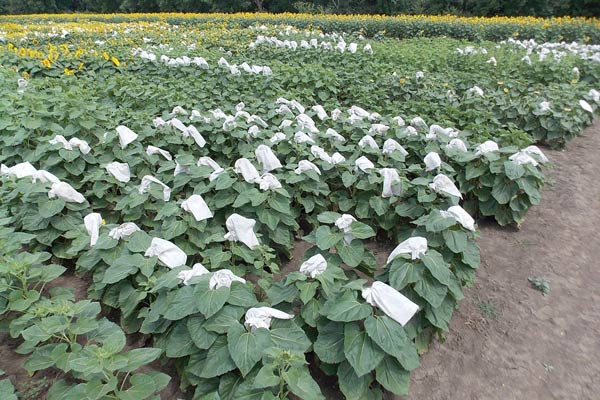
Breeding field
The Dobrudzha Agricultural Institute has a rich and diverse collection of initial breeding material. The applied methods are intraspecific, interline, interspecific and intergeneric hybridization, experimental mutagenesis, gamma-induced parthenogenesis, embryo culture, somaclonal variation, in vitro screening and selection.
As initial breeding material, Bulgarian and foreign open-pollinated and hybrid sunflower varieties, local and foreign populations, our old lines – maintainers of sterility, their sterile analogues and fertility restorers, wild species of the genus Helianthus, species from other genera of the family Compositae, hybrids obtained through intraspecific, interspecific and intergeneric hybridization, forms obtained by applying experimental mutagenesis, lines obtained by various biotechnological methods applied alone or in combination with induced mutagenesis have been used.
At DAI near the town of General Toshevo, under natural conditions in a permanent stationary field, the only collection in Bulgaria of 250 accessions of perennial species of the genus Helianthus with an official FAO registration number is maintained. The collection also includes about 200 accessions of 7 annual species.
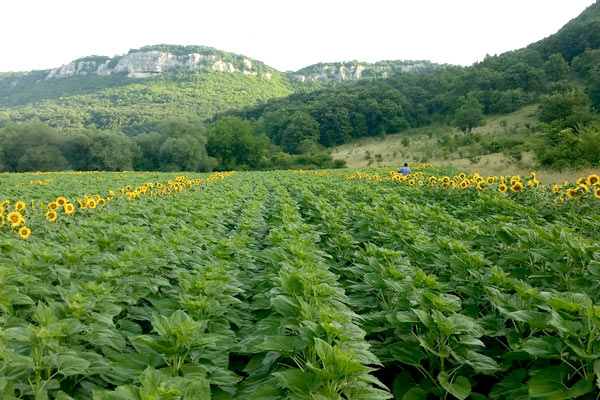
Enigma – seed production
Methods for conducting interspecific and intergeneric hybridization are constantly being improved. More than 3,500 new lines and forms have been created through distant hybridization, experimental mutagenesis and some biotechnological methods and techniques. Methods for assessing resistance to economically important sunflower diseases and the parasite broomrape have been adapted to the conditions of the institute. A new methodology has been developed for testing resistance to Sclerotinia, and a methodology for irradiating immature sunflower embryos with gamma radiation or ultrasound.
Of the 4 hybrid seed production schemes developed at our institute, only the method of interline hybridization is used to develop a two-line, male-fertile simple hybrid with complete fertility restoration.
All newly approved and registered lines and hybrids have been morphologically characterized according to UPOV descriptors.
Over the last decade, many new materials with traits valuable for breeding have been developed. More than 6,000 self-pollinated sunflower lines are currently under study. This includes 3,300 fertility restorer lines, 2,400 sterility maintainer lines and 320 sterile analogues of lines with normal cytoplasm. Twenty-nine new sources of CMS and 230 new sources restoring fertility have been identified.
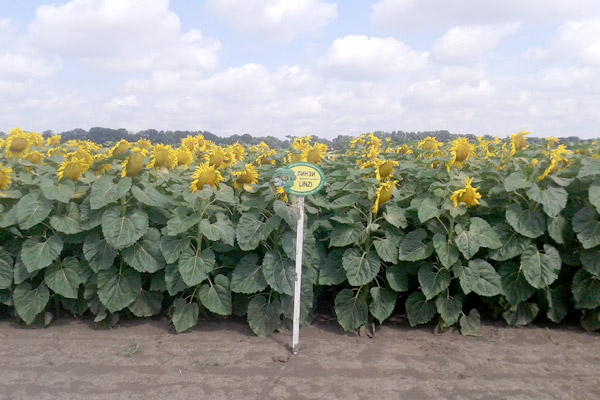
Linzi – one of the newest hybrids approved in Bulgaria
Each year, 1,400 new hybrid combinations are tested in Bulgaria and abroad. Hybrids possessing very good productive and adaptive potential have been developed, which are approved and registered both in Bulgaria and in EU and non-EU countries. Several foreign companies have included our new hybrids, such as Veleka, Velko, Yana, Divna, Valin, Maritsa, and others, in their catalogues, produce their seed and successfully market them in their countries. One of the new directions in our breeding work is the development of sunflower hybrids resistant to herbicides.
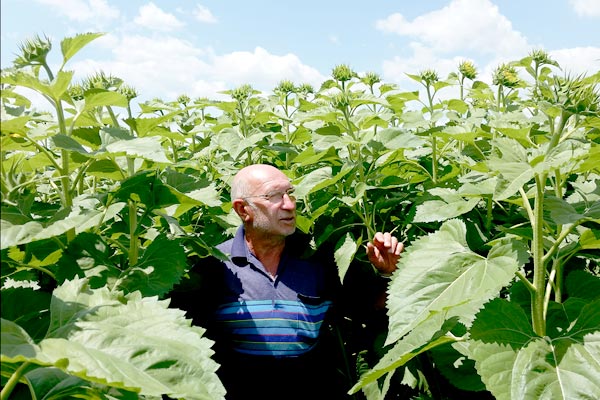
In 2021, the first Bulgarian Clearfield Plus sunflower hybrid Enigma CLP was officially approved and entered in the National Variety List.
In Ukraine in 2018, another of our Clearfield hybrids, Sunny IMI, was approved, together with the conventional hybrid Vesi. Both hybrids are being officially tested in Romania as well.
In the sunflower breeding department at DAI work the breeders – Dr. Nina Nenova, Assoc. Prof. Dr. Galin Georgiev, Chief Assist. Prof. Dr. Daniela Valkova, Assist. Prof. Dr. Georgi Georgiev and Assist. Penka Peevska; the phytopathologists Prof. Dr. Valentina Encheva and specialist Maria Petrova; agronomist Plamen Nedev.
Brief description of the latest three sunflower hybrids of DAI near the town of General Toshevo that have been approved
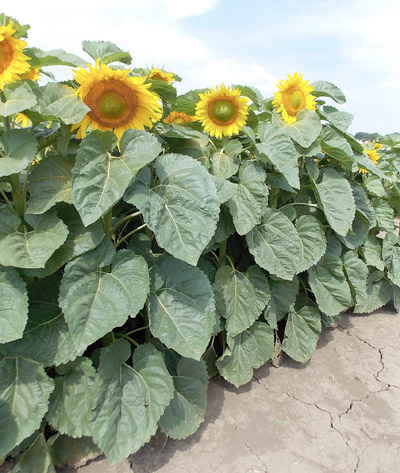
Deveda – conventional sunflower hybrid
Male-fertile, simple, interline hybrid obtained by crossing the maternal line 217A, possessing cytoplasmic male sterility, and the paternal line 102R – a fertility restorer.
The maternal line was obtained by crossing a candidate variety No. 72 and line No. 246, derived from Russian varieties, followed by self-pollination and selection. The paternal line was obtained by the method of induced parthenogenesis combined with embryo culture from experimental hybrid 188A × 8R. Plant height is 145-155 cm. The vegetation period is 121 days. It belongs to the group of medium-early hybrids. The hybrid has 53.2% seed oil content. The leaves are green, medium-sized, rounded in shape, medium to coarsely serrated. The shape of the cross section of the leaf is flat, with very large auricles and no wings. The angle of the leaf in relation to the lowest lateral veins is obtuse. The stem is covered with hairs. There is no branching. Ray florets are of medium density, orange-yellow in colour and broadly oval in shape. Disc florets are orange, without anthocyanin coloration. Bracts are rounded in shape, with medium tip length. Head diameter is 22-26 cm. The head position is semi-pendulous with a curved stem and is slightly convex. Seeds are black, with weakly expressed grey stripes at the periphery of the seed. Seed shape is narrowly ovoid. Seed thickness relative to width is medium. The hybrid is resistant to downy mildew race 731, broomrape up to race F, and moderately resistant to Phoma and Phomopsis.
The hybrid has no special cultivation requirements and can be grown using conventional technology. A 1,500 m isolation distance is required for its seed production. The optimum plant density is 6,500–6,700 plants per decare. The maternal and paternal lines flower at the same time and can be sown simultaneously in hybrid seed production.
In 2014 it was included in ECVO after two years of testing in CVO. In ECVO it showed an average yield from two trials of 403.7 kg/da, which is 12% above the average standard.
In 2015 and 2016 it was tested in IASAS.
Deveda was approved by Order of the Minister of Agriculture and Food No. RD 12-2 of 07.04.2017. It is protected at the Patent Office with a Certificate for a new plant variety No. 11156 P2 of 30.10.2018.
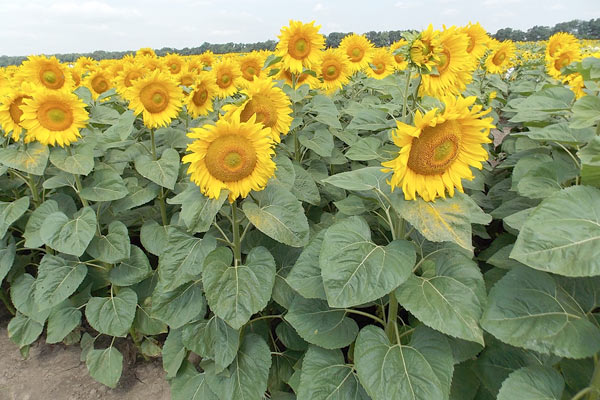
GTS Tedi – conventional sunflower hybrid
Male-fertile, simple, interline hybrid obtained by crossing the maternal line 3607A, possessing cytoplasmic male sterility, and the paternal line 240R – a fertility restorer.
The maternal line 3607 was obtained by hybridization between lines with normal cytoplasm No. 650 and No. 217, followed by self-pollination and selection.
The paternal line 240R was obtained by hybridization between fertility restorer lines 256 and 213, followed by self-pollination and selection.
GTS Tedi is a medium-early, conventional hybrid with linoleic-type oil, seed oil content 43–44%, kernel percentage in the seeds 71.4%, plant height 150–160 cm, head diameter 22–23 cm. Its vegetation period is 120 days. It is resistant to downy mildew race 731 and broomrape up to race F, tolerant to Phoma and Phomopsis. The stem is moderately covered with hairs at the top, unbranched. Ray florets are medium yellow, very dense, narrowly oval, of medium length. Disc florets are orange. Seeds are small to medium-sized, narrowly ovoid, with black ground colour and weakly expressed grey stripes. In the mature stage the head is slightly convex on the seed side and its position is semi-pendulous.
Seed production of the hybrid requires a 1,500 m isolation distance. In the seed production field the two lines can be sown simultaneously, which is a considerable agronomic advantage.
In two-year control testing the hybrid outyielded the average standard by 7.9% in seed yield. After testing in ECVO in 2013 the hybrid showed an average yield advantage from two trials of 8.3% above the average standard, and an average yield of 403.6 kg/da. The maximum seed yield achieved in the institute’s fields is 458 kg/da.
Cultivation technology – conventional, with a recommended plant density of 6,800–7,200 plants per decare.
Period of testing in IASAS – 2015 and 2016.
Approved by Order of the Minister of Agriculture and Food No. RD 12-2 of 07.04.2017. Protected at the Patent Office with Certificates for a new plant variety No. 11156 P2 of 30.10.2018.
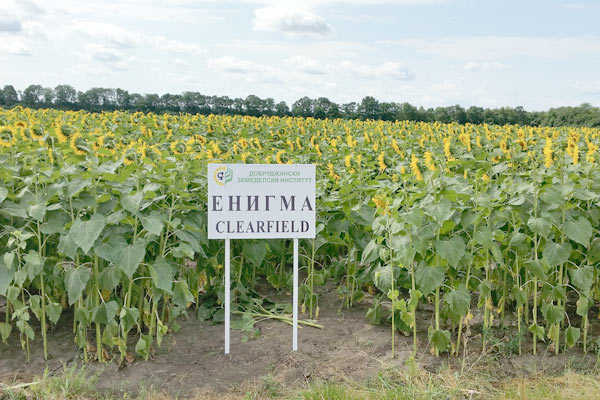
Enigma CLP – the first officially approved and registered Clearfield Plus hybrid
Male-fertile, two-line hybrid. The cross is 1111A × 10023R. The maternal line was provided by BASF, and the paternal line was developed by self-pollination of an imidazolinone-tolerant candidate hybrid and selection.
The hybrid is suitable for the so-called Clearfield Plus technology, which allows control during vegetation of annual grass and broadleaf weeds, as well as the parasite broomrape up to race F.
Plants are 180–190 cm high, head diameter reaches 20–22 cm. The hybrid is intended for oil, linoleic type, with an oil content in the seeds of 46–47%. Seeds are black with weakly expressed grey stripes at the edge and in the middle. It is medium-early, with a vegetation period of 115–120 days, maturing 7–8 days after the hybrid San Luka. It is resistant to downy mildew up to race 731, which is derived from both parental forms, and tolerant to Phoma and Phomopsis.
Maximum average yield in the fields of DAI – 427 kg/da.
Seed production of the hybrid is identical to that of the hybrid San Luka, where it is mandatory that the paternal line be sown 7–8 days before the maternal line.
Hybrid ENIGMA CLP was approved by Order of the Minister of Agriculture and Food No. RD 15-2 of 10.04.2019.